
The backstory.
I had the idea for this book 20 years ago as a student at Georgetown. I was sitting in the Jefferson Reading Room at the Library of Congress. Bill Clinton was president. I’d landed in the reading room that day through an odd series of accidents and mistakes which began when I inverted two numbers on my class schedule enrollment sheet and hastily turned it in. These were the sorts of mistakes I was always making. Inversions. In haste. I took any opportunity to skip the paperwork and get to the stuff. When I received my course schedule at the beginning of the semester I did a double-take. “Drugs in the Third World?”
Georgetown’s archaic procedure to alter your schedule was to attend the class you were enrolled in, request a dismissal from the professor, head back to the Dean’s office to see which classes had open spaces and attend those classes in the hope of gaining entry. On this occasion, the requirements were serendipitous. I arrived at Drugs in the Third World to discover there were 10 spaces in the class, one of which I held, and double that number of students vying to get in. I’d lucked into a spot in a coveted class and there was no way I was giving up a chance to find out what the fuss was about. It turned out to be one of the best seminars I took in college.
Perhaps the subject of drugs wasn’t initially interesting to me because I wasn’t a drug-doer. I was indifferent to all drugs except for heroin, owing to the terrifying ad campaign the UK government waged on young minds in the 1980s. Life-sized posters were plastered on the walls of my English girls’ school depicting tragically emaciated peers whose lives were lost to addiction. Heroin was bad. So, the policy aspects of drug trade in America didn’t interest me, even as we waded into the geopolitical context. What did catch my attention was the history. How had the drug trade become so powerful?
While other students chose careerist topics for their term papers, dissecting current policies, crafting future policies, investigating drug lords in Colombia and scratching that Latin American mosquito bite (Dispatches from Medellín: What We So Totally Learned From Pablo Escobar), I thought about the history of heroin.
As a kid, I’d seen a musical on the West End called Poppy. The actors writhed around on cool-looking beds dressed in colourful Asian robes and sung about a strange kind of love with comically blackened mouths. They smoked up a tortured storm. If we’d knowingly imported this culture of addiction to the West then I wanted to know why and since my professor didn’t have any satisfying answers I decided to get to the bottom of it in my term paper. (A couple of decades later I can safely say the answer to every question I investigated in college was “Money.” Thankfully I was naïve to this unifying decoder or I wouldn’t have bothered with anything at all.)

Then came “the bus accident.” The campus librarian informed me that a term paper on the history of the drug trade required an entire semester of research at the place that housed the best history — the Library of Congress. There was no home internet to sort all of this out back then. No GoogleMaps. Travel from the public-transportation-island of Georgetown meant finding a bus stop, reading up on the places the bus went and trying to land yourself in the general vicinity of where you wanted to go, if you even knew where that was to begin with, which I didn’t. By pure happenstance, there was a citybus that stopped at the corner directly across the road from the townhouse where I lived on 35th Street. I could see the bus coming and going from every room. So one day I walked outside and got on it. I rode it all over the city, moving at the speed of a touristing camel past the white marble pyramids of the United States Treasury, the Supreme Court, the Capitol…until the bus seemed to be turning in a sort of loop. So I got off. I stepped onto the sidewalk on Independence Ave., walked up to the nearest building and asked a security guard to point me toward the Library of Congress. He just smiled and opened the door. Miraculously, I’d arrived at the Library of Congress.
I’m notoriously, epically horrendous at maps and directions. If the bus at my front door hadn’t been the exact bus to wind around town and deposit me at the front door of the exact building that held the exact knowledge I needed to write the paper I’d proposed there’s a 99.9% probability I would’ve given up after one lost day and returned to Georgetown’s stacks to research a more accessible topic. People love to recount tales of passion projects that were fueled by mentorship and encouragement. The unsexy truth is that progress often hinges on ignorance, proximity and logistics.
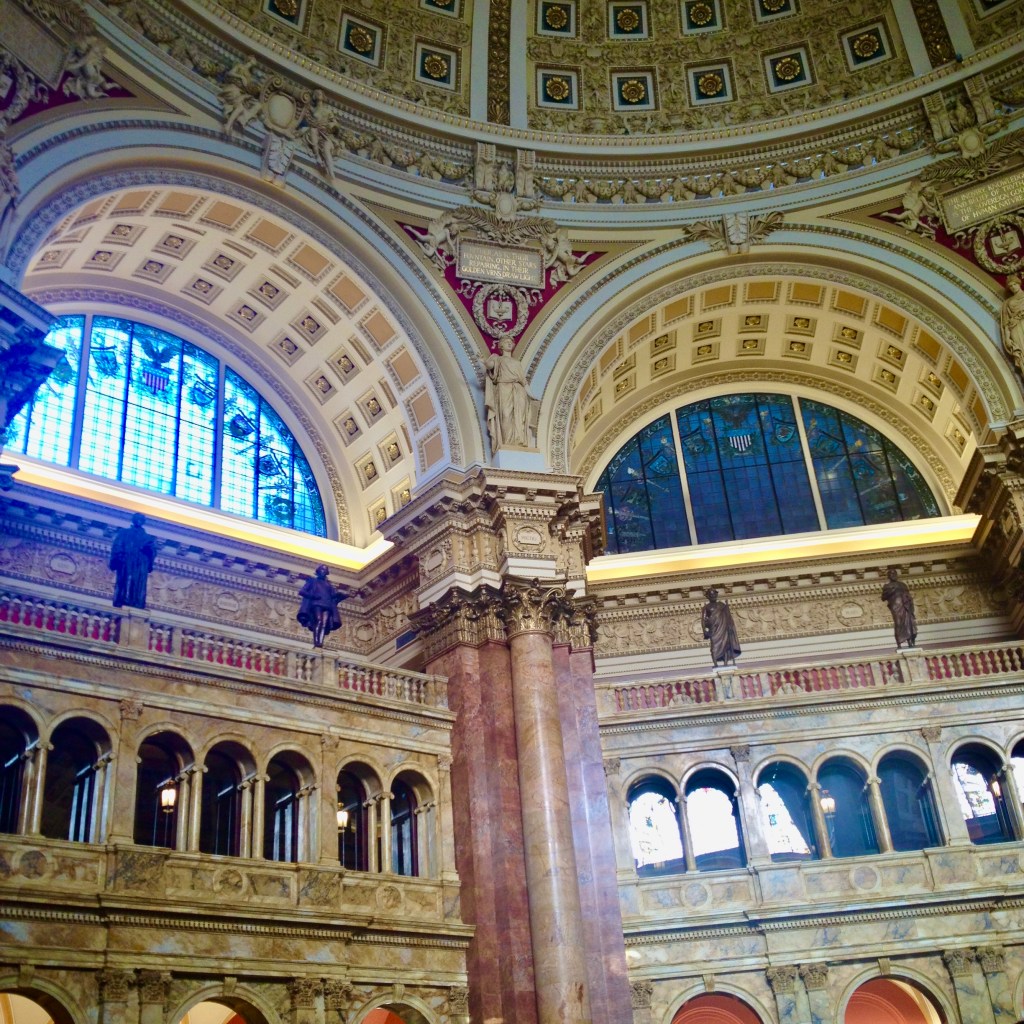
So now I’ve got the bus covered and I’m in the Jefferson Reading room a few times a week. It’s unlike anywhere else. It’s a geometrically balanced visual manifestation of wisdom and it smells like gently rotting paper. There are imposing statues representing the eight categories of Knowledge — Philosophy, Art, History, Commerce, Religion, Science, Law and Poetry — looking down and sizing up your evident stupidity. You’d feel like a heretic sitting in that room doing unimportant work with the posse of Knowledge watching, so you don’t. No one does. It’s an unspoken pact.
My lightbulb moment happened one night, a few hours into the contents of three enormous tomes which were spread out in front of me showing maps of shipping routes from the Orient to England and sad ink drawings of limp Chinese opium addicts. I was reading through the ship log of an 18th century trade ship captained by a decorated British buffoon who, against his better judgment, had swapped out tea cargo for opium. There was an accompanying illustration of a naval officer whipping an opium addict on the deck of a ship. I thought:
Laws hold no sway over people who are far from home. Humans are human. I’m a stone’s throw from the Capitol and the Supreme Court. You couldn’t pay me to break a major law right now. But all the way out there on the high seas, or in a foreign country? Even here on the continent…How much control does this government have across the country? It’s an illusion we buy into, but really people need to be in close proximity to their government for the laws to work. Like England. It’s a tiny country. Everyone is politically engaged there. What would it take for Americans to become that politically engaged? What if the states broke up into countries? Could the states break up into countries? What would it look like if America became Europe without the history?
This idea of the break-up of the federal government and the dissolution of the United States was thus planted in my head. This was remarkable because I had no extra space up there. I was a foreign service student buried in periodicals and ephemeral theories on policy that just kept coming. My academic world was immediate forecasting, as in next week. Staying on top of the information was overwhelming, so to get out in front of it and theorise decades ahead seemed foolish. More importantly, why should I care? This was the 90s. Americans gave off the strong impression that they didn’t care. In England it was uncool to be ignorant. In France, they won’t even look at you if you can’t articulate an opinion. In America, the impassioned people were marginalized. Feigning political ambivalence was encouraged. God forbid someone embarrassed themselves by taking a stand in public.
So I told myself I didn’t care either, even as I took that accidental bus route to research my inconvenient paper for the class I was never supposed to be enrolled in, all as an excuse to sit in that reading room and let the muses feed my future of American history idea with possibility and promise.
In 1996, I began writing the first chapter of the book. I opened the story in 2016 with a man who is wholly unqualified to be president riding a wave of misguided populism all the way into the White House. His name was Julius Jackson.
—
In 2010, I completed the novel. The manuscript traveled through publishing houses in New York, passed between agents, editors, Hollywood directors, including several of my idols. I was told by one editor: “Americans don’t want to read about the fragility of their democracy.” And I thought, but did not reply, “That is tragic.” The story gathered a core group of fans, but no publisher. I put it in a drawer.
In 2020, with the Covid-19 pandemic, national rioting over the murder of George Floyd, a collapsed economy, the devastating climate challenge and an oligarchic faction threatening America’s democracy…the story is more relevant than ever. It’s still a “future” history. The mistake of contemporary political analysis is to label Donald Trump as the story. He is not the story. He is a catalyst for a national crisis, and a puppet for smarter men with dark ambitions. How the country comes to terms with Trump’s criminality will determine the outcome of Benjamin Franklin’s oft-quoted nail-biter of a question: Can America hold on to its republic?
 Elizabeth McCarthy