Notes, ideas and unpolished pieces

Stragglers from the “ideas” file.


February 13, 2011 — sketch notes


October 30, 2008 — notes for Ch. 8 of first draft of novel


June 8, 2015 — Epistolary Satire between separated editor-husband and writer-wife as she travels for her new book; title??; Ch. 1
Ch. 2, jotting down opening prose

Theoretically, everything we learn is proof of something we already know. 

Her hand reappeared from the depths of her bag covered in oily black ink. She plunged both arms into the tote and swam around until she located the promiscuous fountain pen and straying cap. Her palms, fingers, knuckles, wrists, forearms and left elbow were soiled. A cartridge of ink had stretched itself far beyond anyone’s estimation. The Schaeffer Company would be proud. She brushed a gnat from her face and caught her nose. Smudge. This wasn’t a glamourous arrival. This was karma giving her the finger.

Charlotte Dorr, the famous writer, walked with her palms up, carry-on bag hooked under her elbow, the damp, capped pen held at a safe distance from her body, and searched for a bathroom. It occurred to her that writing was little more than staining a page with thoughts. Her skin was bathed in lost ideas.

When she returned from the loo the crowded hall had emptied. The conveyor belt shuttled one pathetic little bag in dismal circles. It was not hers. She set off to Customer Service. 

“Buonjourno.” 

This would be her first attempt at communicating in Italian in several years. She gave up immediately.

“I seemed to have lost…” she pointed urgently with light blue hands “…Do you have the leftover luggage from Flight 306?” 

A gentleman glanced up. He was seated at a low tabletop, in contrast to the high counters that shielded airline employees from the general public back at Heathrow or JFK. The English and Americans were up to their necks in work while the Italians were only up to their asses. Six employees gathered behind the desk with barely enough room to move, the women wearing neck scarves, the men in too-nice suits, studying an array of important papers that took precedence over Charlotte’s missing luggage. 

The youngest of the group, a bizarrely handsome luggage agent, gathered the papers and tapped them proficiently on the desk until they fell into beautiful order. Charlotte stared at his gorgeous hands. They were manicured. They rested the papers on top of the counter and spread all ten perfectly tanned fingers across the top page. 

“Si.”

She gazed at the nude, wanton hands and had the unreasonable thought that she was in love. Under the spell of jetlag every interaction was intimate and sexual or remote and surreal. For the rest of the day this warped sense of time and sex would control her. She loved his hands. 

“Signora?”

“I was on Flight 306 and my luggage isn’t on the belt…” She pointed again and held out her ticket. It was illegible, bathed in ink. 

***

Twenty minutes later, she was in a musty taxi speeding into Rome. 

Her head rested on the cracked leather seatback. She tuned out the driver who practised the urban Italian method of passing a day by free-associating with strangers until a topic caught fire. Every conversation on every street corner in Rome was a verbal stomping to put out such fires as these. She’d foolishly convinced the driver that she was Italian with five perfectly pronounced introductory words and now he felt uneasy because she wasn’t participating in obligatory banter. It’s a terrible idea to offend an Italian taxi driver, she thought. I’m going to find myself on the street. 

“Per favore…mi dispiace molto. Un longo volo.” She was sorry for her silence. It was a long flight. He sniffed loudly, sniffed again, and looked out of the side window. He was contemplating whether to leave her, she thought. The taxi appeared to drive itself in precarious bursts while the driver was distracted. He devised a truncated question for his reluctant conversation partner that she couldn’t refuse. Satisfied, he looked back at the road.

“Da dove?” 

“Los Angeles, via Londra.” 

His shoulders tensed and he sat up at the wheel. 

“Quante ore?” 

“Twenty-two.” 

He tipped his ear toward the back of the taxi on hearing her English. English! He muttered to himself in lyrical bursts and Charlotte closed her eyes to soak up the verbal opera. She gathered from his soliloquy that it wasn’t the first time a foreigner had tricked him, but she guessed that each instance was a successively worse injury to his ego.  

*

“Ciao.”

She said it to his face with a smile. The taxi driver swung her suitcase and dropped it too close to her toes. 

“Ciao.”

He slammed the door and was gone. She missed him. 

Charlotte looked at the building in front of her. It was the wrong colour. She gathered her bags close to her body, determined not to fall prey to petty thieves on this trip. She would survey the area, find her apartment and arrive there without paying a penny to the pinching gods. A young man leaned in the doorway of a gelato kiosk. He watched her without offering to help, a singularly European behaviour that made her homesick for New York. She wanted help. She wanted someone to want to help her. She wanted to be wanted here. 

There’s no goddamn numbering, she thought. She loaded herself up like a pack mule and lumbered along the cobbled street without a clue which direction she was headed. Her phone had a dead battery, much like her brain. The driver had to drop her in approximately the right place, she surmised. He wouldn’t show himself to be a poor loser. Perhaps if she wandered a few paces she’d find her building. It couldn’t be far. 

Unencumbered Italians moved past her like gazelles, everywhere a swish and splash of beautiful fabric and luxurious hair. Moped engines hummed unseen, European cars sped, and all she could think was that Rome sounded like an alloy of New York. Tin foil to cast iron. Light yellow stone to New York’s leaden cement. Her homesickness passed as she took in the city, walked too far and realised she hadn’t paid a bit of attention. She wanted to lie down. Where the fuck was her building? 


December 16, 2011 — hitch and america

In 2004, America was at war in Iraq. The Los Angeles Times’ Festival of Books held their second panel on the war, ‘U.S. and Iraq One Year Later : Right to Get In? Wrong to Get Out?’ that would be a seminal experience in my understanding of a longish list of topics: how a panel is conducted brilliantly, how intelligent people discuss issues when they’re actually listening to each other, how to disagree with someone and still marvel at their intellect, how to be persuaded, how to persuade, and how differently a conversation goes when the participants respect each other deeply.

The discussants were Christopher Hitchens, Michael Ignatieff, Mark Danner and Bob Scheer, and the moderator was Steve Wasserman. It was a powerhouse. Their stances weren’t opposing, rather each brought a nuanced perspective to the question of war. Hitchens was fully invested in his right-wing, go-war philosophy at the time (which he would later reverse); Ignatieff held a human rights view of calling for regime change, having spent time in the mountain regions with disenfranchised (then slaughtered) Kurds; Danner stuck close to discussing specific policies in the American political arena, holding a left-supporting view; and Scheer balanced Hitchens in rhetorical vigor with his signature left, anti-war stance.

At the center, Steve Wasserman effectively ran the best conversation I’ve witnessed to date. With an acute ear for threading these four perspectives, Wasserman was the ringmaster, leading Scheer toward Hitch, back to Danner, over to Ignatieff. That the four gentlemen permitted themselves to be led at all was quite a nod to their respect for Wasserman.

The debate ran over an hour, but it might have been ten minutes. Time flew. Ideas flew faster. In England, I had a steady diet of intense political debate, and years away from living there left me detached from a key part of democracy. It was incredible to see Americans debate well. Not sure I’d seen before. (Hitchens supplied the necessary gravitas, elevated the whole thing.) I’d forgotten that the format of debate is, when effective, an internal monologue externalised, analysed and considered.

agreed with something in each perspective

showed complexity of the issue…


April 28, 2016 — Mediocrity Acceptance Speech — use when blocked

Well, this is…embarrassing. I wrote an entirely different speech. For a different award, actually. 

Some of you might be familiar…In 1959, Elaine May presented Lionel Klutz with the Most Total Mediocrity award. It was before I was born, so I’d have to wait forty years to learn of the award, on youtube — which was appropriate — and it was at that moment I knew my life’s mission. 

It’s a balance. How mediocre is too mediocre so as to tip over into pisspoor uselessness? Does exceptional mediocrity push one into a category of too good to be considered blah? 

For years, my dream was strengthened. Every ignored phone call. Every email I sent that went unread. Every time I wrote a blog post that got nothing more than a “meh.” Every time I pitched an idea to someone with a frozen face and thought “Yes. I’ve done it again. I’m winning.” 

I foolishly thought if I devoted myself…that one day Elaine May was going to walk out from behind a big curtain and reward my outstanding, undeniable mediocrity. This…takes me out of the running, I think. It’s a tragedy, really. My whole life’s work just went down the drain.


June 18, 2015 — “Five Dollars: Net Worth”; satire putting woman on paper money

The honor of gracing the five-dollar bill would go to a woman, alive or deceased, straight, gay, or transgender, married or single, of any race, and bearing proof of physical birth on American or American Territory soil. Submissions arrived from across the globe. No physical address was provided, yet the postal service did its best to put a few letters in the right hands. The vast majority of contenders were emailed to the official address — ?? — and waited in an inbox each morning to be dutifully cataloged by Sean P. Frommer in a tiny cubicle he shared with a contract worker for Veteran’s Affairs whom he had never met. Sean had the desk every weekday from 9am to noon. He enjoyed his work. 

Sean’s favorite submissions included: 

Eve, from the bible

The Dixie Chicks 

JAWS 

George Clooney’s Wife (american now?) 

Sean set up an automated filter to delete further submissions for: 

Katie Couric 

Bruce Jenner 

Michelle Obama 

Martha Washington 

Amelia Earhart 

He set up an entirely separate filter to count the entries for: 

Oprah

The tally passed two million on the second day. 

Sean also kept a running list of questions that accompanied people’s submissions and forwarded them on to his boss, who deleted most of them and returned a handful to add to the future FAQs page on the Treasury Department’s website. Sean would be tasked with authoring the page once his time freed up after the initial flurry of submissions died down. 

Martha Washington was the first woman to grace a denomination of American currency, in her own right and as part of the First Spouse Program. [Technically not the first woman; lady liberty “flowing hair” on dollar coin; Martha Washington on a silver dollar coin? So — “First on Paper”]

Puts careful list together with suggestions; Word comes down his boss has left; Jack Lew has been reading his emails with great interest – so, who would Sean pick?

Sean asks for time to think about this; takes a walk around the capital; describes what he sees through new eyes; chooses an “everywoman” …who is that in America?

Conversation with a woman on a bench; takes her picture; suggests it to Lew; almost fired for it; asks for one more chance; back to the drawing board, this time thinking like a man…

??


January 9th, 2015

TRANSCRIPT OF THE MAYOR OF HOLLYWOOD’S REMARKS FOLLOWING THE FUROR OVER TODAY’S ALL-MALE OSCAR NOMINATIONS

FOUR SEASONS HOTEL, BEVERLY HILLS, CA 

Mayor: Thank you. [waits for applause to die down] Thank you. First, I’d like to address this year’s Oscar nominations because — oh my goodness! — there’s been a lot of nonsense printed in the press. Let me explain how this works. Here in Hollywood, we don’t reward people for their gender, we reward people for their work. And we don’t hire people for their gender, we hire the most talented, most qualified people for the job. Hollywood is wide open for lady business. I’m going to say that again because it’s important: Hollywood is wide open for lady business. It’s not Hollywood’s fault there’ve only been four Oscar-nomination-worthy female directors in a century of filmmaking. Only four women have made Oscar-worthy films in 85 years. Incredible. I don’t want to call women out, but clearly female directors aren’t working at a competitive level. If women want to be taken seriously they need to up their game. I don’t know a single guy in Hollywood who says “I won’t work with women” or “I don’t know any talented women” or “Women aren’t funny” or “Women are too difficult” or “Women make me uncomfortable” or “Women want too much” or “I never know what women want” or “Who’s going to cook dinner?” It’s a falsehood, complete hooey that the business is a boys club. We love women here and we want nothing more than to give them power if they’ll only demonstrate they can use it productively. We welcome the ladies with open arms. 

As a sidebar, my daughter suggested I do a little googling on my own and sadly I confirmed what I suspected was the case: Women have been making films for as long as men have. [pause while Mayor takes out piece of paper and puts on reading glasses] Now I think where women go wrong is to limit themselves to lady topics. I kid, of course, but just looking at this list here, these are mostly films I haven’t seen and never will see. [puts list away and takes off glasses]. 

I’d also like to address the unimportance of women in film, and before everyone loses their minds let me explain what I mean by that: There is no reason in the world why a young girl needs to look up to a woman. She can just as easily look up to a man and, in fact…I’m going off prompter here but we have time…I think maybe that’s what’s holding women back. What’s wrong with looking up to men? What’s wrong with wanting to be Steven Spielberg? I say to young women all the time “You don’t yell. You’re too nice. I can’t trust a smiling woman and I don’t want to argue with you about money. Be more like Steven. Or Marty. Or Cameron Crowe. He’s got a soft voice but he knows how to use it.” The harsh reality is that we can’t hire women because they don’t command enough respect to direct a movie. Simple as that. It’s not our fault if little girls ask for Barbies instead of cameras. You don’t see a lot of women plumbers, or electricians, or carpet layers, do you? Maybe they don’t like to get their hands dirty. It’s not my job to speculate.

[he winks to the camera; press corps laughs]

And while I’m at it, I’d like to speak directly to Geena Davis: Of course there are female characters in film. Plenty of them. They serve a real role. They brighten up the screen at just the right time. Stop saying “statistics etc., etc., female characters have less screen time, women always talk to other women about men, and so on.” Mean Girls was all white…excuse me…women. Geena, it’s fine to throw out numbers, but what are you personally doing about them? Get back to work. No one’s going to ask you take your clothes off now. You’re out of excuses.

Okay, that’s it for my prepared remarks. I’ll take a few simple questions. [pointing] Yes.

Female Reporter: You mentioned four exceptional female directors as potential role models for young women. Who are they?

M: Exceptional? Did I say that?

[laughter] Uh, [refers to notes]: Sophia Coppola, Kathryn Bigelow, Jane Campion and Carol Reed. I’d add Leni Reifenstahl but she was never nominated.

Female reporter: Carol Reed is…

M: And there’s our very own Angelina Jolie! How could I forget her? She’s directing now and we home grew her. She’s homegrown, so don’t tell me we aren’t doing anything about gender. We are doing something and it is working, but we can’t nominate her for anything because it will look like nepotism, and it will be nepotism. So today didn’t work for her, and it didn’t work for women, or for these remarks, but we’re all doing something important and Hollywood should be congratulated. Next? [pointing] Yes.

Male reporter: You referenced Hollywood’s role as the leader in cultural creation. Can you elaborate on that?

M: Sure. As I told J.J. the other day, guys just get it. Women enjoy it, some of them, but guys really get it. That’s why we think of guys first when we come up with storylines. The guys need that special extra something to get them into the theater, and the women always follow.

Female reporter (checking notes): You’re referring to J.J. Abrams.

M: He’s a director. One of our most important directors.

Female reporter: I know who he is, I was just…

M (pointing): Yes?

Male reporter: Transformers!

[applause]

M: Man after my own heart.

Male reporter: When is the next installment.

M: Well, I haven’t talked to Brad but we’re…there’s something special in the works. I wasn’t going to announce this today but since you’re stuck covering this other stuff I’ll give you the scoop…Hollywood is going to Shanghai.

[loud cheers, applause]

M: And we’ve signed on to build the world’s largest full-service studio in the heart of Beijing. We found the silver lining to the Chinese smog problem — no more day-for-night shoots. Costs slashed to almost nothing. Endless labor supply. I told President Xi this morning, “Je suis China.”

 [applause]

Thank you.


August 25th, 2015 — 20 Questions You Must Answer Before You Get Married

When you order takeout, which one of you lamely suggests it would be cheaper to go pick it up?

If it’s you, you’re probably okay. If it’s him, no. Run. Faster. You’re not running fast enough.

Do you shop at Barneys?

You’re not doing this for the right reasons. 

How often do you like to eat out every week? 

If your number isn’t exactly the same as your beloved, it’s okay. If your number is different by a factor of 2 meals and one snack, consider that your lives are on different paths…going in opposite directions…and that you might be happier with someone else. 

Astrology Intermission: Are you compatible? 

Scorpio, with no one. Leo, with anyone. Virgo, PITA. Everyone else, you’ll be fine, but you’re definitely not with the person you think you’re with. We’re all full of shit, but 75% of the world is too self-absorbed to realise it. Duh. The Stars. PAY ATTENTION.

Can you agree to store your DVDs and CDs that you must own a physical copy of in one 3-ring binder with addable pages, or does one of you feel strongly about disc packaging and cover art? 

This question is its own questionnaire. The answer can predict not only whether you should be getting married but, further, how long your marriage will last depending on who feels what about what. (Him: pro-package, 1 year; You: pro package: 5 years.)

Do you like your thighs? 

Not you. Him. He answers this one. About his thighs. Listen closely. It’s interesting stuff.

Do you need to drink a bottle of wine before you have sex?

It’s okay if you do, but you should ask yourself: can I afford all of this wine? Marriage is forever.

Do you have food poisoning all the time?

Marry a doctor only. No one else is capable of ignoring you.

Can both of you fake orgasms? 

If you’re tempted to answer this question in any way, do not get married. 

Bath or shower? 

Trick question. 

Tom Cruise or George Clooney? 

No matter your gender identification, this question is a shortcut to determining true compatibility. (Obviously, you don’t want to choose the same guy.)

Swingers: Lifestyle or Movie?

The answer you both say out loud is: Movie. It’s okay to change your answer after you’ve been married for a few years. Nobody’s holding you to anything. But today, right now…

Do you have any food allergies? 

The answer to this question doesn’t make or break a marriage. It’s just a vulnerability you must consider every time you fight with your spouse. 

Did you overshoot your engagement? 

The reason these 20 Question questionnaires are 100% accurate is their speed. You know in minutes whether you’re right for each other. If you’ve already spent months or years pondering marriage while people pressure you to plan a religious ritual full of life-altering vows, you’ve missed the boat. Take the next one.


September 17, 2013Fighting the Bad Fight cuts

At whatever age we leave school, we quickly discover that the classroom of life is unmanageably large once we’re wholly responsible for uncovering good information, infallible sources and, most importantly, trustworthy messengers. I’ve always taken this task seriously and become cranky (see opening satirical nonsense) when highly intelligent people of all walks of life lose sight of the following:

— the endgame

— the intermediate goals

— the tools needed to accomplish those goals

— that no one can carry a movement alone

— that knowledge dissemination is an art, not a job

— that building is constructive and aggression is destructive

— that intelligence exists in hidden layers and forms

— and that potential (potential advancement, potential awareness, potential enlightenment) must be nurtured or it dies

Killing potential is near the top of my list of crazy-making experiences. A missed opportunity for learning is the express train that blows through my station. I’m left with what I already know and a frustrating blur of what I don’t.

On Cheating

On Cheating

The first time someone tried to cheat off of me it was a revelation. The cheating I’d been taught about in England was a solo endeavor. We were instructed not to write notes to ourselves on our hands or hems, or put answers in flip top desks to refer to. The shame of being caught was too terrible to contemplate, and most of our work was too complicated to be aided by a one word answer anyway. I could never wrap my head around how someone might cheat, so I didn’t follow why there was a lot of discussion about it. And for a long time I assumed no one was cheating because they felt as I did. It was shameful.

Years later, in American high school, a boy I barely knew would pester me through an important biology exam in summer school, demanding answers in a confident whisper as though I had previously agreed to give them to him. He eventually he left me in peace to take the test, but the incident troubled me. He was so casual about what he was doing, and I was disturbed that he had chosen me to rope into his scheme. He acted as though I was harming him by not helping him, like I was abandoning him in a time of trouble. I’ve never forgotten his name. I expect he’s still cheating today.

My senior year in high school, my AP Poli-Sci class made national headlines for a cheating scandal. National. Headlines. It was awful. Known as the “Harvard” of public high schools, and the school John Hughes made famous in some of his films, we were supposedly the lucky kids, and this cheating scandal was an indication that wealth isn’t all it’s cracked up to be. Not everyone who went to my high school was wealthy. Not by a long shot. But there were a handful of very rich kids driving sports cars and wearing clothing I couldn’t afford today, and the suburbs we lived in had some of the highest average incomes in the country. The perception was that if these kids were compelled to cheat, something must be wrong with utopia. (Short answer: There is.)

Because it was a huge public high school with thousands of kids, we had a long-standing mentoring system for freshmen. It was an honor to be chosen as a “senior helper,” assigned to a freshman advisory for their first semester of high school. I applied and was accepted along with 23 other seniors. We worked closely with a freshman advisor, the teacher assigned to each group of students for the full four years of high school.

I had a great group. I organized parties and get-togethers for them. They had my phone number and called me during difficult, and sometimes truly horrible, life moments. One of their mothers died of cancer. Another’s father was violent. I didn’t really know what I was doing, but I talked to them and facilitated putting them in a room with an adult who could help. It was one of the only times in my high school career when I remember the thick cloud of American cynicism lifting. Kids were encouraged to reach out and connect, and they trusted me enough to bridge the student-teacher divide when it was necessary and needed.

One of the freshmen boys’ advisors was a beloved guy, a handsome AP Poli-Sci teacher who coached track. I knew his senior helper, a popular guy, smart, an athlete, and good-looking. It was a photogenic group, and a picture-perfect ideal of what “north shore” families wanted for their kids. I remember a lot of smiling and self-assured banter. I admired them.

I was also in the AP Poli-Sci class and it wasn’t just hard, it was impossible. I figured I was struggling because I had no background in the subject matter, coming from a different country, but most of the other kids were struggling too. The teacher said he was disappointed by how we were doing, especially because there were a few students who were really getting the material. Really putting the time in. Really studying. And for that reason, he wasn’t curving the grades or even addressing the difficulty of the tests.

My parents were constantly on me about my AP Poli-Sci grade. They didn’t buy my story that it was impossible to do well. When a guy in my class picked me up for a date my mother cornered him to talk about whether he thought the class was hard. He just smiled, all charm, and told her he found it pretty easy. I was stunned. Easy?

As it turned out, the AP Poli-Sci teacher’s handsome senior helper had discovered where the tests were kept in his desk drawer. It was never clear whether he stole them himself or told an even less scrupulous friend where they were, but they obtained the tests in advance week after week for over a semester, and shared them among a sizable group of friends who also happened to be the leaders, the cool kids, and the high achievers of my senior class.

Second semester senior year, the scandal broke and what followed was the worst tension I had ever witnessed in my life. PA announcements from the principal sternly informed us that interviews were being conducted and we were expected to be truthful about what we knew. Daily, people were pulled from my classes to be interviewed. They were all people I’d known for three years, the top academic group in a class of 700. Everyone was suspicious of each other. Gossip was out of control. And all the while, college acceptances were rolling in and we were preparing to graduate. A time that should have been exciting was a stressful nightmare.

I will never forget when the scandal resolved. The names of those involved weren’t published. The colleges they’d applied to weren’t notified. The kids were all high-achievers and they were allowed to pass the AP Poli-Sci class. They had their titles taken away; our class president didn’t graduate as class president. Their parents had advocated for them and won. My parents were incensed that colleges weren’t notified. My dad had desperately wanted to me to go to his alma mater, an Ivy League school, and I hadn’t gotten in. The senior helper who’d stolen the tests was going there instead.

American school was new to me then, and I was never invested in the system of getting ahead. It’s still strange to me that learning is turned into a competition here. I also never wanted to go to my dad’s alma mater; my application essay was the driest, most lifeless thing I’ve ever produced. I remember my dad taking it and trying to spruce it up to no avail. I was secretly relieved not to be admitted. But the part of the experience that mattered, what will always haunt me, were the moments I witnessed when lifelong friendships were utterly destroyed. The moment one guy called out in a choking, panicked voice to another guy across a class that was in-progress, begging him not to turn him in, reminding him they were friends. The look of conflicted disgust on the other guy’s face was terrible. Two girls I’d sat with all year in Poli-Sci had been friends since grade school. Then one participated in cheating while the other did not. I’ll always remember the cheater, sobbing, trying to talk to her friend as class started on the day the scandal broke. The friend wouldn’t even look at her. It was gut-wrenching. I felt so helpless. They sat apart for the rest of the year. And I’ll never forget the broken teacher. The guy who was always smiling, who had such positive energy in his classes, was visibly devastated. His philosophy was that kids are essentially good, and you can trust them to make good choices. He’d left his desk drawer unlocked, this was the outcome, and he felt completely responsible. He never recovered.

So, when I read about these parents and their money and their schemes, and I see my university named in today’s scandal, and read the callous jokes and schadenfreude tweets, I can’t help thinking about those moments. There’s a system of justice to deal with the crimes, but there’s no path for dealing with broken trust and betrayal between friends, between parents and kids, between spouses, between schools and families, and on and on. It’s that loss no one will see, but I know it’s there, and it’s truly awful. The emotional damage from today’s scandal is permanent and it has been done to lots of innocent people.

A response to Judd Apatow’s interview in Deadline: “Can Hollywood Turn Sex Scandals Into Meaningful…

A response to Judd Apatow’s interview in Deadline: “Can Hollywood Turn Sex Scandals Into Meaningful Reform?”

Dear Judd,

Thank you for stepping up and speaking out about this issue. You’re doing more than most people I know. Many of my own friends didn’t share my op-ed about sexual harassment on social media. People are powerfully averse to addressing this topic. I’m grateful you’re willing to tackle it. (It made my day to see “Mike Pence has some sort of mental problem” in print.)

Your definition of the problem and its complexities is, in my experience, correct. You say we need to “change the culture.” When you hear about a harasser you’re “never going to work with that person again,” which makes sense for someone who wields a lot of power. Most people don’t. Your solutions, unfortunately, only usefully apply to you and a handful of people. Please hear me out on this: your approach is going to be part of the problem in the long run.

When I was sexually harassed by my boss, a director on a studio film, I had nowhere to go. Who does someone on a crew talk to when the director is harassing them? Or the producer? Or the star? Your Deadline interview mentions sexual harassment training videos are currently shown to staff on TV productions. That’s seriously great; one area of the business where there’s a framework for starting work on the right note.

But you know like I do that on a film, made at a studio or independently, the process is a free-for all. It’s nearly impossible to get a movie greenlit. Everyone jockeys for their jobs for months. Once they’re there, a director is king (very rarely queen) of the production. The stars are revered. The cast and crew come together as a temporary family, often traveling on location together, staying in hotels, working long, strange hours, and socializing with each other during downtime, because who else is around? The cast and crew are at the mercy of the above-the-line people who are going flat out to meet insane deadlines. I don’t care how much sexual harassment training you give a cast and crew, speaking up about anything controversial puts the movie in jeopardy and could cost everyone their jobs. This is the nature of entertainment work that’s largely absent from the present discussion: across the board, entertainment workers are interdependent in highly unusual ways. One person really can take down a whole production. As we saw with Louis C.K., one person’s disgrace can bury a completed film and shut down multiple productions in 24 hours. It’s true that Ridley Scott’s decision to reshoot All The Money is going to provide jobs, but I don’t remember this having being done before on a completed film. It would be a huge step forward if this response became the norm.

Today, however, no one wants to hear complaints from anyone about anything when you make a movie. A second camera assistant was willing to walk on live train tracks because a director asked her to, and I wouldn’t judge her decision to acquiesce as extreme if it hadn’t ended in tragedy. (The fact that she was asked does make me extremely angry, though.) Your solution is to change the culture we’re working in, but do you honestly think a crew member on location, in Cambodia say, is going to rock the boat with a sexual harassment claim against a director? Culture is always going to be what we create within each production. If the director is toxic, the culture will be toxic. We need more formal solutions than “better culture.”

As for not working with people after you hear something about them, this is confusing advice. Hollywood is a town of storytellers. Gossip is the primary information machine in this business. Gossip has been weaponized against women for at least as long as I’ve worked out here. You mentioned Maureen O’Hara’s news clipping that circulated on twitter. She pointed out that the gossip machine was brutally effective at torture and character assassination. As you noted, women today are badmouthed as difficult, crazy, cold, not talented, not funny, and on, and on, and on, but your solution to the harassment and abuse problem is to expect people in the business to decide not to work with someone based on what they hear about them. You expect people to discern between lies about women and truths about men in the mountain of gossip they traffic in daily. That’s not feasible. The choice to work with Harvey Weinstein was not greedy for many people. It was a paycheck, and it came with baggage that could just as easily be true as false. That’s the nature of gossip.

It is also not necessarily greed that drives people to smooth over sexual assault claims when, in so many cases, they’re keeping the ship afloat for the hundreds of people who will lose employment if it goes down. In reading your piece I felt like you might have lost track of this. They’ve got horrible choices to make and many of them know it. I agree with you that the culture of the business has evolved to a point where it’s way too easy to make bad decisions, and I’m certainly not in any way defending anyone who has silenced a victim, but I’m unwilling to generalize that it’s always done out of greed. Only millionaires comfortably walk away from work when they smell something fishy. For the rest of us, those decisions border on impossible.

In my experience the most powerful reason people in Hollywood don’t speak up, or speak out, is fear of losing their proximity to fame. That’s true of everyone from assistants all the way up to studio heads. The right kind of famous for most people working in this industry is being celebrity-adjacent. It’s how you get jobs, jump onto projects, get your work read, get your movie made, and on, and on. Being there means you know how to keep secrets. Predators like Harvey who compulsively dominate and destroy women and verbally and physically assault men are protected by this dynamic because outing his behavior is a violation of the secret-keeping culture of celebrity. Clearly from your interview, your immediate focus is on reporting criminal activity, and I agree with you. It should be. However, Hollywood is full of criminal activity. Until recently, smoking a joint was illegal! I’m confident “discrete” will return as the most prized recommendation for any job after this intense house-cleaning is over. Hollywood may redefine its relationship to women, but it will also revert to a culture of secrecy. We may have to wait a generation before the culture truly shifts.

While we wait, here are a few solutions that came to me while reading your interview, useful for people working in and out of the business, that can bring about real change today:

1. It doesn’t matter how powerful you are, or aren’t, the first response to hearing someone has been assaulted is to ask them what they need from you. If they want to file a report or complaint, tell them you’ll support them. This addresses the problem of someone feeling too isolated to speak up.

2. Be a voice of reason if there is public push back, with the victim’s permission. (You speak to this in your interview, but not in a concrete way that involves the victim’s wishes; that part is so important.) Remind people that fame and financial success are not indicators of good character. This addresses the problem of powerful harassers having a louder voice and wider reach in the court of public opinion.

3. If you’re in a position of power, be mindful of who you elevate. Hold people accountable if they empower someone who does harm.

4. Whenever possible, formalize ways for victims to speak out.

5. Finally, be transparent in your hiring process and above all, HIRE DIVERSELY.

Thank you.

This letter responds to Judd Apatow’s interview in Deadline — “Can Hollywood Turn Sex Scandals Into Meaningful Reform?” http://deadline.com/2017/11/judd-apatow-harvey-weinstein-sex-scandal-reforms-commentary-breaking-news-1202204254/

I Hope a Woman Never Plays Bond

I Hope a Woman Never Plays Bond

I love fashion magazines unabashedly. I’ve read them my whole life. Vogue, W, Bazaar, Elle…I love the photography, the art direction, the clothes, the style, and often I enjoy the interviews and writing. I also love to hate the very same magazines because they’re in the business of selling us things we don’t want or need. Fashion magazines push one evil step beyond a museum or gallery by asserting that to look at this art is not enough. To be worthwhile in this world, you have to own.

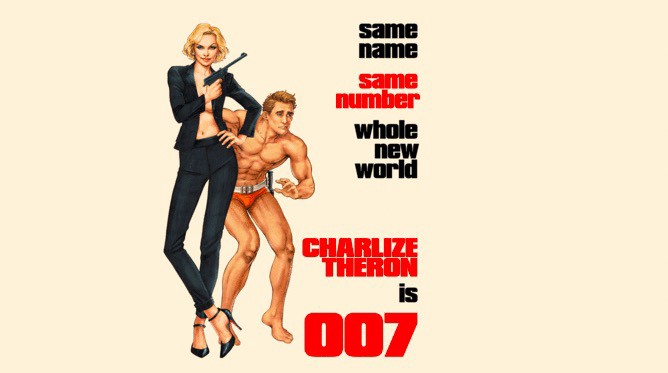
When a piece in W nominated Charlize Theron For Bond, I hit the brakes on my love-/hate-read and parked for a minute to feel my feelings. The trailer for ATOMIC BLONDE is thrilling. Theron is a compelling MI6 agent (based on what’s culled for a 3-minute sizzle reel.) If the movie delivers on its promise, I expect it will clean up at the box office. That’s why, for all of its good intentions, Katherine Cusumano’s “Why Charlize Theron is the James Bond We Need Now” is misguided.

I’ve been writing screenplays for almost 20 years. For most of that time, I’ve stubbornly pitched female-centric films and written female protagonists, despite the fact that they never land with the many (so, so many) male producers I’ve sat across from. It isn’t those scripts that get me in the door. If I’m sitting with a producer, it’s almost certainly because I’ve shopped a script that hits all the right notes and elevates familiar male characters in some unique, non-derivative ways, and checks the boxes for appealing, non-threatening, man-lovable female characters to support them. To stay in the game, I’ve written material to appeal to my first audience, male executives, because they’re predominently the gatekeepers. Over the years, I’ve evolved as a writer to the point where I now pull off this feat and sneak a few mutinous female characters into my stories. I view it as a temporary arrangement to help me sleep at night while I impatiently await the day that I’m sought out for all of the great women I’ve been writing. In my fantasy, I casually pull my unread scripts off the shelf, one by one (as John Hughes famously did with his scripts about teenagers), and I pass them to men and women who have their hands out; producers who are finally ready to make some noise.

Given my aims as a writer, you’d think I’d be in the cheering section for “A Woman For Bond” but at this stage of my career, and at this point in Hollywood’s evolution, the last thing I want to see happen is for popular male characters to be converted into female roles. It all comes down to how an audience meets a character. Back in 2008 when it was announced that the Tom Cruise vehicle SALT would be reworked for Angelina Jolie, I smiled for weeks. When Star Wars writers put Daisy Ridley front and center, I was melancholic (for a parallel youth) and inspired. This week’s announcement of Jodie Whittaker taking on the Doctor Who mantle was spine-tingling. (I grew up in England on a steady diet of Doctor Who. When I experienced my first cast change I dropped the show like a cheating boyfriend. It was my first television show betrayal. That’s the great part about the role of The Doctor — any change is unwelcomed at first. As such, Whittaker’s casting is likely the most well-received announcement in the history of the show, despite what you read online.)

However, those characters were introduced to audiences as women, or in the case of The Doctor can plausibly be any gender without changing a mote of the franchise’s history. Conversely, taking a role like Bond away from men and handing it to women does both a disservice. James Bond, Ethan Hunt, and the like are beloved because the audience is invested in the character’s history. That history shouldn’t change.

Women deserve their own roles, just like men do. Female characters deserve that investment of time and care, and frankly they’re owed more input from female writers. It was crushing to see zero women on the long list of writers for WONDER WOMAN. I have no doubt Patty Jenkins and the female cast of the film brought plenty of ideas to the table, but it was a bitter pill that, in 2017, Marvel didn’t see fit to credit any women for that script. It says to me that they don’t realize how many of us are out here working our a**es off, and how significant that representation would be for us in our daily work.

For all of those reasons, I hope women will sit tight and hold out for their own characters. We’ve waited this long for more recognition in Hollywood. It’s worth waiting a tiny bit longer for the highest quality writing and characters we fully own. I hope audiences will demand the same, and that they’ll support films like ATOMIC BLONDE in the theater so that Lorraine Broughton’s name is as notorious as James Bond’s some day. WONDER WOMAN slayed at the box office, largely because female filmgoers understand the drill now: if we want more high-quality female characters, we have to vote with our wallets and buy what we really need. The only goddess Hollywood bows to is the blessed female buck.

My Sordid History of Believing I’m Wonder Woman

My Sordid History of Believing I’m Wonder Woman

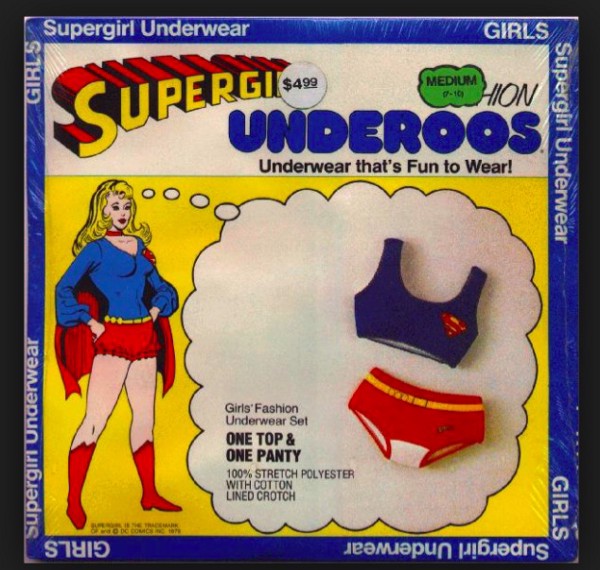
My wonderwomanhood began in London at age 5 when my visiting grandparents gave me a pair of American Underoos. They were blue on the top and red on the bottom with a yellow belt and three “buttons” that did absolutely nothing when you pressed them. I’d never heard of Wonder Woman before which was fortunate because it turned out these were Supergirl Underoos. Still, it was explained by my parents, using the visual aid of the packaging and a deft, long-forgotten reason for the large S on the tank top, that Wonder Woman was the owner of these unlikely undergarments; she had magical powers, incredible strength, speed and agility, and wearing this get-up would endow me with supernatural mojo.

I have always been a scientist. I was deeply skeptical. I wore the Underoos to school for weeks, patiently awaiting an opportunity to field test the veracity of what I’d been told. The day arrived when the teacher stepped out to the loo and the boys began their usual taunting. Henry was being particularly awful. He made Arabella and Jemima cry. I gave everyone fair warning that we girls were not to be trifled with. Henry went one taunt further and I had no choice but to make good on my threat. I locked everyone out of the classroom, took off my clothes and exploded into the hallway in my Supergirl Underoos, fists raised and screaming at the top of my lungs “I AM WONDER WOMAN!” For pure shock value, I give myself an A+. The girls cheered. The boys scattered. Henry hid in the broom closet. The teacher returned and politely asked me to put my clothes back on which I was more than happy to do. I was freezing, but I was no longer skeptical.

No endeavor I’ve undertaken since has been so cleanly successful. Like a lab technician trying to replicate my results, I blame the overwhelming success of this first outing for my subsequent compulsive, often misguided attempts at speaking out against injustice.

There was the fact-heavy lecture on everything Madonna has done for women which I delivered to an all-male group of “music experts” after they disparaged her on a conference call titled “World of Madonna.” (Wonderlesson: Honesty doesn’t get you invited to future meetings; use wisely.)

There was the casting meeting for a screenplay I wrote when I called out the creative executive for compiling an all-white list of actors. (Wonderlesson: Strategy, not reactivity, wins the war.)

There was the music industry Christmas party when I confronted a group of grown men surreptitiously taking pictures of a young woman’s ass. During a tense face-off in which it appeared one of the guys was going to haul off and punch me, I stood my ground and introduced myself, offering to shake his hand until he stormed off. I later recounted the story to my boyfriend and he was so traumatized that I had to accompany him to his therapist’s office (also male) where they spent an hour explaining the error of my ways. Could I understand how my confrontational behavior might put my boyfriend in a vulnerable position at a future date? Yes. Yes, I could. (Wonderlesson: Principles sometimes cost relationships. This is often a good thing in the long run.)

I’ve also failed to be Wonder Woman without an obvious principle at stake. For example, I’ve worn impractical shoes in every circumstance imaginable. Most Saturday night outfits between the ages of 17–25 were a Wonder Woman #FAIL. I once permitted a first date to tell me I reminded him of his mother after I drove him to dinner and picked up the check. I later didn’t object when the same guy parked his unemployed ass on my couch for six months. (There’s nothing in the superhero handbook about “ill-advised rescuing” but I’m 100% certain Diana Prince would’ve kicked this guy to the curb on Day 1, directly after dinner.)

Since I’m confessing, I’ll also admit I once saw my reflection in a shop window and stopped to adjust the height of my ponytail during a half marathon race, and I purposely go to the car wash where the owner calls me “sweetheart.” Oddly-timed vanity and coddling by strangers are this aspiring Wonder Woman’s Achilles’ heels. No matter how hard I work at being the best version of myself, some days I’m all heel.

When I saw Wonder Woman in the theater last week I was relieved. I’d started to worry I was one of those insufferable do-gooder types with a chronic heroine complex, the kind who sabotages relationships over trivial, non-permanent victories. The movie was a popcorn baptism that reminded me why I do what I do. With logic that echoes my own, Diana tells her mother she has to save the world.

Hippolyta: “If you choose to leave, you may never return.”

Diana: “Who would I be if I stayed?”

Amen. Unfortunately, I’m not an Amazonian goddess with mad sword-fighting skills. I’m 5’2″ and I need help reaching the granola at Whole Foods. My battle skill is writing, usually done crosslegged on the floor. So, I fiercely protect my naïveté and cultivate selective amnesia. It’s anti-heroic, but I’d be too much of a coward to do the right thing time and again if I recalled how badly it was going to hurt the next day. Ignorance, not bravery, lets me fight for justice.

The other revelation of Wonder Woman was eye-opening. I left the theater high on comicbook adrenaline and newly aware that, despite my own origin story, I have utterly failed to embody the sartorial spirit of “stop messing with women.” It’s possible my efforts to right wrongs have been hampered for decades by my lack of red leather bustier and bullet-deflecting boots. I already talk like a badass but perhaps if I walk like a badass then I’ll finally be a badass? (At the very least, I’d be identifiable on sight to the nearest Steve Trevor-type and we could spend a few torrid nights together before, well…relationships between heroes are complicated. Stuff happens.)

I ordered a gold tiara and wrist cuffs online this week. I plan to carry them in my purse until an opportunity arises to test my theory. Thanks to Wonder Woman, I’m skeptical but optimistic.

Letter to a young writer

Letter to a young writer

Upstairs at the Last Bookstore (photo credit: E.C. McCarthy)

I’ve always been passionate about supporting fellow writers and artists. I recently received a lovely email from a college student who I babysat for when he was an infant. He asked for advice on everything from publishing to internships. Even though I’m convinced I don’t know a goddamn thing about life (and have extensive proof to back this notion up), I shared a few things I’ve picked up along the way that help me make sense out of being a writer. This email was written specifically for him, and belongs to him, but I thought it might be helpful to other writers who are starting out, or to people who work with writers, are parents to writers, are friends with writers, are in love with writers…

There’s a world of difference between someone who writes and someone who identifies unequivocally as a writer. This letter is for the latter.


Dear D,

Well, this is lovely symmetry. You’re now the age I was when you were born. If I remember correctly, you and I had a few one-way conversations that summer, mostly me reasoning with you to stop crying and fall asleep. If only I’d had the foresight to suggest that someday you’d want my help getting an internship. At least now I can honestly say “He never sleeps.”

This is going to be a long email that won’t make complete sense to you now. I recommend hanging on to it and rereading it in a couple of years. Most of this advice will eventually synthesise. I’m including even the kitchen sink because I wish someone had said these things to me at your age so that the issues were in my peripheral thoughts and not complete surprises when they presented themselves, generally at inopportune moments. Anything here that doesn’t make sense, just push it aside. It may crop up down the road.

Most writers you ask for advice will warn you off becoming a writer. Don’t take it personally but do take it to heart. It’s not rewarding in any traditional sense. It’s lonely and it’s hard work, but it’s incredibly meaningful because of what you’re giving up to pursue it (stability, regular income, a sense of belonging.) We live in a culture that romanticises a writer’s life, so you aren’t allowed to complain about your choice even though you’re sacrificing just as much as the people who take jobs they don’t want in order to support families, or themselves. Your life won’t look like a sacrifice because you’re privileging your thoughts over everything else. It’s the “everything else” that you sacrifice.

Don’t underestimate the emotional toll it takes to carry a mountain around on your shoulders. To mitigate the discomfort, do the uncomfortable things like emailing other writers and artists and connecting with people. Build a network of support with people who grasp what you’re trying to do. Also keep in mind that artists can be some of the most fucked up people in the world, so try to be smart about who you trust and don’t beat yourself up when you get burned. It’s going to happen and it will suck. One of my favourite quotes is from Bohumil Hrabal’s I Served The King of England — “He was a gentle and sensitive soul, and therefore had a short temper, which is why he went straight after everything with an ax…” (it’s a great book that I highly recommend, but only after you read Too Loud a Solitude, which is even better.) Some artists (friends, mentors, colleagues) will come after you with an ax, but chalk it up to their having bruised temperaments from a lifetime of being misunderstood (as all writers have been) and get really good at forgiveness. Forgiveness is probably the third most useful skill in this profession, after curiosity and word usage.

Here’s the good news — you can’t screw this up. You can only fail to meet certain expectations that you’ve created in your mind, like getting published or living the life of a writer. Those are broad concepts. Yet, as you’re reading them here, they probably call up specific images because you’ve been thinking about them a lot. The truth is our future life only promises shades of what we imagine. I can’t think of a single time something happened exactly the way I imagined it, and more often things work out completely differently than I thought they would. The imagination is a writer’s bridge to their finished work, but using it to reach practical decisions can blur the line between goals and expectations which leads to crushing (but avoidable!) disappointment. So, you can’t screw this up because there’s nothing to screw up. The future is a blank. Set yourself a few goals, preferably achievable ones, and then set to work attaining them through curiosity, investigation, skill, and hard work. If you want to write about politics, move to Washington. If you want to write about love, love people…mindfully and willfully, not like it’s expected of you, and not like it’s a given. If you want to write about seeing the world but can’t travel, talk to people who have and write nonfiction. If you want to write about a world that’s better/different/more advanced/more regressed than the one you live in, become knowledgable in what this one offers. These are all logical choices, but when you begin to write it can feel overwhelming to identify what you want to write about because you haven’t really tried anything yet and you may not know where your true interests lie. See, screwing up is what you’re supposed to do. It’s the currency of writing. The screw ups become your material. The thing to get good at, then, is failing. (And yeah, it’s painful to write that, because I often wonder if I’m TOO good at failing, and then I write something that speaks to people and it gives me a good enough reason to go out and fail again. ☺)

For good measure, here’s a piece of my advice you can ignore — don’t be afraid of the smiley face. (DO. BE AFRAID. I use it all the time and it’s complete laziness on my part. Inventor of the Smiley Face, I shake my fist at you! I undercut everything I write with the smiley face. ☺)

re: Being terrified

Being terrified is completely normal. You’re taking a big risk. I was just having this conversation with a friend the other day and we disagreed over the concept of bravery (which I mention only to remind you that everything I say here is subjective and easily disagreed with.) For me, being scared is inherent in bravery. Understanding what’s at stake and being willing to face that loss repeatedly is imperative to living an honest life. Some people rely on religion for this sort of self inventory. Personally, I prefer philosophy and science. No matter your chosen paradigm, fear is going to be a part of everything, always. People have ways of convincing themselves it isn’t but writers don’t have that luxury. We live with an excruciating awareness of life’s poverty of reassurance. (It’s why we write.)

re: Publishing now vs later

I’m not a great person to answer this question. Publishing was never on my radar and I have an ambivalent relationship to all things “publishing.” Actually, that’s an understatement. If I’m completely honest with you, I’m disdainful of a lot of publishing practises, but that’s my idiosyncratic view and it doesn’t serve me well. I’m a purist first, careerist last, and it’s highly likely that’s why my novel isn’t currently sitting on a bookshelf somewhere, so…take heed. I didn’t go to school for writing and I send out one story a year. I prefer to publish in unprotected venues (like Medium, Red Lemonade, G+) just to see what sort of readers it brings me into contact with. I meet the most interesting people through the writing I put out there. I’m familiar with what’s going on in the world, publishing-wise, so if you have specific questions down the road feel free to drop me an email. For now, given that you’re pursuing writing in an academic setting, I’d listen to your professors on this one. Further to that, if you’re in school and around these experienced people it makes sense to get the most out of their expertise by following their advice; it doesn’t strike me as the right time to rebel against it. Without meaning to sound pretentiously zen, be where you are. Embrace where you’ve chosen to learn. Anything else is a waste of energy, and writing already requires more energy than most of us have. I’d focus your time in school entirely on developing your writing practise. Having a practise is SO important. Simply put, think of yourself as a word athlete. You have to train your muscles every day. When you don’t, you grow weak. When you do, you become boundless.

On practical matters — an internship.

Do you want one? If you want one, apply for one. Your resume looks great and I’m sure anyone would love to have you. I don’t think you’ll need any help from me (remember, you’re giving them your time for free) but I’ll happily put in a call for you if you don’t hear back from someone. As for whether to apply, it all comes down to what you think you need most. If you get an internship over the summer, then a year from now you’ll be writing about bureaucracy, unpaid work and publishing a literary magazine, so if those things intrigue you then pursue them. To answer your question, I interned at the UN in college. It was an insane time. I ended up with the largest, nicest office I’ve ever had while I harassed the Senate Budget Appropriations Committee for more money, went to State Department briefings and wrote policy papers on the effects of economic aid in developing economies, all while I was an unpaid 20-year old college student! But that’s a longer story for another time. It’s a great story, actually, and one I should write someday. It makes a great case for getting an internship somewhere completely unrelated to writing, in a field you’d be happy in if writing doesn’t pan out the way you need it to. Just a thought. As an aside, unrelated to anything in your email, I’m always skeptical of people who go to the ends of the earth to find adventure when they aren’t really adventurers. The people who spend three months on an Alaskan fishing boat just to say they did it? I’ve only ever met two people who truly belong on an Alaskan fishing boat, or somewhere comparable, and the rest are sadly misguided individuals. If you don’t want to be an Alaskan fisherman then what the hell are you doing on that boat? (That’s my question; rarely gets a decent answer.) There’s plenty of adventure to be found in the middle of whatever excites you, so my suggestion is to start exploring things that are interesting to you, the stuff you’ve always wondered about, whatever it may be, and don’t let anyone else paint the picture of what “adventure” looks like. They don’t have to live it, you do.

Money, not publishing, is the thorn in the side of every writer. There’s no money in this work whatsoever. Zero. I’ve been in debt for almost my entire career, as have many of my friends, and it’s exhausting and demoralising. That said, I worked at Apple for a few years and took the time to figure out if I’d be happier with a great paycheck at the top company in the world, building a “music geek team” — ostensibly a dream job. The experience was awesome, but once the learning curve levelled off I thought about writing every day. I was just too tired and distracted to sit down and do it. I made the practical decision to stay at the company for several years to save money so I could eventually pay myself to write, and guess what — the screenplay I just turned in has a character built on my experiences in tech. I traded five years of writing for five years of security and experience, and I don’t know what on earth I’d be writing about now if I hadn’t had that experience. Which loops back to the idea that no matter how hard you try, there’s really no screwing this up.

…Except if you don’t develop a writing practise. That’s the only way to screw up being a writer.

The direct segue from money is to the subject of time. Most people will be profoundly confused by any decision you make that privileges anything over money. My suggestion is to form a relationship to money, understand what your threshold for risk is before you start to feel like your writing process suffers because your time is bound up with the wrong place. (Some of the greatest novels in the world are written on this subject. Bel Ami comes to mind.) Make it a priority to learn how much time you need to write and live above that threshold — is it a job at Starbucks, a tiny apartment and writing every day? A job at Apple and writing a novel every four or five years? The main thing to remember is that a financial goal won’t be met by writing, so be on the lookout for ways you can support yourself and accomplish your writing goals, knowing that the way you support yourself will also likely become your material.

The last thing I’ll say is on your work, which I enjoyed reading. As I mentioned above, it’s your life experience that informs the subject matter of your writing, and both pieces you sent me involve young men who are observing their lives and the people in their immediate vicinity (parents, friends, etc.) I expect this is why your professors aren’t pro-publishing — because right now that experience is not substantially unique, no matter how unique your voice or skill set may be. To me, the greatest books, and my favourite writers, bring me into worlds they’ve seen and experienced, and share their observations of life and human behaviour that come from those places. They make meaning out of the human condition, as all writers are obligated to do, but they make the journey exhilarating with backdrops and characters I wouldn’t otherwise know about. My first novel was about a young woman trying to figure out how to live on her own — not unique. I only gave it to a few people, and someone wanted to make a TV series out of it, but I declined and am very glad I did. I would hate to be known for that piece of work now. You strike me as someone with strong observational skill, and when you turn that outward it will open up so many worlds for you to write about. But, for now, I’d sit tight and develop your writing habits so you have a foundation to stand on when you’re out there having the singular experience of pursuing what interests you.

I really hope some of this is helpful to you. It’s a lot of information. No matter how confidently I state it, it is subjective. Use what works, discard what doesn’t. I think the strangest thing about writing is that you’re always writing about something from the past, but in the name of the future. People don’t understand how unsettling that can be, the mental time-travel of it all. Most people live life looking forward — earning money they’ll receive next week, or planning weddings, holidays, babies. Writers spend as much or more time thinking about the baby that was born, the holiday that was had, and the wedding that happened. To do that effectively without letting life pass you by it’s helpful to see the present moment for what it is: what you’ll be writing about tomorrow. So…make now interesting.

Take care, and keep me posted on how things go. You can email me any time.

EC

Jennifer Lawrence and the Righteous Deal

Jennifer Lawrence and the Righteous Deal

I learned about the righteous deal when I negotiated to buy my first car. It was a five-hour ordeal at the dealership. I met with a rotation of Car Cops: good cop, bad cop, friendly-but-stern cop, calculator-wielding cop, they’re-going-fire-me cop, and finally contrite cop. Contrite cop acknowledged that my negotiating skills (which included a late-in-the-game “memory lapse” over how many months I had left on the leased Jetta I was selling them) won me a new car at close to base price. I wasn’t in it to gouge them. I wanted what was fair and told the floor salesman up front what I was willing to pay. He assured me that that was all I’d have to pay. Then six men spent five hours trying to break me. “In the car business we say you got ‘the righteous deal,” contrite cop told me. It was the proudest moment of my negotiating career.


I applaud Jennifer Lawrence for speaking up today on her experience with gender discrimination. I also completely understand why she didn’t speak up sooner, and I support the decision made by many women to remain silent about the double standards they contend with daily. The nature of the wage gap is such that merely beginning a conversation about changing our expectations and standards feels subversive. Lawrence’s situation is unique, as she repeatedly mentions, because her decision to speak up comes from a position of considerable power. Nonetheless, it’s a generous contribution to solving an industry-wide problem which she could easily have addressed privately with her agents. Her essay demystifyies the wage discussion and sets an invaluable precedent for women working in Hollywood.

I’m older than Lawrence and have been working in and around Hollywood for long enough to remember when there were no role models for what I do. Only Nora Ephron and Nancy Meyers were writing and directing studio comedies when I came up. That fact remained true for years. When I say there were “no role models” I mean this: Nora and Nancy were anomalies. There was no sense patterning your career after them. The job of being Nora Ephron was already taken. The absence of women at the top of the creative side of the business made it abundantly clear that those two women got to make movies because of who they were, not because women had any rightful place in the director’s chair. Today, thankfully, there are more women in those jobs than ever before, and young women have comparatively more opportunities to see women at work behind the camera. This is progress.

Lawrence is right when she suggests that her male counterparts are respected for getting better deals for themselves. It’s a man’s game and men begrudgingly respect other men who beat them in competition. In general, men don’t lose to women with the same equanimity. In fact, in most instances losing to women brings out the basest qualities of bad-loserdom in men, including name-calling. Lawrence mentions the “spoiled brat” tag as one she wanted to avoid. Personally, I think “crazy” is more potent, and “difficult” and “nightmare” are reputations that stick. Brattiness can be outgrown but crazy/difficult/nightmare are terminal traits of people you can’t trust and don’t want to be near. That women are routinely called crazy in Hollywood is, in my mind, a highly effective method for marginalizing them.

As for straight talk, Lawrence’s experience of giving direct feedback and essentially being told to “calm down” is pervasive. The unspoken expectation for women is that they should mother their work relationships and creative projects, and selflessly donate their time. If something comes back to them in any form — money, an agent, an opportunity — then they’re expected to feel grateful, not deserving and highly skilled. The upshot is that women are rightly confused as to the real value of their work. They contribute the same work as a guy, but for less money and with the added burden of social cues which actively dissuade them from confidently communicating their opinions. It’s a mindfuck, and sadly a lot of men aren’t aware of how they perpetuate it.

As long as women struggle to negotiate for themselves, studios will profit from paying them less than their male peers. It’s worth mentioning the Hollywood Diversity Report that came out this year which assessed the 2012–13 production year and found the executive ranks of TV networks and studios to be 71% male, and at film studios the number was an astounding 100% male. This means that if male executives independently decided to end the wage gap, it would be gone. Women may be slow to value themselves, but men are failing women too, possibly intentionally. (How’s that for blunt?) As Lawrence sees it, the onus is on her to negotiate for herself. She’s fortunate to have a powerful team of negotiators to help her make that happen. Most women begin their careers negotiating for themselves, without anyone to advise them, and my personal experience is that this is a losing battle. Every single time I’ve asked for equality, I’ve lost. There is no shortage of opportunities for me to write either on spec or for under-the-table money, and men later put their names on my work. This gives me zero negotiating power in the long run. The deck is stacked so many ways in favor of the wage gap.

Lawrence mentions her desire to be liked, and that it’s a part of her personality she’s trying to change. I also have a desire to be liked. I don’t think that’s a bad thing. I get a natural high off of creative collaboration, and at the heart of those relationships is a genuine like and respect for the person or people I’m working with. These days I find I’m less and less able to respect the guys who can’t or won’t see the discrimination I’m dealing with. I mostly attribute their complacency to busyness, but I harbor a fear that they turn a blind eye to my situation so they won’t have to do anything about it. In short, their inaction makes me not like them, which is a state of affairs I’m wholly uncomfortable with. I don’t like not liking people.

I take heart in the cultural changes that are underway right now. As I read Lawrence’s essay, every frank conversation I’ve ever had with a guy in charge that cost me an opportunity made me feel retroactively empowered rather than foolish. It’s a huge relief when someone speaks the truth about the inequality that women face. I’m grateful every time someone acknowledges the problem, even more so when someone begins a national discussion. These are not easy things to do.

On a positive note, there is an upside to gender discrimination. When you give a group of talented people very little to work with, over time they become adaptable, resourceful and more creative. Women writers, directors, actors and comedians are kicking ass right now because they have an astounding work ethic, and they’re exceptionally nimble. There’s a richness and depth to their creativity that comes from time spent watching and waiting in the wings. The next step is encouraging women to sit down with the guys and negotiate a righteous deal.

(Read Jennifer Lawrence’s essay in Lena Dunham’s Lenny.)

An Argument Against Cynicism

An Argument Against Cynicism

In response to “Spare a Thought For Those Who Are Not Charlie”

Rosa Brooks’s piece in Foreign Policy this week reminds me of every time I’ve donated money to an urgent cause while I, myself, was in debt.

It’s not two weeks since the terrorist attack on Charlie Hebdo and the pundits are nearly done discrediting the public outcry over the deaths of journalists, police, and grocery shoppers — those hypocritical world leaders, that faux French populace, the silly pencils. Brush your hands together and prepare for the maudlin, bizarre “let’s compare deaths” ritual that is now as inevitable as a funeral.

We cannot respond to death emotionally anymore. When we do we are mocked for it. The truncated news cycle has obliterated our reverence for loss of life. The fact of death, not the means, not the method, but the fact of its devastating permanence used to unite us, if only for a month or two. Before 9/11 and the news ticker we permitted ourselves a period of raw emotionality, insanity and despair over our helplessness to bring back the dead. Now death is analyzed and picked over while the gun is still pointed, before the crime is fully perpetrated and last breaths expelled. A dead person is controversial for being dead, and he or she divides us.

I’ve never understood the thinking behind comparing deaths. I’m generally an admirer of Brooks’s commentary but her piece in Foreign Policy this week angered me. It’s a laundry list of tragedies under the umbrella of “je ne suis pas Charlie.” She seems to view mourning as a finite resource and thinks the world is foolishly wasting its supply. This process of death comparison is rooted in the absurd and I feel compelled, in my own emotional state, to push back. All of the victims of murder over the last two weeks are strangers to me, but still I’m able to make different meanings out of their deaths without holding them up side by side. “Spare a thought” for the non-Charlie victims? That directive is insulting.

I value free speech, and the attack on Charlie Hebdo was a symbolic attack on free speech.

I live in a country where I could be a victim of that kind of attack. The perpetrators of those attacks are trying to dismantle a right that I live and die by: the right to speak my mind. My solidarity with Charlie Hebdo has nothing to do with their cartoons and everything to do with the free speech they exercised courageously in the face of threat. I didn’t hear a single person interviewed over the past ten days say “I love Charlie Hebdo! It’s my favourite publication and I never miss an issue.” If Brooks had watched television coverage of the historic march across France she would have heard this refrain from the multinational crowd again and again: I didn’t like what they said but I support their right to say it. “Je suis Charlie” asserts a value. I feel the same solidarity with the Al Jazeera journalists who are imprisoned in Egypt, and the blogger in Saudi Arabia who is undergoing weekly lashings for his website posts. People marched after the Charlie Hebdo attacks to find their voice together and confirm their shared value of free speech in a country that purports to offer that freedom. Three-and-a-half million people made the greatest physical statement in the history of France: The French must be free to speak. The march was not a statement about every other death in the world. Their march does not say “I care about this but not that.” The suggestion that racism and callousness stand in the shadows of this display of “unearned angst” damages the potential for progress. A much-needed conversation has begun about topics people often avoid and it must be encouraged to continue.

I value human life, and the violence in Nigeria is an attack on human life.

My heart aches for the victims of Boko Haram’s rampage through Nigeria. I follow the stories. I am moved and horrified by the news that trickles out of the country with less regularity, and notably less reliability, than what is available in more accessible countries. I also understand why those murders do not inspire public marches the world over, despite the fact that beautiful, innocent children and unarmed adults are dying by machine gun bullets. Those victims are bystanders in the path of mass murderers. A march is not going to help us mourn their deaths. We are already openly in agreement that murdering innocent people is wrong. We don’t need a conversation but a plan.

Brooks voices similar sentiments to quite a few journalists I’ve read this week when she states:

“[Maybe] I just find it depressing to be reminded that the murder of a dozen mostly Caucasian people in a major European city seems to bother us more than the mass slaughter of non-Caucasian people in other parts of the globe.”

It is hard work not to become cynical. We don’t discuss this aspect of life cogently as a society. Instead, reality assaults people and we reserve the right to judge them when they respond in ways we deem ineffective. But what is an appropriate response when people are slaughtered for drawing, or joking, or playing games with their friends in front of their house? Perhaps a futile death engenders a futile response. It’s what follows that matters. Injustice can be addressed. In my experience, cynicism cannot. Cynicism is never satisfied. That is its only power.

We try to make meaning out of world events, and that meaning generally begins with personal values. As someone who grew up internationally, I have great sympathy for people who work in geopolitical realms of study and reporting because I share a frustration that multiculturalism is lacking in cultural dialogue. I fight the temptation to become cynical on a daily basis. It is horrifying to know that most deaths are needless and unjust. I feel it to my core. I know other people do too. That’s where I look to strengthen my optimism — in other people who share that value. We will address injustices eventually. Taking a long view and ignoring the rhythm of the internet is imperative.

To Ms. Brooks and her likeminded colleagues I say: Be depressed about the tragedy and the needless deaths. I am, very. But please be inspired by the marches in support of free speech. Don’t compare deaths and see racism. Don’t undercut people from all walks of life who are struggling to find a unified voice in defense of a value. If we encourage people’s outpouring of solidarity in the aftermath of these tragedies we might see more of this cooperation. A motivated citizenry is a powerful weapon in the fight against ideological brutality, but it takes practise to get a population of 66 million people walking in the same direction. Three-and-a-half million people is a start. Today the French are taking on al Qaeda in their country. That’s also practise for ending Boko Haram. People must secure their own rights before they can successfully defend the rights of others.

The Art of Consolidation

The Art of Consolidation

Clare Graham’s Wonderland of Cast-Off Riches

There’s an early scene in Warren Beatty’s classic film REDS when a couple of great writers have their first lovers’ quarrel. The backdrop is 1916, on the eve of World War I, the Russian Revolution, and the first Red Scare in America, a time when it would be undignified for two top-flight political journalists to go head-to-head over tardiness for dinner, or whose turn it was to take out the trash. As such, Louise Bryant and Jack Reed naturally, bitingly, opt to level each other over the relevancy of their work and the all-consuming question of what to write. Jack shouts his way through this appraisal of Louise’s choices in light of current events:

Why do you even expect to be taken seriously if you’re not writing about serious things? I don’t understand that! I’m not even sure I know what things you’re serious about! One day you’re writing about the railroads and you don’t even finish the piece. The next day you’re doing a piece on an art exhibition that happened three years ago. Look, why do you give me anything to read anyway. If I criticize it at all you tell me you like it the way it is, and when we’re out with other people, if somebody doesn’t ask you a direct question you tell me you feel ignored! But with everything that’s happening in the world today you decide to sit down and write a piece on the influence of the goddamned Armory Show of 1913? Are people supposed to take that seriously?

The answer is yes.

In 2014, the world is once again in a state of turmoil so urgent and complex that it’s a daily chore to wade through the choices and finally plant a flag: Today I will write about this. This is important. Against the measuring stick of relevancy I’m compelled to write about Clare Graham’s art. His exhibition at the Craft and Folk Art Museum, Clare Graham & MorYork: The Answer is Yes, is more vital than ever in this millennium of successive global challenges. Graham holds the key to our future if we’re willing to contemplate it.

The entire 3rd floor of the museum is devoted to Graham’s furniture-adjacent pieces. A ranch-house layout gives the suggestion of seating areas comprising same-material objects that range from cut and hammered soda pop cans and bottle tops to buttons, shuttlecocks, and, memorably, a jar of teeth. The process of fashioning each piece of each mosaic, which one can only imagine was painstaking given the perfect symmetry and construction, is easy to take for granted. The wonder of Graham’s art is the seamlessness. Each chaise and armoire appears to have been born just so. Like the fabled orphans of 19th century literature, the discarded materials he gathers for his work weren’t destined for mundane lives.

The main room showcases his taller cupboards that are made from dominos and mesmerising triptychs of paint-by-number canvases. The paint-by-number art was my introduction to Graham seven years ago when a 3×8 foot geisha-themed panel caught my eye in a gallery on Abbot Kinney Boulevard. I visited that panel for several years until it sold and the gallery owners were kind enough to put me in touch with the artist so I might find another piece to fall in love with.

A Paint-by-Number panel

At the MorYork workshop I found a trove. In fact, there are far too many pieces to love. The workshop itself became the object of my affection. Thousands of square feet are packed with touchable, functional art. Although my affinity for words would indicate a preference for the scrabble tile cupboards that spell out passages from novels, I’m still most powerfully drawn to his paint-by-number pieces. I learned how each small canvas is painted, then cut into 2×2 squares and reassembled in a cubist echo of lovers, horses, or autumn leaves that would make Picasso and Braques fall, rhapsodic, into each other’s arms.

One side of the exhibition is devoted to dismembered teddy bears – probably my least favourite choice of material because it recalls a childhood with too few toys to cuddle. Unlike discarded game pieces and beverage containers, the teddy bears that never find their way to a child make me disconsolate. That is exactly the point of this show. Every material Graham uses is mass-produced without commensurate demand or obligation to utility despite the state of our environment. Need does not equate with inventory in any logical sense. Consumerism drives manufacturing only to generate piles of surplus (“more-more”) merchandise in warehouses and factories across the country to await Graham’s discovery, vision and touch.

Pop-Top furniture

The show has a “this is our house” feeling to it, and on a second walkthrough the dread creeps in. We are all culpable for this waste. We heedlessly accumulate so much we don’t need and never use. For all of the pop tops in Graham’s living room, how many more are floating in the ocean or permanently abandoned in a landfill? His use for these objects demonstrates that the tragedy in wastefulness can be redeemed. He has made something beautiful from America’s refuse and the results are gruesome, funny and most of all practical. We’re invited to sit on our cast-offs, read our literature on the sides of cupboards, and stare at a wall of empathic plastic eyes to contemplate what we might do next.

It’s possible this is what Louise Bryant was thinking as she sat down to write about an art show on the eve of so many wars. It’s possible her unfinished railroad piece was merely a springboard to the train she soon rode across central Europe into Russia to witness Lenin’s victory march into the Kremlin. For anyone who asks whether there is something they can do, or something to be done, Clare Graham offers an elegant answer: Yes.

Clare Graham & MorYork: The Answer is Yes, September 13, 2014 — January 4, 2015

The Craft and Folk Art Museum, 5814 Wilshire Blvd., Los Angeles, CA 90036

Admission is Free on Sundays

On Social Media Activism and the Myth of Apathy

On Social Media Activism and the Myth of Apathy

A response to “Turn On, Retweet, Tune Out”

Ten years ago, the term social media didn’t exist. Facebook was founded in 2004. Twitter was a twinkle in someone’s eye. Billions of users weren’t organized into a handful of hubs and advertisers were barely dipping their toes in the water. One could attribute the rapid escalation in social media use to ease of entry but other factors including desire for entertainment or social value, anxiety at being excluded, and the discovery of online “self” all play a role in an individual’s decision to join the masses in any given forum. I’d be surprised if “Solving humanitarian crises” came out on top in the “Reasons why I joined Twitter” survey, but that’s exactly the point: anything is possible. We should expect to be surprised by internet-based outcomes.

Our proclivity for reverse engineering has driven the conversation about social media and invited near-constant conclusions about human nature based on “the evidence.” Free data of any kind is extremely attractive. We’re hungry for knowledge. Sure, seasoned analysts caution that examples and observations aren’t proof and point out that the internet is one massive, on-going, uncontrolled experiment that makes it nearly impossible to a) ascertain what constitutes reliable data, and b) draw substantive conclusions about causality. The primary use for social media statistics is sales and the stakes are low enough for corporations to ignore the warnings and proceed with trial-and-error marketing ploys. Outcomes have thus become “evidence” of something we want to see.

Through social media, we’ve embarked on a new method of activism that involves marketing a humanitarian cause and citing viral chatter as evidence of public interest and support.

Last week’s Foreign Policy column entitled “Turn on, Retweet, Tune Out” is a good example of this approach. In her piece, Lauren Wolfe reiterates a common refrain about the public’s appetite for humanitarian causes. Specifically, the piece marries social media content to “caring,” an assumption that is so prevalent in contemporary dialogue that the inverse is now a foregone conclusion: if an atrocity, law, event, or person isn’t being discussed on social media then people don’t care. The conversation seamlessly flows to second-tier concern. Why don’t people care? (A frazzled data scientist would follow this question with: Who are “people” and what is “caring”?)

It’s easy to trace this culture-wide assumption to a logical starting point. There have been profound social media “successes” that altered the global political landscape. Hashtags and social media posts during the Arab Spring were widely cited as being instrumental in keeping anti-government protestors connected and informed. On the humanitarian front, Wolfe mentions the ongoing kidnappings in Chibok, Nigeria, and the Kony2012 hashtag in her piece. #Kony2012 was a video campaign to bring Ugandan war criminal Joseph Kony to justice. It attracted the attention of millions of Twitter and Facebook users, many who I expect couldn’t pick out Uganda on a world map even today. #BringBackOurGirls refers to the 300 teenaged girls that Boko Haram took from a school four months ago and continue to hold prisoner today. The hashtag circulates on various sites intermittently while the world waits for news out of the region — the pertinent words for the apathy discussion being “world” and “waits.” Social media’s role in generating global concern by disseminating information is undeniable in these instances, but asking why public support dwindles to apathy over time is merely an activist-end lament. Better to ask: After the retweet, what more can geographically distant non-activists do?

The public isn’t paid for their time on these issues. People willingly participate in humanitarian causes they care about by doing the one thing that they’re directed to do, namely share the story to get the word out. And then what? Share again? This terrible thing happened. It happened. It’s happening. It happened. It’s happening. It happened. It’s happening. The chatter itself doesn’t physically walk Kony into a jail cell, discover the hideout of Boko Haram, or stop bombs from falling in Syria, or Gaza, or Iraq, and since those are the immediate goals then remote participants need guidance on what they can do beyond retweeting. Further, there’s a likelihood that the next step will have nothing to do with clicking a link and more to do with writing a check or contacting a representative, neither of which show up in a Twitter feed. Social media content during the Arab Spring frequently revolved around specific actions – announcing protest locations, giving eye-witness accounts of atrocities to share, uncovering the movements of opposing sides, tracking the whereabouts of arrested protestors – but that chatter is silent now. Should we assume those people are apathetic about continued strife in the region because they aren’t discussing it with the same frequency on social media? Absolutely not.

It’s not a given that every humanitarian crisis will capture global attention but many do, because many people care. The wave of public participation can be ridden much farther than it often is simply by giving people continued guidance on steps they can take beyond posting and tweeting. To this end, it’s crucial for journalists and activists to stay in front of a crisis and lead the groundswell of social media users who eventually turn to face the issue. I expect we’ll see more of this pattern as we learn from our successes and failures in real time, but in the meantime it’s incongruous to assume apathy, or exhaustion, in the absence of online chatter. The short answer to sustaining public participation is to find the best leaders for the cause.