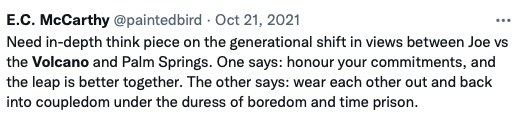
Joe Versus the Volcano, Palm Springs and the Lost Decades of Romantic Comedies

Joe Versus the Volcano, Palm Springs and the Lost Decades of Romantic Comedies

A looming future of transhumanism and the encroaching threat of climate change enshroud our daily lives. Sure, we’re facing a pandemic, a gun crisis, a healthcare crisis, unprecedented economic inequality, a crumbling democracy, impending regional wars, loss of privacy, disinformation, and a privatized space race with questionable aims, but all of that pales next to the strangeness of confronting an existential crisis of unsustainable life on earth alongside the rapid devolution of our humanity at the hands of software and machines. What I mean to say is this is a historically bad time to make the case that Hollywood should be focused on reviving the romantic comedy genre. We’ve clearly got bigger problems. 

However, it’s my view that we, the imperiled public, desperately need to be watching interesting, funny relationship movies. In theatersOn dates. The communal experience of laughing in a theater while watching ourselves—regular people, not superheros—reflected in stories on a big screen is essential. It suggests we’re able to laugh at ourselves with each other, that we’re not too proud to laugh at ourselves in front of strangers, and reminds us that we share our life experiences with a large, diverse group of people. The theater is where we experience common ground. If Hollywood doesn’t find the will to make those movies, and fast, and if we don’t find the will to force ourselves to go see them, no matter how in love we are with our couches, we will most certainly never again have the necessary social glue needed to solve much bigger, more urgent problems that are presently breathing down our collective neck. (We do have a collective neck, whether we like it or not, snowflakes be damned.)

The world didn’t arrive at hell’s oasis overnight. The blueprint for our demise has been around for some time. Love and dating in America have taken a backseat to more urgent problems for years, if not in practice then at least in conversation. Hollywood turned all of its attention to comic book world-saving and space operas years ago, first because they were so lucrative, and later because they were so reliable. There’s not much happening these days on a high budget studio level that echoes WHEN HARRY MET SALLY in broad appeal, which implies we don’t care about the one-on-one love stories that used to preoccupy many of us morning, noon and night, that we’ve dropped the topic that serves as the foundation for building a life, joining social groups, starting families and forming communities. Hollywood’s output suggests that we, the viewing public, don’t find ourselves interesting or entertaining enough to warrant a big budget film. I think that implication is false (and dangerous). I think we care a lot about understanding each other, across political, social and gender divides. During the course of technological advancement, those stories have been devalued, and that’s the reason for this piece.

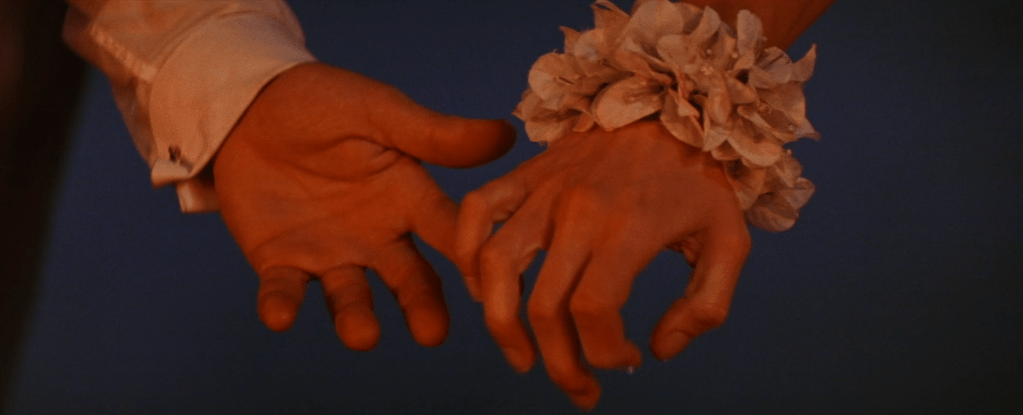
In 1990, the brilliant playwright and filmmaker John Patrick Shanley made JOE VERSUS THE VOLCANO. Joe (Tom Hanks) begins with tired eyes and a bad haircut, trudging through urban muck to reach his depressing basement job, and ends looking debonair in a white tuxedo, with a great haircut, newly married in the South Pacific. His wife is Patricia (Meg Ryan), whom he has known for four days. They’re married for all of two minutes before they join hands and jump into an erupting volcano. Joe does this because he wants to be a man of his word. He agreed to jump into the volcano after being told he has a “brain cloud” and only a few months to live. In exchange for the adventure of reaching the South Pacific by boat, he will end his life spectacularly. He later learns he was duped into going on this nonsensical journey and is actually in perfect health.

Patricia’s reason for jumping into the volcano is a bit murky. She spends two days getting to know Joe on her boat, the Tweedle Dee, before a typhoon sinks it, taking her entire crew with it. Joe saves her life and they survive two more days floating on his luggage—she, unconscious, he, delusional—before arriving at the island, at which point she announces she’s in love with him. She tries to talk Joe out of jumping but he’s set on a heroic death, so she asks him to marry her, they marry, and then she says she’s jumping with him. Maybe the thrill of getting married made her feel spontaneous and lucky. It’s hard to tell. They jump holding hands, the volcano ejects them in a cloud of gas and they survive. Love conquers all.

Exactly thirty years later in the California desert, Nyles (Andy Samberg) begins PALM SPRINGS looking good, if bored, and ends the movie still looking good but now nervous and awake as he takes the hand of his new love, Sarah (Cristin Milioti). They walk into a cave with a boiling time tunnel where they kiss passionately before she blows them both up with a body belt of C4. It’s very romantic. 

They do this because they’re trapped in a time loop, living the same miserable day over and over at Sarah’s sister’s wedding, à la GROUNDHOG DAY. Sarah slept with the groom the night before the wedding and wakes up every morning to the awful realization of what she has done. Nyles is in a relationship with a self-absorbed younger woman and is reliving a daily hell of settling for mediocrity. By the time Sarah figures out a theoretical way to exit the time loop, Nyles has figured out he needs to be with her. He’s ready to grow up and blow himself up for love.

The message of both films is horrible when taken literally. A leap of faith, better described as “a hopeful dual suicide,” is presented as the only way forward for these endearing characters, as the only honorable choice. Metaphorically, however, the notion of taking a leap with another person, ending life as you know it by annihilating yourse…whoops, no, that’s also horrible. Both films push a fantasy narrative of complete abasement to the mysteries of the universe, on par with taking life advice from a horoscope. At no point does the audience believe the film is really going to kill these people off. They’ve come so far! They’ve learned so much! Apparently for their proverbial sins, they still have to die. At least, they think they do. 

The films are both surreal fantasies with comparable endings, and they share one similarity in having unusually normal female protagonists. Neither Patricia nor Sarah are flighty, conflicted, dependent, or particularly interested in love and marriage. They’re both self-reflective, insightful and very smart, which comes across with refreshing clarity in the midst of a surreal narrative. When female characters are effortlessly normal, flawed without silently broadcasting “I’M UNLIKEABLE, DAMNIT,” the writing has delivered a rare wonder and should be congratulated. 

Other than those broad similarities, the two films are notable for their differences. Baby boomer Joe is a cog in a dark, dirty corporate wheel at a medical hardware company. His life is meaningless, and it’s making him sick. The satirical commentary on what passed for a “job” in the late 80s is played to the hilt, complete with an “artificial testicals” prototype on his boss’s desk. Joe’s problem is not Joe. It’s the world he’s living in, the expectations placed on him, and society’s numb acceptance of it all without resistance. 
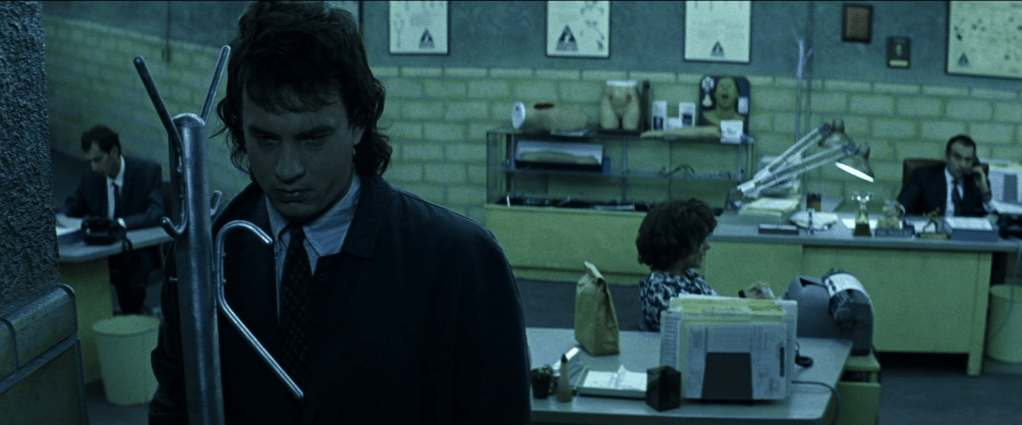
By comparison, millennial Nyles never mentions his job. When Sarah asks what he did for a living before he got stuck in the time loop he’s unable to remember. He never asks about her job or career, although it’s later suggested that he already knows a lot more about her than he initially confesses. He’s not incurious, he’s wise. Regardless, they don’t discuss the central focus of modern life, one’s work, suggesting that careers don’t define millennials the way they define older generations. In GROUNDHOG DAY, Phil Connors uses his eternal time loop to do the things he missed doing by having a demanding job and a bad attitude, namely reading the classics, learning to play the piano, and doing good deeds. Two generations later, Sarah and Nyles face the same meaninglessness and choose to drink all day and amuse themselves by breaking every law and rule. They have no apparent interests and there’s no possible way to create anything lasting or meaningful…until they fall in love.

On the subject of sex, both films are sweetly chaste. Sarah and Nyles agree not to sleep together, given that they’re stuck in a loop and don’t want things to be eternally awkward. Eventually they relent, which serves as the catalyst to try to escape the loop and have a real future. Joe and Patricia get married before they even make out, which is a loud wink coming from the “free love” generation who danced naked at Woodstock and marched on Washington for birth control. Baby boomers single-handedly liberated sex from puritanism. By the 80s, however, boomers were divorcing in unprecedented numbers. The generation that decided it was free to sleep with whomever it pleased discovered that finding one person to go the distance with was more romantic than passion itself. If boomers had learned anything by midlife, it was that passion didn’t make a marriage. People did.

It’s unsurprising that Baby Boomers and Millennials are responsible for tales depicting coupledom as the death of the individual, a traumatic decision that one only survives by chance or miracle in explosive, spectacular fashion. Both generations take themselves too seriously. Generation X, however, is the goldilocks audience for these fables, fairly committed to the idea that it’s not good to blow yourself up and/or jump into a volcano for love, but blasé enough to use dating websites where miracles are purported to happen. Gen X was also the receptive audience to the TV fantasy of Friends, happily patterning the future on the impossible economics of a massive two-bedroom apartment in Manhattan and as much spare time in adulthood as one had in college to banter wittily with, well, friends. Gen X has a shrug-and-see attitude which makes it the ideal generational voice to reestablish a few key narratives if given the opportunity and support.

Because I felt like it.

Generation X came of age during the 30 years between JOE VERSUS THE VOLCANO and PALM SPRINGS. During that time, Hollywood evolved away from the traditional studio system and moved towards corporate ownership, primarily by technology and communications conglomerates. The 2000s ushered in an era of marketing-as-tastemaking, with studio executives increasingly taking their scripts to the marketing departments before greenlighting them, often during the development process. This was new in the filmmaking process. Repeat: This was new. Film buffs can disagree all day long about how the industry has changed over the years and whether certain changes have been good or bad for filmmaking on balance, but it’s incontrovertible that this shift in decision-making gave tastemaking power to the sales and marketing side of production. In journalism, this would be the equivalent of the ad sales department for a newspaper weighing in on whether a journalist should cover a story. These two branches of media companies, business and news, are strictly separate and do not interact with each other because of the conflict of interest. (For example, the Washington Post needs to be able to cover any and all newsworthy stories, whether a tech company buys advertising space in their pages or not. A news organization should never opt out of covering a story because their advertisers are lobbying them.)

However, Hollywood is not journalism. The industry famously views itself as living by its own rules, of which there are none. The foundation of Hollywood decision-making was most eloquently summed up in three words by the late, great William Goldman: “Nobody knows anything.” Nobody is in charge. Nobody codified essential aspects of the creative process. Nobody thought to protect Hollywood’s most precious commodity from encroaching corporations. Instead, the industry frittered away its tastemaking power by demoting high quality films to “indie” status, meaning they’re made using independent financing, and instead poured all of its money into “tentpole” franchises. This began in earnest in the 90s, so by the time the Internet Age arrived with streaming technology, the studios rolled over, seemingly grateful to have someone new to blame for their imploding “business model.”

What does this have to do with romantic comedies? While Hollywood’s output became increasingly marketing-based and franchise-heavy, adult relationships became the purview of HBO and premium cable, with Sex and the City dominating the high-quality but definitively at-home viewership of relationship storytelling. A major split occurred. Prestige filmmaking no longer included relationship movies, conveying the unspoken message that adult relationships weren’t considered valuable enough for studios to support in kind alongside Batman, Marvel, Star Wars, Avatar, Star Trek, “Tom Cruise,” etc. To wit, Warner Bros. made JOE VERSUS THE VOLCANO with a budget of $25 million and it opened to $9.2 million in 1990, while PALM SPRINGS was made independently for $5 million and opened to $164,000. Granted, it opened during the pandemic, but given its budget it was unlikely to see a big opening weekend in 2020, no matter the circumstances of its release. 

One interesting aside to this discussion is what Generation X filmmakers did between 1990 and 2020 with dwindling studio support. STRANGER THAN FICTION was pretty much the only mid-level fantasy-relationship studio film made during that time–made for $30 million by Sony Pictures, starring Emma Thompson and Will Ferrell. The Gen X approach to love was (I note with pride) the reverse of boomers and millennials, with Will Ferrell’s Harold Crick begging not to die because he finally found love. He’ll do anything not to die at the hands of a homicidal fiction writer who created him in order to kill him. It opened to $13 million.

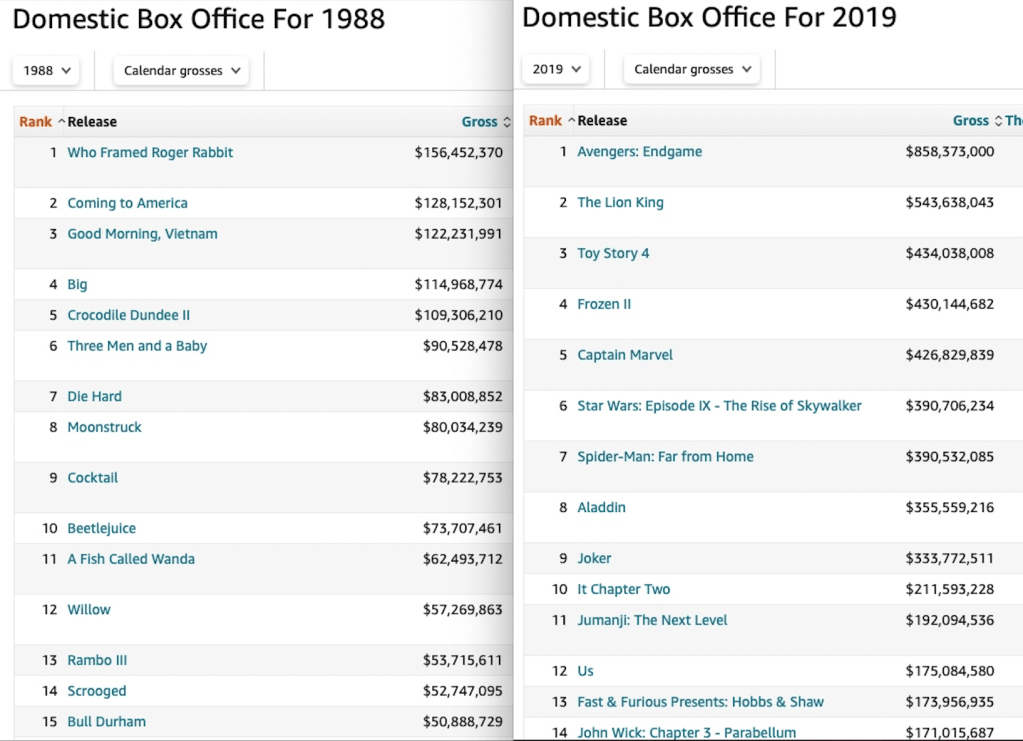
While studios shifted their focus entirely to CGI-heavy franchises, theaters moved to upgrade the theatrical experience to accommodate them, touting high-tech sound systems, screens and 3D capability, all of which sent the cost of movie tickets through the roof. Today, filmgoers rightly balk at paying the same price to see a Star Wars film a Sex and the City movie. Only one of those films requires expensive bells and whistles to get its story across. 
[credit: Box Office Mojo]

Between the loss of support in script development to the theatrical focus on animation and sci-fi with CGI, the film industry essentially dropped an entire genre on its ass without considering the long-term effects on the culture it was entrusted with influencing. Presently, there is more discussion in the trades about whether China is carrying the latest tentpole offering from Hollywood than the overall quality and content of output in American theaters in general. American audiences aren’t Hollywood’s primary concern anymore, and that is most obvious in the snapshots of box office earnings year over year. With the business geared towards foreign audiences, it should be no surprise that movies about interpersonal relationships have dropped in status, since the nuances of relationships, humor and love are highly specific to each culture, hence those films don’t translate easily overseas.

Thus, younger generations of Americans are getting their top-tier entertainment-based insights on adult relationships from broadly drawn superheroes sprinting toward each other, futuristic guns drawn, ready to fight for a magical orb that will save the universe, not wittily navigating the treacherous end-of-dinner decision about who picks up the check on a first date. This may sound like an inconsequential overgeneralization, but the shift in Hollywood’s tone and storytelling has real-world effects for kids growing up in a franchise-dominated, entertainment-heavy culture. There’s no angst-ridden wait of several years between buying a ticket to a G-rated Disney animated film and an R-rated live-action one, of staring up at the marquee with longing and thinking about being able to see any number of movies without sitting next to a parent. Today there are mere inches on a screen between clicks, and the short jump from animation to sci-fi has very few relationship films vying for attention in between. 

This 30-year reliance on sci-fi fantasy franchises and the implied value of those stories over relationship fantasies is, in my view, responsible for quite a lot that isn’t good in the 2020s. When an entire industry devotes the lion’s share of its resources to superheroes and the distant future, it neglects the dreams and fantasies of real people who are buying movie tickets. Nobody sitting in the theater relates to a superhero the same way they relate to an average guy who hates his job, who has no life, or who needs an adventure. Nobody sitting in the theater relates to someone who flies around on a spaceship the way they relate to getting nervous about getting married, or pondering their future, or questioning what their purpose is. When people stop viewing their own lives as interesting, and their own problems as being worthy of having movies made about them in a fun, fantastical way, they’re encouraged to devalue regular life. There are many reasons why people walk around staring at their cellphones these days, their attention freely given to a tiny screen while life happens in real time around them. This is certainly one of them.

The process of elevating a future that doesn’t exist yet over a present that needs attention is a major contributing factor in our social dysfunction. The evidence is in the films themselves. JOE VERSUS THE VOLCANO is one man’s escape from the drugery of his life. He seeks help from doctors, begging for a reason why he feels so sick inside. He jumps into a volcano under false pretenses, despite being newly married to a woman he loves, because finding meaning in life is even more important. Had he known the truth about his health, he would have refused to jump and continued to search for hope and answers. Thirty years later, PALM SPRINGS is a story of two people trapped in meaningless time. They only recognize each other and fall in love because time has been reduced to one day. If not for that, they would pass by each other and continue on with their empty, dissatisfying lives, distracted by what they’re told is meaningful, unaware that there’s something better right in front of them if only they could slow down and see it. 

Hollywood used to be our time loop, slowing life down for a couple of hours with sharp, compelling relationship movies that encouraged us not to take ourselves too seriously. If there’s any risk to be taken in the business now, the essential one is to push for a return to more traditional filmmaking, and to search for the writers and directors with a fresh perspective on love and relationships, and new stories to tell. In my view, studio support for this genre would make a substantive difference in the direction the world is taking, while entertaining people in the process.


If you read this, you owe me a dollar.

I don’t work for free. Donate $1 to www.wikipedia.org, or somewhere that matters to you.

Notes, ideas and unpolished pieces

Stragglers from the “ideas” file.


February 13, 2011 — sketch notes


October 30, 2008 — notes for Ch. 8 of first draft of novel


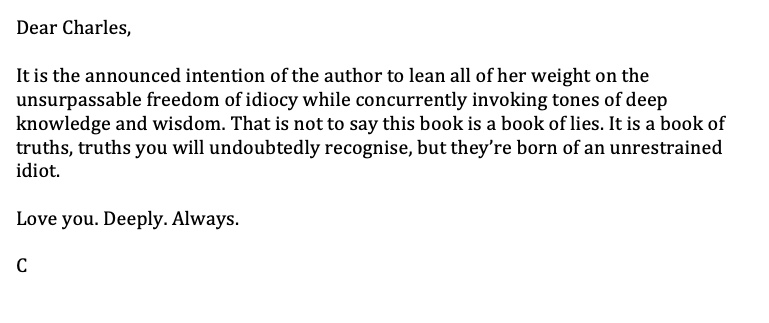
June 8, 2015 — Epistolary Satire between separated editor-husband and writer-wife as she travels for her new book; title??; Ch. 1

Ch. 2, jotting down opening prose

Theoretically, everything we learn is proof of something we already know. 

Her hand reappeared from the depths of her bag covered in oily black ink. She plunged both arms into the tote and swam around until she located the promiscuous fountain pen and straying cap. Her palms, fingers, knuckles, wrists, forearms and left elbow were soiled. A cartridge of ink had stretched itself far beyond anyone’s estimation. The Schaeffer Company would be proud. She brushed a gnat from her face and caught her nose. Smudge. This wasn’t a glamourous arrival. This was karma giving her the finger.

Charlotte Dorr, the famous writer, walked with her palms up, carry-on bag hooked under her elbow, the damp, capped pen held at a safe distance from her body, and searched for a bathroom. It occurred to her that writing was little more than staining a page with thoughts. Her skin was bathed in lost ideas.

When she returned from the loo the crowded hall had emptied. The conveyor belt shuttled one pathetic little bag in dismal circles. It was not hers. She set off to Customer Service. 

“Buonjourno.” 

This would be her first attempt at communicating in Italian in several years. She gave up immediately.

“I seemed to have lost…” she pointed urgently with light blue hands “…Do you have the leftover luggage from Flight 306?” 

A gentleman glanced up. He was seated at a low tabletop, in contrast to the high counters that shielded airline employees from the general public back at Heathrow or JFK. The English and Americans were up to their necks in work while the Italians were only up to their asses. Six employees gathered behind the desk with barely enough room to move, the women wearing neck scarves, the men in too-nice suits, studying an array of important papers that took precedence over Charlotte’s missing luggage. 

The youngest of the group, a bizarrely handsome luggage agent, gathered the papers and tapped them proficiently on the desk until they fell into beautiful order. Charlotte stared at his gorgeous hands. They were manicured. They rested the papers on top of the counter and spread all ten perfectly tanned fingers across the top page. 

“Si.”

She gazed at the nude, wanton hands and had the unreasonable thought that she was in love. Under the spell of jetlag every interaction was intimate and sexual or remote and surreal. For the rest of the day this warped sense of time and sex would control her. She loved his hands. 

“Signora?”

“I was on Flight 306 and my luggage isn’t on the belt…” She pointed again and held out her ticket. It was illegible, bathed in ink. 

***

Twenty minutes later, she was in a musty taxi speeding into Rome. 

Her head rested on the cracked leather seatback. She tuned out the driver who practised the urban Italian method of passing a day by free-associating with strangers until a topic caught fire. Every conversation on every street corner in Rome was a verbal stomping to put out such fires as these. She’d foolishly convinced the driver that she was Italian with five perfectly pronounced introductory words and now he felt uneasy because she wasn’t participating in obligatory banter. It’s a terrible idea to offend an Italian taxi driver, she thought. I’m going to find myself on the street. 

“Per favore…mi dispiace molto. Un longo volo.” She was sorry for her silence. It was a long flight. He sniffed loudly, sniffed again, and looked out of the side window. He was contemplating whether to leave her, she thought. The taxi appeared to drive itself in precarious bursts while the driver was distracted. He devised a truncated question for his reluctant conversation partner that she couldn’t refuse. Satisfied, he looked back at the road.

“Da dove?” 

“Los Angeles, via Londra.” 

His shoulders tensed and he sat up at the wheel. 

“Quante ore?” 

“Twenty-two.” 

He tipped his ear toward the back of the taxi on hearing her English. English! He muttered to himself in lyrical bursts and Charlotte closed her eyes to soak up the verbal opera. She gathered from his soliloquy that it wasn’t the first time a foreigner had tricked him, but she guessed that each instance was a successively worse injury to his ego.  

*

“Ciao.”

She said it to his face with a smile. The taxi driver swung her suitcase and dropped it too close to her toes. 

“Ciao.”

He slammed the door and was gone. She missed him. 

Charlotte looked at the building in front of her. It was the wrong colour. She gathered her bags close to her body, determined not to fall prey to petty thieves on this trip. She would survey the area, find her apartment and arrive there without paying a penny to the pinching gods. A young man leaned in the doorway of a gelato kiosk. He watched her without offering to help, a singularly European behaviour that made her homesick for New York. She wanted help. She wanted someone to want to help her. She wanted to be wanted here. 

There’s no goddamn numbering, she thought. She loaded herself up like a pack mule and lumbered along the cobbled street without a clue which direction she was headed. Her phone had a dead battery, much like her brain. The driver had to drop her in approximately the right place, she surmised. He wouldn’t show himself to be a poor loser. Perhaps if she wandered a few paces she’d find her building. It couldn’t be far. 

Unencumbered Italians moved past her like gazelles, everywhere a swish and splash of beautiful fabric and luxurious hair. Moped engines hummed unseen, European cars sped, and all she could think was that Rome sounded like an alloy of New York. Tin foil to cast iron. Light yellow stone to New York’s leaden cement. Her homesickness passed as she took in the city, walked too far and realised she hadn’t paid a bit of attention. She wanted to lie down. Where the fuck was her building? 


December 16, 2011 — hitch and america

In 2004, America was at war in Iraq. The Los Angeles Times’ Festival of Books held their second panel on the war, ‘U.S. and Iraq One Year Later : Right to Get In? Wrong to Get Out?’ that would be a seminal experience in my understanding of a longish list of topics: how a panel is conducted brilliantly, how intelligent people discuss issues when they’re actually listening to each other, how to disagree with someone and still marvel at their intellect, how to be persuaded, how to persuade, and how differently a conversation goes when the participants respect each other deeply.

The discussants were Christopher Hitchens, Michael Ignatieff, Mark Danner and Bob Scheer, and the moderator was Steve Wasserman. It was a powerhouse. Their stances weren’t opposing, rather each brought a nuanced perspective to the question of war. Hitchens was fully invested in his right-wing, go-war philosophy at the time (which he would later reverse); Ignatieff held a human rights view of calling for regime change, having spent time in the mountain regions with disenfranchised (then slaughtered) Kurds; Danner stuck close to discussing specific policies in the American political arena, holding a left-supporting view; and Scheer balanced Hitchens in rhetorical vigor with his signature left, anti-war stance.

At the center, Steve Wasserman effectively ran the best conversation I’ve witnessed to date. With an acute ear for threading these four perspectives, Wasserman was the ringmaster, leading Scheer toward Hitch, back to Danner, over to Ignatieff. That the four gentlemen permitted themselves to be led at all was quite a nod to their respect for Wasserman.

The debate ran over an hour, but it might have been ten minutes. Time flew. Ideas flew faster. In England, I had a steady diet of intense political debate, and years away from living there left me detached from a key part of democracy. It was incredible to see Americans debate well. Not sure I’d seen before. (Hitchens supplied the necessary gravitas, elevated the whole thing.) I’d forgotten that the format of debate is, when effective, an internal monologue externalised, analysed and considered.

agreed with something in each perspective

showed complexity of the issue…


April 28, 2016 — Mediocrity Acceptance Speech — use when blocked

Well, this is…embarrassing. I wrote an entirely different speech. For a different award, actually. 

Some of you might be familiar…In 1959, Elaine May presented Lionel Klutz with the Most Total Mediocrity award. It was before I was born, so I’d have to wait forty years to learn of the award, on youtube — which was appropriate — and it was at that moment I knew my life’s mission. 

It’s a balance. How mediocre is too mediocre so as to tip over into pisspoor uselessness? Does exceptional mediocrity push one into a category of too good to be considered blah? 

For years, my dream was strengthened. Every ignored phone call. Every email I sent that went unread. Every time I wrote a blog post that got nothing more than a “meh.” Every time I pitched an idea to someone with a frozen face and thought “Yes. I’ve done it again. I’m winning.” 

I foolishly thought if I devoted myself…that one day Elaine May was going to walk out from behind a big curtain and reward my outstanding, undeniable mediocrity. This…takes me out of the running, I think. It’s a tragedy, really. My whole life’s work just went down the drain.


June 18, 2015 — “Five Dollars: Net Worth”; satire putting woman on paper money

The honor of gracing the five-dollar bill would go to a woman, alive or deceased, straight, gay, or transgender, married or single, of any race, and bearing proof of physical birth on American or American Territory soil. Submissions arrived from across the globe. No physical address was provided, yet the postal service did its best to put a few letters in the right hands. The vast majority of contenders were emailed to the official address — ?? — and waited in an inbox each morning to be dutifully cataloged by Sean P. Frommer in a tiny cubicle he shared with a contract worker for Veteran’s Affairs whom he had never met. Sean had the desk every weekday from 9am to noon. He enjoyed his work. 

Sean’s favorite submissions included: 

Eve, from the bible

The Dixie Chicks 

JAWS 

George Clooney’s Wife (american now?) 

Sean set up an automated filter to delete further submissions for: 

Katie Couric 

Bruce Jenner 

Michelle Obama 

Martha Washington 

Amelia Earhart 

He set up an entirely separate filter to count the entries for: 

Oprah

The tally passed two million on the second day. 

Sean also kept a running list of questions that accompanied people’s submissions and forwarded them on to his boss, who deleted most of them and returned a handful to add to the future FAQs page on the Treasury Department’s website. Sean would be tasked with authoring the page once his time freed up after the initial flurry of submissions died down. 

Martha Washington was the first woman to grace a denomination of American currency, in her own right and as part of the First Spouse Program. [Technically not the first woman; lady liberty “flowing hair” on dollar coin; Martha Washington on a silver dollar coin? So — “First on Paper”]

Puts careful list together with suggestions; Word comes down his boss has left; Jack Lew has been reading his emails with great interest – so, who would Sean pick?

Sean asks for time to think about this; takes a walk around the capital; describes what he sees through new eyes; chooses an “everywoman” …who is that in America?

Conversation with a woman on a bench; takes her picture; suggests it to Lew; almost fired for it; asks for one more chance; back to the drawing board, this time thinking like a man…

??


January 9th, 2015

TRANSCRIPT OF THE MAYOR OF HOLLYWOOD’S REMARKS FOLLOWING THE FUROR OVER TODAY’S ALL-MALE OSCAR NOMINATIONS

FOUR SEASONS HOTEL, BEVERLY HILLS, CA 

Mayor: Thank you. [waits for applause to die down] Thank you. First, I’d like to address this year’s Oscar nominations because — oh my goodness! — there’s been a lot of nonsense printed in the press. Let me explain how this works. Here in Hollywood, we don’t reward people for their gender, we reward people for their work. And we don’t hire people for their gender, we hire the most talented, most qualified people for the job. Hollywood is wide open for lady business. I’m going to say that again because it’s important: Hollywood is wide open for lady business. It’s not Hollywood’s fault there’ve only been four Oscar-nomination-worthy female directors in a century of filmmaking. Only four women have made Oscar-worthy films in 85 years. Incredible. I don’t want to call women out, but clearly female directors aren’t working at a competitive level. If women want to be taken seriously they need to up their game. I don’t know a single guy in Hollywood who says “I won’t work with women” or “I don’t know any talented women” or “Women aren’t funny” or “Women are too difficult” or “Women make me uncomfortable” or “Women want too much” or “I never know what women want” or “Who’s going to cook dinner?” It’s a falsehood, complete hooey that the business is a boys club. We love women here and we want nothing more than to give them power if they’ll only demonstrate they can use it productively. We welcome the ladies with open arms. 

As a sidebar, my daughter suggested I do a little googling on my own and sadly I confirmed what I suspected was the case: Women have been making films for as long as men have. [pause while Mayor takes out piece of paper and puts on reading glasses] Now I think where women go wrong is to limit themselves to lady topics. I kid, of course, but just looking at this list here, these are mostly films I haven’t seen and never will see. [puts list away and takes off glasses]. 

I’d also like to address the unimportance of women in film, and before everyone loses their minds let me explain what I mean by that: There is no reason in the world why a young girl needs to look up to a woman. She can just as easily look up to a man and, in fact…I’m going off prompter here but we have time…I think maybe that’s what’s holding women back. What’s wrong with looking up to men? What’s wrong with wanting to be Steven Spielberg? I say to young women all the time “You don’t yell. You’re too nice. I can’t trust a smiling woman and I don’t want to argue with you about money. Be more like Steven. Or Marty. Or Cameron Crowe. He’s got a soft voice but he knows how to use it.” The harsh reality is that we can’t hire women because they don’t command enough respect to direct a movie. Simple as that. It’s not our fault if little girls ask for Barbies instead of cameras. You don’t see a lot of women plumbers, or electricians, or carpet layers, do you? Maybe they don’t like to get their hands dirty. It’s not my job to speculate.

[he winks to the camera; press corps laughs]

And while I’m at it, I’d like to speak directly to Geena Davis: Of course there are female characters in film. Plenty of them. They serve a real role. They brighten up the screen at just the right time. Stop saying “statistics etc., etc., female characters have less screen time, women always talk to other women about men, and so on.” Mean Girls was all white…excuse me…women. Geena, it’s fine to throw out numbers, but what are you personally doing about them? Get back to work. No one’s going to ask you take your clothes off now. You’re out of excuses.

Okay, that’s it for my prepared remarks. I’ll take a few simple questions. [pointing] Yes.

Female Reporter: You mentioned four exceptional female directors as potential role models for young women. Who are they?

M: Exceptional? Did I say that?

[laughter] Uh, [refers to notes]: Sophia Coppola, Kathryn Bigelow, Jane Campion and Carol Reed. I’d add Leni Reifenstahl but she was never nominated.

Female reporter: Carol Reed is…

M: And there’s our very own Angelina Jolie! How could I forget her? She’s directing now and we home grew her. She’s homegrown, so don’t tell me we aren’t doing anything about gender. We are doing something and it is working, but we can’t nominate her for anything because it will look like nepotism, and it will be nepotism. So today didn’t work for her, and it didn’t work for women, or for these remarks, but we’re all doing something important and Hollywood should be congratulated. Next? [pointing] Yes.

Male reporter: You referenced Hollywood’s role as the leader in cultural creation. Can you elaborate on that?

M: Sure. As I told J.J. the other day, guys just get it. Women enjoy it, some of them, but guys really get it. That’s why we think of guys first when we come up with storylines. The guys need that special extra something to get them into the theater, and the women always follow.

Female reporter (checking notes): You’re referring to J.J. Abrams.

M: He’s a director. One of our most important directors.

Female reporter: I know who he is, I was just…

M (pointing): Yes?

Male reporter: Transformers!

[applause]

M: Man after my own heart.

Male reporter: When is the next installment.

M: Well, I haven’t talked to Brad but we’re…there’s something special in the works. I wasn’t going to announce this today but since you’re stuck covering this other stuff I’ll give you the scoop…Hollywood is going to Shanghai.

[loud cheers, applause]

M: And we’ve signed on to build the world’s largest full-service studio in the heart of Beijing. We found the silver lining to the Chinese smog problem — no more day-for-night shoots. Costs slashed to almost nothing. Endless labor supply. I told President Xi this morning, “Je suis China.”

 [applause]

Thank you.


August 25th, 2015 — 20 Questions You Must Answer Before You Get Married

When you order takeout, which one of you lamely suggests it would be cheaper to go pick it up?

If it’s you, you’re probably okay. If it’s him, no. Run. Faster. You’re not running fast enough.

Do you shop at Barneys?

You’re not doing this for the right reasons. 

How often do you like to eat out every week? 

If your number isn’t exactly the same as your beloved, it’s okay. If your number is different by a factor of 2 meals and one snack, consider that your lives are on different paths…going in opposite directions…and that you might be happier with someone else. 

Astrology Intermission: Are you compatible? 

Scorpio, with no one. Leo, with anyone. Virgo, PITA. Everyone else, you’ll be fine, but you’re definitely not with the person you think you’re with. We’re all full of shit, but 75% of the world is too self-absorbed to realise it. Duh. The Stars. PAY ATTENTION.

Can you agree to store your DVDs and CDs that you must own a physical copy of in one 3-ring binder with addable pages, or does one of you feel strongly about disc packaging and cover art? 

This question is its own questionnaire. The answer can predict not only whether you should be getting married but, further, how long your marriage will last depending on who feels what about what. (Him: pro-package, 1 year; You: pro package: 5 years.)

Do you like your thighs? 

Not you. Him. He answers this one. About his thighs. Listen closely. It’s interesting stuff.

Do you need to drink a bottle of wine before you have sex?

It’s okay if you do, but you should ask yourself: can I afford all of this wine? Marriage is forever.

Do you have food poisoning all the time?

Marry a doctor only. No one else is capable of ignoring you.

Can both of you fake orgasms? 

If you’re tempted to answer this question in any way, do not get married. 

Bath or shower? 

Trick question. 

Tom Cruise or George Clooney? 

No matter your gender identification, this question is a shortcut to determining true compatibility. (Obviously, you don’t want to choose the same guy.)

Swingers: Lifestyle or Movie?

The answer you both say out loud is: Movie. It’s okay to change your answer after you’ve been married for a few years. Nobody’s holding you to anything. But today, right now…

Do you have any food allergies? 

The answer to this question doesn’t make or break a marriage. It’s just a vulnerability you must consider every time you fight with your spouse. 

Did you overshoot your engagement? 

The reason these 20 Question questionnaires are 100% accurate is their speed. You know in minutes whether you’re right for each other. If you’ve already spent months or years pondering marriage while people pressure you to plan a religious ritual full of life-altering vows, you’ve missed the boat. Take the next one.


September 17, 2013Fighting the Bad Fight cuts

At whatever age we leave school, we quickly discover that the classroom of life is unmanageably large once we’re wholly responsible for uncovering good information, infallible sources and, most importantly, trustworthy messengers. I’ve always taken this task seriously and become cranky (see opening satirical nonsense) when highly intelligent people of all walks of life lose sight of the following:

— the endgame

— the intermediate goals

— the tools needed to accomplish those goals

— that no one can carry a movement alone

— that knowledge dissemination is an art, not a job

— that building is constructive and aggression is destructive

— that intelligence exists in hidden layers and forms

— and that potential (potential advancement, potential awareness, potential enlightenment) must be nurtured or it dies

Killing potential is near the top of my list of crazy-making experiences. A missed opportunity for learning is the express train that blows through my station. I’m left with what I already know and a frustrating blur of what I don’t.

Nora Ephron, Heartburn and Everything is Copy

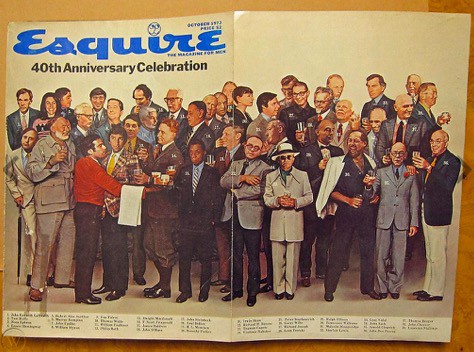
Nora Ephron, top row, second from the left; October 1973

At the end of Everything Is Copy, Jacob Bernstein’s insightful 2016 documentary about his mother’s life, there’s a clip of Nora Ephron discussing her final film, Julia & Julie, on Charlie Rose. She explains what the film is about — “Love” — but elaborates enthusiastically about the depiction of Julia Child’s “romantic marriage” to Paul Child. Of the relationship that plays out onscreen, Ephron says: “It’s a kind of marriage that actually exists. Thank god it does or people would accuse me of making this up! But there are guys who really do take enormous pleasure in their wives’ growth.” While her husband, Nick Pileggi, was reputedly one of those guys, her acknowledgement that these men are rare to the point of seeming fictitious exposes a dark truth about American culture, one we’re deeply invested in denying because it reflects so poorly on our national character. America is not teeming with well-adjusted men who encourage, let alone facilitate, the success of women. [Translation: If you can’t comfortably call yourself a feminist, dude, you’re a major part of the problem.]

There’s a fuse burning throughout Everything is Copy. Nora Ephron is gone but she feels alive for the duration of the film. This is not, as some reviewers opined, because of her work. Nor is it because she’s living on through her talented friends and family, although they shoulder her legacy beautifully. Ephron feels alive because she externalized her thinking process throughout her career. She performed self-reflection. It’s impossible to hear her words or watch her interviews without being drawn centripetally to the very moment she was in. We are all with Nora, processing, now, and almost always that means we’re processing a relationship, real or imagined, and parsing the exquisite differences between women and men from the point of view of an intelligent, outspoken woman. That Ephron was thorny and honest made her observations liberating; that she was an unabashed romantic made her absolutely inspiring.

In 2020, the internet is a broken faucet streaming endless first-person tales, but in 1982 there were exponentially fewer of these, and what was in print came almost entirely from men. In that moment, Ephron’s novel Heartburn, a lightly fictionalized tragicomic chronicle of her marriage to and divorce from famed journalist Carl Bernstein, was the ideal earthquake to rattle established norms. Ephron’s irreverent tone made a mockery of the unspoken rules that dictated how women should and shouldn’t behave when cheated on. Ephron was the wronged party, but she had a formidable voice that equaled Bernstein’s, so she stepped up and took control of the narrative with bravado socially unbecoming for a woman but culturally celebrated in a man.

Ephron’s choice to lay bare the private details of her marriage and Bernstein’s cheating was a gift to women everywhere. Her refusal to quietly accept the terms of “cheated-on wife” and instead write humorously and honestly about her experiences marked a turning point in women’s perception of marriage. Ephron engineered national dialogue about infidelity and divorce, and later, after much litigious handwringing, she and Mike Nichols pressed the message home through the film adaptation of the book.

Her justified anger woke people up to the double standards women were forced to live by, and the artificially-imposed conflict women faced over whether they could get angry at being lied to, and how. In other words, Ephron facilitated the earliest “conscious uncoupling,” although a better term would be “honest divorce.”

Quite a lot of Everything is Copy is devoted to Heartburn. There are questions of morality — was it fair to Carl Bernstein to air his dirty laundry in a novel and, more importantly, was it healthy for their two children to witness a protracted public battle between their parents — both questions laid at Ephron’s feet, despite the transgression belonging entirely to Bernstein. Alongside this retelling, Nora’s sisters — Delia, Amy and Hallie — describe the troubled family life they endured growing up, their parents’ alcoholism, and their cheating father. Ephron’s younger sister Hallie astutely notes that it was cruel of their father to deny his womanizing to his wife and children because his transgressions would have explained their mother’s crazy behavior. He was gaslighting them all with lethal consequences. Their mother, Phoebe Ephron, an Oscar-nominated screenwriter, died at the age of 57 of cirrosis and an overdose of sleeping pills. On learning this, I wondered if, beneath the vindictiveness, Nora actually wrote the book not for her mother, nor for herself, but for her children.

Ephron was determined not to die of a broken heart as her mother had, but in the shadow of her mother’s example she couldn’t have known with certainty that she could pull off the impossible, even as she holed up at editor Robert Gottlieb’s home in New York and furiously wrote her fateful first novel. If grief overtook Ephron the way it overtook her mother, then at least her children would have a manuscript with answers. Even if the book never made it to print, even if it took decades for her message to reveal itself, I can’t think of a better way to explain lovesick humanity to your children than through humorous, incisive, self-deprecating fiction. While Heartburn was perceived entirely as Ephron’s revenge against her cheating husband, this one-note interpretation came from male-dominated media commentary. Heartburn was an incredible sacrifice of privacy for Ephron, too, as she opened herself up to public scrutiny. In my experience, this sort of act is really only done in fundamental pursuit of salvation.

Her choice bore out. Her book was a success. Her life restarted and she ascended to greater heights in love and career. Meanwhile, a photograph of Ephron standing with Bernstein on either side of their college-aged son testified to a positive outcome for their family, certainly more positive than the fate of her own parents. The Ephron-Bernstein divorce may have been acrimonious, and her writing seemingly vengeful, but the act of bringing her pain out into the open saved her, and served as a hopeful example to women everywhere who needed permission to save themselves.

For that reason, the moment I wanted from Carl Bernstein in Everything Is Copy was a posthumous thank you to Nora. Crazy, I know, but hear me out: I wanted him to express gratitude for her bravery during an uncertain time, with the wisdom of all that came after. Everyone in the film acknowledges how hard it was on Bernstein to be cuckolded, and you can literally see the shivers ripple through even her closest friends at the thought of standing in the spotlight of Ephron’s glare. He’s not short on sympathy. However, Bernstein’s no dummy. He knows that Ephron showed women another way to deal with the pain of betrayal, a way that claimed a happy ending as a rightful outcome for anyone who has been abandoned or deceived. He’s certainly capable of acknowledging that Nora’s survival was an immeasurably better outcome for their sons than a version of her mother’s descent into madness and alcoholism. To the extent that she saved herself, she also gave Bernstein a better future. In 2020, that message needs to come home to millions of women, and it can only be conveyed by self-assured, intelligent, feminist men. It’s time for men to finally get it. Otherwise, I’m afraid we’re looking at four more years of Donald Trump and the end of democracy as we know it.

The question Jacob Bernstein poses in the documentary is a strong one, namely did his mother ultimately agree with the mantra she inherited from her mother. Is everything copy? Ephron lived by this mantra. She built an amazing career out of it. But at the end of her life, she reversed course. She died very much as she lived, with immediacy. The second half of Everything Is Copy deals with NORA’S BETRAYAL OF US. For many of her friends, her decision to hide her grave illness is a psychic palm print that still stings the cheek. By holding everyone at bay until the very end, Ephron demanded real-time self-reflection from capable, if reticent, friends who had to process her loss without preparation or direction. Nora left without giving instructions. They had to move on without her help.

There’s so much to love about Nora Ephron that a posthumous documentary about her can be unflinchingly honest and leave the audience only loving her more. It’s a flawfest that one imagines Ephron would have loved and hated — loved for the juicy truths, and hated that they were solely about her; hated because she couldn’t edit or comment; hated, most of all, because she’s no longer here and no longer writing the story. That last part? I hate it, too. We all do.

Everything is Copy is available to stream everywhere.

Decorum Will Save Us, You Moron

Decorum Will Save Us, You Moron

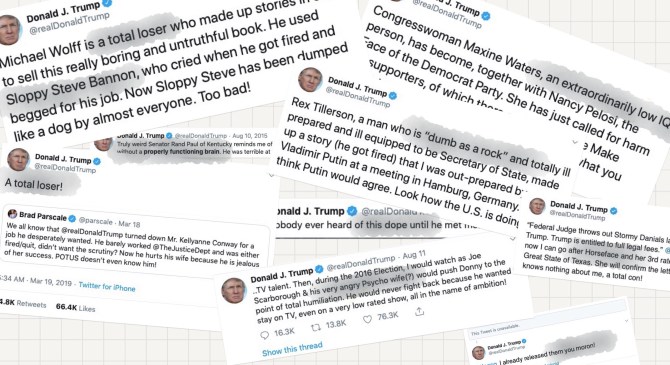
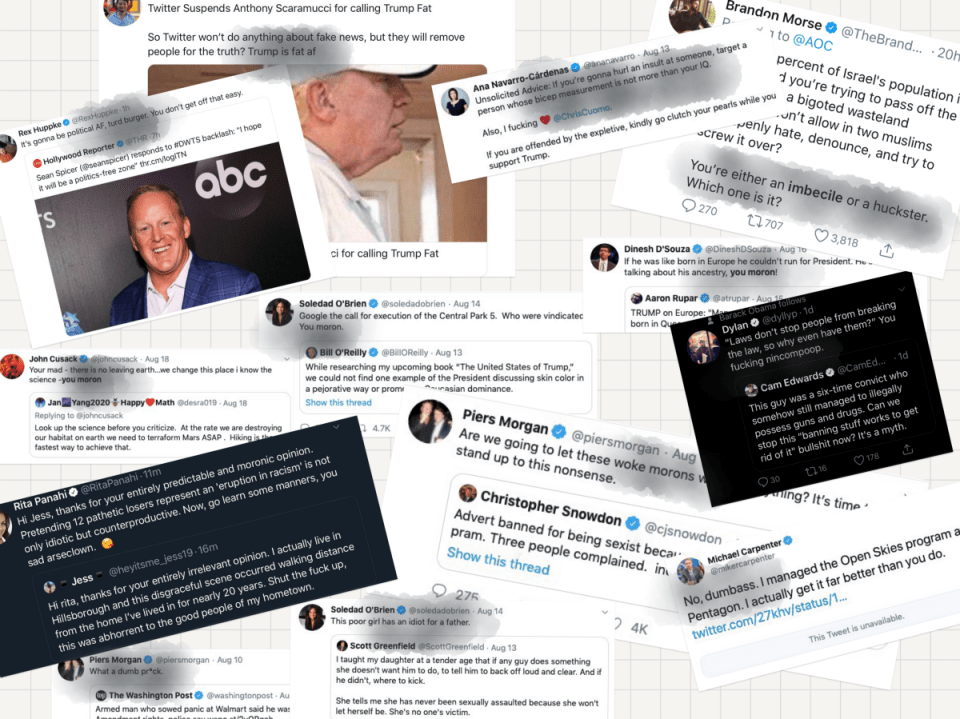
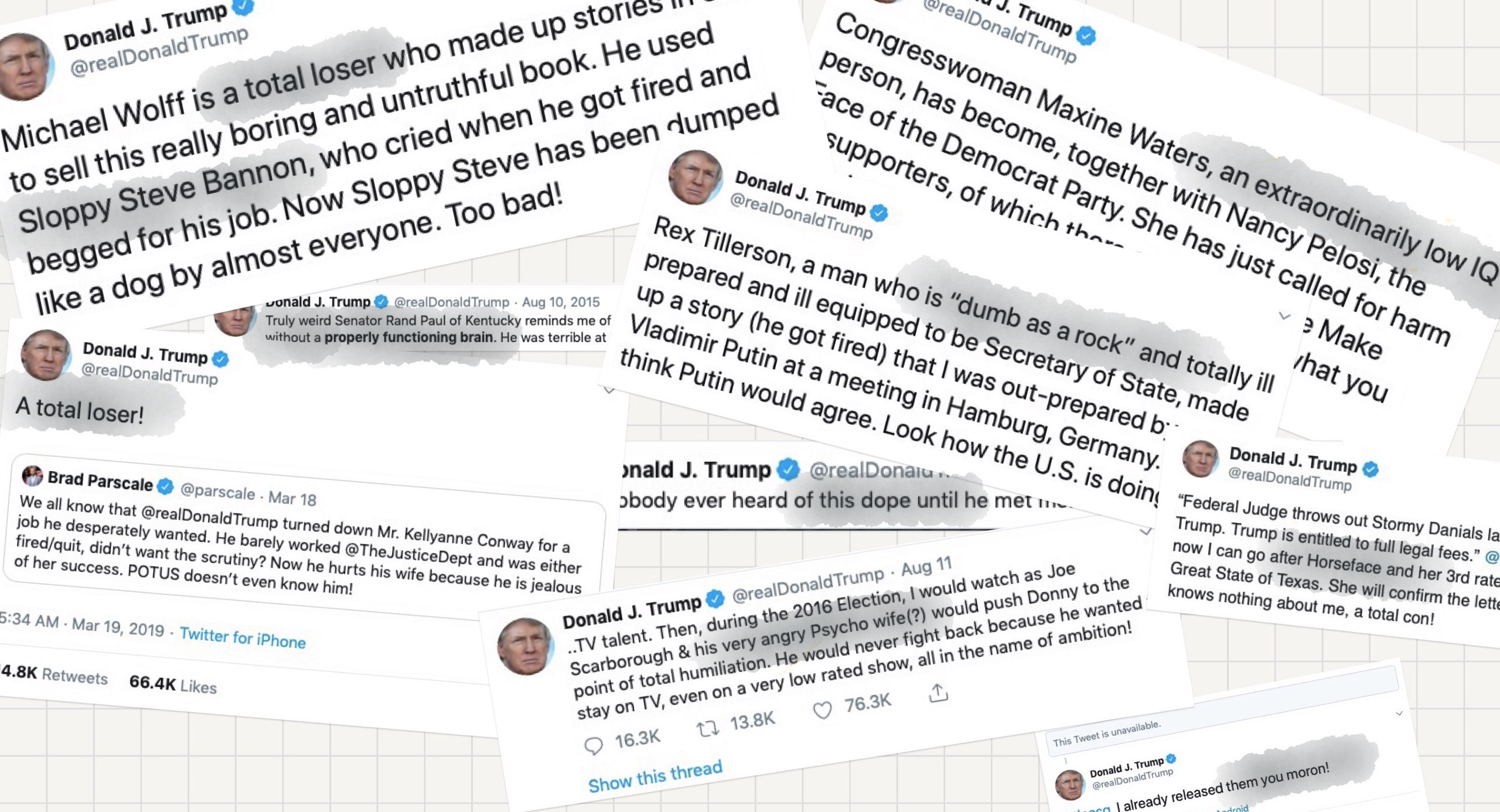
You’re a professional, you idiot. You’ve worked your entire adult life to achieve respect in the field of your choice and you were just getting used to seeing the term “expert” in your bio when the cataclysm-that-is-the-Internet came along and turned your dreams of contributing knowledge and insight to the progress of humanity into lowbrow waking nightmares. Now you spend your days online, which is to say that you’re physically somewhere in the world, everyone is somewhere, but your mind isn’t focused on your immediate surroundings, your walls, your floors, your children, you negligent imbecile. Instead, you’re emotionally elsewhere, pulsing thoughts with millions of other people’s thoughts, people who are equally there-but-not-there; people who’ve shown up, uninvited, just like you; people who’re anonymous and not of your choosing, who may or may not know things, and you engage them randomly depending on your mood and the scant remainder of your finite daily willpower, you unfathomably stupid jerk. You’re interacting with people you would never have crossed paths with if not for the internet, which would be a miracle and a blessing except that, day after day, hour after hour, they predominantly require you to correct their falsehoods and wrongheaded assumptions, and hold them accountable for their basest, most repellent prejudices, and you oblige them, you dumbass! You throw down facts and historical context, insights and morally sound thinking, but you don’t just leave it there, do you, you mindless cretin. No, you do what you never dreamed you’d do in all of those years of reputation-building that led to now: you publicly call a complete stranger an ass clown. In the absense of inspirational leadership and national identity, you cave, you schmuck, and sink to the lowest possible rung of human interaction, the rung where cruel, douchebag power mongers hang out. From down there, everything you shout into the ether sounds small, and less than, and angry, you worthless P.O.S. And all of the people who turn to you for expertise and role-modeling, they follow you down there because that’s where you’ve chosen to live, you slob. You’re leading alright! Leading millions of people down the drain, you weak, visionless, soft-brained piece of excrement.

If there was a shred of evidence, even a single study, that proved calling people morons and idiots and low I.Q. imbeciles had the effect of motivating them to reconsider their views, or bettered the lives of their victims, or just got them to plain shut-up, then your tweets would make perfect sense. You’d be a hero, you pathetic dope. Instead, time and again, the only reliable outcomes from insulting someone are fist-fights, exponentially more hate, and a swell of entitlement to the festering rage and alienation that sits pent up in all of us, ready to savage the next person who ticks us off and feel damn justified doing it. Well done! You did that! Way to be, you fetid piece of garbage.

Did it ever occur to you that the reason we need a police force is for the comparatively tiny number of people who can’t police themselves? That the vast majority of us choose not to break the law for the same reason we choose not to insult people — not because we’re masochists and we get off giving assholes a pass, but because we aspire to civility? Do you realize that anarchy is just one decision away? That what makes each of us better than the worst of our society is the ability to control our impulses, you deplorable reject? That you’re following the lead of the guy who separates kids from parents and holds them all in cages every time you call someone a moron, you stinking piece of trash? Did you stop just once to consider that no amount of fact-checking and moral-vetting matters if it’s accompanied by a black eye, you total, complete and utter dipshit?

What to do instead. Mmmm, I don’t know, jackass. Maybe climb back out of the sewer. Try deleting the insults and stick with the facts and perspective. It’s surprising how powerful the truth is when the messenger’s pre-teen angst isn’t butted up to it like a rapey locker room weasel. If someone says something so ridiculously stupid that you’re tempted to call them a name, take the high road instead, or zip it. Be a study in contrast. Don’t jump in the ring.

Meanwhile, if, deep down, you really do care about elevating public dialogue (and let’s be honest, that’s not too challenging these days, especially for you) then get creative. You’re an expert. You’re a role model. People are listening. React intelligently in the online space when someone behaves ignorantly or monstrously. You’re not an average joe who occasionally slips. You have a platform. Be accountable to it. People will amplify whatever you do, so set an example. Forget #BeBest. Just #BeBetter. Remember that person you wanted to be when you started out in life? #BeHer. #BeHim. #BeYou.

CORRECTION: The Apology Samantha Bee Should’ve Given

CORRECTION: The Apology Samantha Bee Should’ve Given

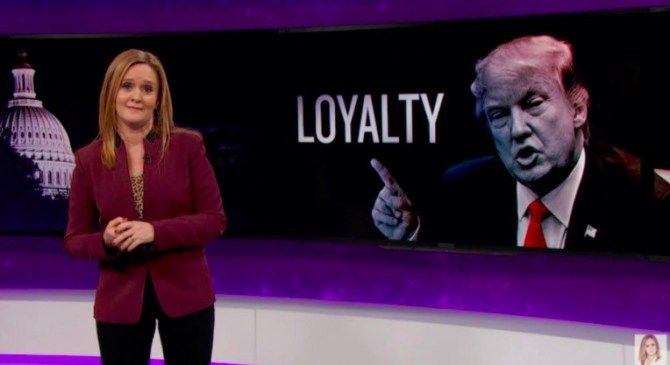
Good evening, I’m Samantha Bee,

Last week, I used the c-word, as I have many times before, but this time all hell broke loose. I understand why. In the past, I’ve used the c-word to demystify the preciousness of female anatomy, to reclaim the word by using it humorously. It’s not my favorite word and if I wrote the rules the world wouldn’t need to hear it at all, except perhaps as a term of endearment or a compliment. “Sweetheart, I love your cunt.” “Thank you, honey.”

But last week I was faced with a news report so inconceivable, so beyond my understanding of acceptable behavior on the part of my government, that it struck at the core of my identity as a mother, as an American, and as a human being. I can’t remember the last time I was so enraged.

*thinking*

Okay, I can. When we adopted a shih tzu and she refused to be house-trained. Wouldn’t crap outside. Just didn’t care. It was 18 months of finding dog crap in the living room, dog crap in the kitchen, dog crap in the bathroom… I finally realized “This dog is trying to break me, and it’s working.” I secretly started calling her Shitty Shih tzu, and then one day I was eating breakfast and she walked indoors, turned in a circle and took a crap right at my feet, then looked over her shoulder and kicked it back at me.

It was at that moment I had the urge to kick the dog. I know! I know. The urge, mind you, because I have never kicked a dog in my life and I would never kick a dog…unless it viciously attacked a child.

People might say “Sam, it sounds like you’re trying to draw some sort of analogy between a gut-level response to a dog attacking a child and…how is that similar to grown men physically removing a child from the arms of her mother and putting her in a cage or in a home with complete strangers, with no plan to reunite her with her mother? That’s not terrifying for the child the way…the way an attacking dog would be.” Okay.

Ivanka Trump is part of the White House staff. I have no idea what her title is. I’m not sure she knows. She has an office above her dad’s. Americans pay for it.

I also have no idea if Ivanka’s staff of political strategists are paid by the American government. She probably doesn’t know that either. But I assume they are on the government payroll because they were definitely working overtime last weekend to get their message out on her instagram account and, you know, the Trump family doesn’t have the best reputation when it comes to paying their workers. Would you work through the weekend if you thought you might not get paid?

Ivanka speaks to the president whenever she wants to, purportedly every day, and she travels abroad at the expense of American taxpayers to meet with foreign dignitaries on behalf of the American government. She is a highly recognizable face of the Trump administration. Which is to say: It’s Ivanka’s job to know what issues are in the news, what topics are important to the American people, and to doggedly promote her father’s policies when they have a PR crisis. She knows what she’s doing when she posts a picture of her child laughing, safe and happy on a weekend when people were outraged to learn about children being separated from their parents by American authorities at our borders. She was sending a political message. The left is worked up over nothing. We take good care of our kids. See?

To Ivanka, her staff, and the president, I am sorry I used the c-word publicly, in anger. It brought me down to your level. However, you should know that many of us….many, many, MANY of us…continue to use all kinds of unsavory words in private, because only a gutless, heartless, cynical nightmare of a human being would post that picture while American border agents are taking children away from their parents. Your immigration policy is revolting, and I speak for many Americans when I say: We don’t condone these practices. Find a different solution. That’s your job.

And to Ivanka, mother to mother, I say: Be a moral leader on this issue, honey, not a maniacal shih tzu.

Connecting the Dots

Connecting the Dots

Al Gore’s Inconvenient Sequel

Activist Heather Heyer said, “If you you’re not outraged, you’re not paying attention.” Incredibly, it took her murder in a public space in broad daylight to make people pay attention to organized American white nationalists. Even then, her death wasn’t sufficient to galvanize substantive action on domestic terror. The president’s refusal to condemn her killers became the focus of the news cycle, thus shifting the public’s outrage away from a dire national threat, and proving once again that motivated people are easily immobilized without the guidance of a good, well-informed leader.

The Inconvenient Sequel to An Inconvenient Truth doesn’t mention the alt-right or white supremacy, but two centuries of white Western economic dominance over the world has certainly left its mark. While “the West” includes a diverse mix of races, it is white men who led the charge of industrialization and technological advancement with devastating environmental consequences. The deeply upsetting conversation about the environmental crisis often glosses over the fact that older wealthy white men would have to give up substantial economic gains in order to lead a course-correction for the entire planet. Instead, the powerful few are pitted against millions who will be adversely affected by climate change for generations to come and they are using their limitless resources to disinform the world and downplay the dangers.

The images of melting glaciers and floods throughout An Inconvenient Sequel are disturbing, but to an informed viewer the most panic-inducing sections of the movie should be the round table negotiations between world leaders. The magnitude of political star power that shows up for working-level environmental policy meetings is alarming. While the agreement reached at the 2016 UN Climate Change Conference is presented in the film as a triumph, it should strike fear into the hearts of every global citizen. The unprecedented cooperation which occurred to make that agreement happen is damning evidence that we’re facing an imminent existential threat.

Al Gore is no longer a controversial figure. His presence is almost Christ-like now. He’s a mouthpiece for the planet, a voice for millions of people who have no political power in the face of this unfolding man-made catastrophe. Gore doesn’t do much explaining in this film. We simply follow him around the world and watch how he responds to questions about what’s happening. He looks fatigued and worried. He speaks in short bursts of truth. No one has a justification for ignoring reality that he can’t refute in a few words. When Christiana Figueres, Secretariat of the UNFCCC, entreats him to bring India — the 1.3 billion people of India — on board with the Paris Accords, Gore makes a phone call to the CEO of SolarCity and an economic carrot materializes. The urgency of our situation is evident in the staggeringly short distance between nightmare and hope, that distance being the reach of one man, Gore.

Figueres closes the Paris climate conference with an announcement that 194 countries signed the Paris Agreement. The jubilation onscreen is heartbreaking in light of what we now know will follow — an alt-right sympathizer will take power in the White House. He will refuse to acknowledge the global cooperation and sacrifice needed to save the planet. He will withdraw America from the Paris Agreement and derail our best hope of reversing climate change, thus exhibiting the hallmark decision-making of denialism and white American exceptionalism.

Gore says American democracy has been “hacked” by corporations. He’s adamant that the government is not acting in the best interests of the people. Given his personal and very public journey to bring climate change to light, there’s no reason to doubt him. He asks viewers to “connect the dots” but in truth he has connected them for us. All we need to do is watch the film and let that truth wash over us.

An Inconvenient Sequel is in theaters now.

Legislate the Internet, Don’t Rewrite It

Legislate the Internet, Don’t Rewrite It

George F. Cram (1842–1928) — Cram’s Unrivaled Family Atlas of the World, Chicago IL. Lithograph color print. Diagram of the Principal High Buildings of the Old World

A response to Walter Isaacson’s “How To Fix The Internet” (The Atlantic.)

In an article published in The Atlantic this week, Walter Isaacson laid out his vision for “how to fix the internet.” The problem, he says, is Trolls. Bugs. Lack of tracking. He believes anonymity has “poisoned civil discourse, enabled hacking, permitted cyberbullying and made email a risk.” His solution is to do away with anonymity, thereby offering himself as the mouthpiece for every Silicon Valley titan with deep pockets and a hunger for data.

I’ve written on how we civilize technology before, on the challenges we face with each shift forward in technology, whether it’s ships, trains, radio transmitters or nuclear energy. The trajectory involves a series of near-misses while we get the hang of our shiny new toy. When cars were first invented there were no laws to govern driving. As cars proliferated, accidents increased. Now we legislate everything about car and road safety, down to the driver’s decision to wear a seatbelt. There are fines for not wearing one. If the trouble with internet technology is bad behavior why not address the behavior?

What Isaacson skims over in his trolling lament is that the worst trolls on the internet are the very people he thinks should solve the trolling problem. Huge media companies like Facebook shamelessly collect their users’ data and sell it. Anonymity is not permitted on Facebook because the company can’t use you, can’t parse your information into demographics and ad bins, if they don’t know who you are. Similarly, the “trust” relationship built into place by search engines like Google is merely a handshake agreement that the company won’t “be evil.” That doesn’t mean Google deletes your search history. As we saw in the 2016 election, “evil” is a word that’s up for interpretation in our society. We, as users of Google, don’t know who is deciding what’s evil at any given time. Isaacson wants users to lose anonymity but notably makes no mention of tech companies and their addiction to opacity. In Isaacson’s future world, users are the biggest losers.

Isaacson offers logical suggestions for what a safe internet might include but how he gets there is the sales pitch of the century. Certainly, it’s important to institute payment for work. We don’t need a new internet for that. I’ve been pitching companies like Medium on this concept for years. “Find a way to pay your writers, even one cent per read, and you will revolutionize the publishing industry.” “A pay model is the only way forward to maintain the integrity of what is published and read.” Medium could institute a pay-model today. What Isaacson misses is that companies and sites most users rely on for information offer their services for free so that they can take whatever consumer data they want in return. The internet hasn’t evolved naturally into a pay model because the people currently making big bucks off of internet technology are also in charge of its design. There are no checks and balances built into the governing of the internet. This does not mean we do away with internet privacy. It means we legislate it.

To revolutionize the internet, the Googles and Facebooks would have to become industry-leading pay-model services. In a pay-model service, user-consumers would lose anonymity to the company offering the service (via their credit card), but maintain privacy in whatever further capacity they wished while using the service. It would be no different than walking into a Starbucks and ordering a latte. Give the barrista your own name or someone else’s, pay with cash or credit, hide your face behind sunglasses or don’t…at the end of the day, you’re physically standing in the store and someone can deal with you if you cause a disturbance. As long as you’re a peaceful coffee drinker you still have agency to determine your level of privacy. The same is true of a paying customer online.

Finally, and this is perhaps the most important omission in Isaacson’s piece, there is presently a massive power struggle underway between government and technology elites — specific, powerful individuals within broader industries. Both groups are greedy for data. One group wants to retard technology in order to maintain control over its electorate. The other group wants to advance technology so fast it will maintain control over its creations and, by extension, its users. The electorate and users are one in the same. The bad seeds among us exist whether anonymity is built into the internet or not. They exist in government, they exist in boardrooms and they exist in chatrooms. It is persistant abuses of power which promote toxicity. Unless government and technology elites find a way to work together for the betterment of society as a whole, that toxicity will continue no matter what internet protocols are put in place.

Tribeca, Vaxxed, and Credibility

Tribeca, Vaxxed, and Credibility

The fundamental growing pain of the Information Age is distrust.

I don’t want medical information from Del Bigtree, producer of Vaxxed and a former producer for the Dr. Phil-created show The Doctors. Sadly, millions of Americans listen to people like Bigtree because faux medical shows run on free television and are endorsed by celebrities like Oprah. For this reason, Vaxxed must be addressed.

I also don’t want medical information from ABC News after listening to the questions posed to Bigtree by their segment reporter during their unedited 10-minute interview prior to releasing Vaxxed. She asked general rather than science-based questions and subsequently ran a piece focusing on celebrity-non-medical-professional Robert De Niro. Sadly, millions more Americans get their medical information from ratings-chasing sources such as these.

The confluence of too much information and a massive shift in newspaper revenue streams means many journalists have cut the corner of agnosticism and taken the shortcut to opinion. Opinions sell faster and better than impartial news because they provide an extra service. The public is overwhelmed by the sheer scope of information out there. The layperson’s response to information overload has been to confer trust on opinionated individuals in the media, whether those individuals have any expertise or credentials or not. (Dr. Phil has a masters degree in experimental psychology. Millions of people are unwittingly participating in his experiments.)

The underlying problem is this: Everything Del Bigtree says in his interview about the way our institutions are supposed to work is correct. His logic about our broken system lends disproportionate weight to his unrelated thoughts about vaccines. Donald Trump is presently enjoying the same path to success. People are habituated to follow the breadcrumbs of rational-sounding speakers, even if their only rational thoughts are to voice obvious grievances. However, it no longer goes without saying — just because people are right about the way the system is broken doesn’t make them right about anything else.

Our refusal as a society to properly fund journalism by embracing “free” information on the internet is directly responsible for proliferating misinformation.

Distrust of our institutions has ultimately fostered an environment where people distrust professionals. The majority of us are not doctors, haven’t attended medical school, and therefore rely on trained doctors for good/best information. When trust in that system breaks down, the next line of defense is journalism. When trust in that system breaks down, whistleblowers come forward. When trust in whisteblowers breaks down, you have millions of people basing important medical decisions on uneducated readings of partial and/or decontextualized information online or on television. In the case of vaccines, this creates unnecessary dangers and has already lead to unnecessary deaths.

To be extra clear: shaming people for their refusal to vaccinate is profoundly unhelpful. Shaming people for looking for explanations and answers…also profoundly unhelpful. Shaming people for blatantly not doing their jobs is completely acceptable.

To that end, I’d like to publicly shame the writers at mainstream media outlets who pressured the Tribeca Film Festival to pull Vaxxed from their line-up, not because I think the film has an ounce of validity (…how could I know? I haven’t seen it…), but because we have a problem with people not vaccinating their children. When film critics and science writers suppress a film that illustrates a real problem, namely broken trust in our institutions, they feed the narrative on both sides of the vaccine issue (Andrew Wakefield’s a quack/Andrew Wakefield’s being suppressed) and perpetuate a serious problem. A journalist’s job is to convey the necessary facts in order to resolve the issue. When journalists publicly decline to see a film AND assert it is quackery, they squander what little trust remains in the institution of reportage.

If the answer to our vaccine problem is as simple as debunking a quack doctor, then journalists should sit through a two-hour movie, wade through the information yet again, debunk the father of this misinformation and demonstrate to a skittish public that no stone has been left unturned. Journalists should do this not because Vaxxed has any validity, but because anti-vaxxers think it does, and those people are not vaccinating their children. The number of people who will see Vaxxed is negligible compared to the millions of people who will read a widely shared takedown piece. The stronger the case science journalists and film reviewers make against a film like Vaxxed, the sooner this issue will be resolved.

If journalists can’t make a strong enough case for this problem to be resolved — and I doubt they can because the task is too big; a “strong enough” case today entails renewing people’s trust in the entire healthcare system. We’re that far down the path of suspicion — then the issue should continue to be treated with skepticism while a second case is made for the public to accept and weigh the alternatives: potential return of deadly disease versus potential vaccine-autism links. There is no third option at present. “Waiting” for a different vaccine is equivalent to not vaccinating and carries consequences. You vaccinate or you don’t. Personally, I encourage people to do as much investigation of the diseases they aren’t vaccinating against as they do of the vaccines. That precious airtime spent looking at Robert De Niro’s headshot should be filled with information on what happens when we don’t prevent preventable diseases. (I expect he would agree.)

This issue will continue to worsen until we respectfully acknowledge that people’s trust in their institutions is broken, and behave accordingly. Yelling at people to trust something never works. The vaccine debate, like so many debates cropping up across the country, came about due to systemic distrust. The way forward is for institutions to demonstrate their trustworthiness, not their disdain, and to give the public a free, considered, informed alternative to Dr. Phil and his ilk.

The Information Game

The Information Game

…or How to Think About Cyber

There’s a gut-wrenching scene at the climax of the World War II biopic The Imitation Game. Alan Turing and the codebreakers at Bletchley Park decrypt a German cable and suddenly they know the enemy’s plan to attack Allied ships and, incredibly, all attacks for the foreseeable future. Their celebration is short-lived. Turing grasps the ephemeral nature of their discovery and has a sickening epiphany: To win the war they can’t tip off the Germans that they’ve decoded Enigma. Instead they must simulate ignorance by choosing strategic victories and sacrificing the rest of their men. Panic sets in. One of the codebreakers has a brother serving aboard a targeted convoy. He begs his colleagues to use what they know to spare his brother’s life but Turing is resolved. Their secret must be concealed at the highest cost. The ensuing choices haunted the intelligence community long after the war was won.

Over the last 14 years, Americans have been conscripted into an information war. Individual privacy is now incidental to the objectives of government and technocratic elites, and vulnerable to the exploits of criminals and extremists. The battle for control over the digital space is a gloves off, civil-liberties-be-damned free-for-all. To reestablish trust in our oldest institutions it’s necessary to parse the steps that led to the present situation and decrypt the objectives of contemporary leaders and policymakers.

RED FLAGS

Nearly 100 years after Nazism flourished in Germany, the question is still asked with incredulity: Why did German citizens permit and participate in genocide? There will never be a satisfactory answer to the moral question of why, but there is a clear beginning in the circumstances of how. The rise of fascism in post-World War I Europe began with a confluence of domestic troubles in Italy: a financial crisis, concomitant economic hardship, grief over millions of Italian war casualties, widespread dissatisfaction with political parties that failed to deliver on promises, and a perceived threat to financial security from a foreign (Communist) ideology.

Onto this stage stepped Benito Mussolini, a staunch nationalist and war veteran whose preoccupation with violence inspired the formation of an army of uniformed “Blackshirts” — unemployed youth, funded by the middle and upper classes, who assassinated opposition leaders, suppressed and destroyed opposition newspapers, and eventually marched on the capital to take power in 1924. “A Brief History of the Western World” summarizes Italian fascism thus:

“In the beginning, as Mussolini himself admitted, [fascism] was largely a negative movement: against liberalism, democracy, rationalism, socialism, and pacifism…[Italians] had been cast adrift, let down by failed hopes of progress and happiness. Faceless in a mass society, they also felt alienated from themselves. The Fascists found an answer to this emptiness by arousing extreme nationalism….The fascist myth rejected the liberal reliance on reason and replaced it with a mystical faith. Stridently anti-intellectual, it held that the “new order” would spring from the conviction of the “heart.” Fascists therefore looked upon intellectuals as…suspicious characters…. Most ordinary Italians accepted Fascism with enthusiasm. The individual who formerly felt alone and unneeded, enjoyed a new sense of “belonging.”

The rise of fascism in Italy took less than six years from invention to political dominance. Fostered by comparable conditions in neighboring countries, the ideology spread across Europe and fatefully intersected with the political ascent of Adolf Hitler in Germany. The Germans have a word for Hitler’s rise to Fuehrer: machtergreifung — macht, meaning power, and ergreifen, to grab or seize. Like Mussolini, Hitler headed up a violent army of unemployed youth and committed illegal acts to dissuade and undermine his opponents, but it was the power vacuum created by ineffective German leadership that paved the way for the Third Reich and Nazism.

*

Flag of the Soviet Union

A second world war and one Pax Americana later the world was pumped with Cold War adrenalin. In 1962, nuclear superpowers bumbled their way into a stand-off and lucked their way out of the unthinkable during thirteen days of diplomatic posturing over Cuba. The rapid advancement of nuclear technology meant there was no room for error, yet error upon error was made. In effect, American leadership failed the test but passed the class. America and Russia skated by on their shared basic values, but the crisis taught no lessons on how to face an adversary with profoundly different goals, specifically those rooted in tribal conflict and revenge.

In the aftermath of America’s nuclear showdown, political theorist Graham Allison published his seminal work “Conceptual Models and the Cuban Missile Crisis.” It would form the foundation of American foreign policy. Allison defined three distinct methods for understanding policy outcomes: The rational policy model (foreign governments behave rationally in relation to their goals), the organizational-process model (the military typically wants X, the bureaucracy typically wants Y, and historically they have n relationship to each other so the outcome will predictably be z), and the bureaucratic politics model, where shapeshifting factors such as interpersonal conflicts, bureaucratic inertia, and availability of resources act on each other to influence foreign policy outcomes. Government elites strongly favored the bureaucratic model as conventional wisdom that would shape American foreign policy for decades to come.

Political theorist Stephen Krasner reassessed Allison’s models, first in 1972, and later at the height of the “first” Cold War. He was troubled that President Kennedy, subcabinet members, and scholars from top public policy programs in the 1960s wholly adopted the bureaucratic approach, where outcomes were viewed as an evolving compromise of inputs. Krasner identified the fundamental flaw in the model as giving elite decision-makers a blanket excuse for their failures. Specifically, he reframed bureaucratic-politics thinking as a biased framework for blaming policy errors on the “self-serving interests of the permanent government,” where elected officials were viewed as powerless to corral the government “machine.” He summarized the infinite loop of accountability thus:

Bureaucracy is a machine, and “[machines] cannot be held responsible for what they do, nor can the men caught in their workings.”

This is a stunning double entendre for the Information Age.


DIGITAL DICTATORSHIP AND WARRING ELITES

Rights and privacy are dictated by an elite group of decision makers who control the laws (Government) and the digital infrastructure (Technocracy.) Internet usage and hardware purchases now constitute a “vote.” Government and technology sectors each employ 1% (3–4 million people) of the American population. The percentage of top-level decision-makers, technicians and analysts within those fields is assumed to be less than .01% of the American public and is therefore elite. Technocratic elite lumps Anonymous hackers in with tech CEOs, and government elite includes members of all branches of government and political influencers with monetary or legislative sway. Since both elites invest billions of dollars successfully marketing themselves to society, the benefits they provide are widely known and will not be discussed here. Instead, the focus is the encrypted cost of advancement. Decoding the costs reveals which services and policies are truly beneficial, and to whom.

*

The Technocracy

The history of the government’s relationship with computer technology is long and complicated. Perhaps only one fact is universally accepted: Al Gore did not invent the internet. Contrary to popular folklore, he never claimed to invent the internet. Gore’s words were twisted, the transcripts are widely available and he was subsequently defended by two of the “fathers of the internet” as deserving “significant credit for his early recognition of the importance of what has become the Internet.” The urban legend illustrates the strange paradox of the Age of Information. Even with unprecedented access to the truth, millions of people are often misinformed.

Internet development began in the 1960s, became its broadly used iteration in the mid-1970s, was commercialized through the 1980s and came into its own in the early 1990s with the introduction of the World Wide Web, the universally accepted infrastructure for data exchange on the internet. Web engineering is credited to Tim Berners-Lee’s 1989 proposal at CERN. It was developed over the next few years and made free to the public in 1993. Anecdotally, this snippet enumerating current issues confronting global governing bodies from the then-definitive International Law Anthology reveals the digitally unsophisticated world that received this new technology:

Global Communications: The earliest topics in this burgeoning field were international postal services and the laying of submarine cables. The invention of radio, television, and facsimile and modem communications technology, have led to explosive growth in this area of international regulation. Jamming and counter-jamming of another nation’s radio wave frequencies, channel regulation, remote sensing, and stationary satellite transmission are matters of intense interest. There is a move toward international broadcast standards and transmission quality. But there are also countervailing pressures against freedom of information, with some nations (and religious groups) desiring the suppression of international telecommunications relating to the advocacy of war or revolution, criticism of governmental officials or policies, regulation of commercial messages, and materials depicting real or fictional violence or pornography. — Anthony D’Amato, “Domains of International Law,” International Law Anthology

It reads like a mid-century newspaper clipping but that passage was published in 1994. Bill Clinton was president.

Twenty years later, Laura Poitras’s Oscar-winning documentary CITIZENFOUR is more than an exceptional historical record. The film is also a primer for technocratic culture and ideology. In June, 2013, after months of anonymous communications, National Security Agency contractor Edward Snowden sat down face-to-face with Poitras and The Guardian journalist Glenn Greenwald in a Hong Kong hotel room. Snowden spoke eloquently and fluently about the values at the root of his dangerous undertaking to leak classified documents detailing secret surveillance programs run by the United States government.

From CITIZENFOUR:

Glenn Greenwald: So, why did you decide to do what you’ve done?

Edward Snowden: For me, it all comes down to state power against the people’s ability to meaningfully oppose that power. I’m sitting there every day getting paid to design methods to amplify that state power. And I’m realizing that if the policy switches that are the only thing that restrain these states were changed you couldn’t meaningfully oppose these. You would have to be the most incredibly sophisticated technical actor in existence. I’m not sure there’s anybody, no matter how gifted you are, who could oppose all of the offices and all of the bright people, even all of the mediocre people out there with all of the tools and all of their capabilities. And as I saw the promise of the Obama Administration be betrayed and walked away from and, in fact, actually advance the things that had been promised to be curtailed and reined in and dialed back, actually got worse. Particularly drone strikes…That really hardened me to action.

GG: If your self interest is to live in a world in which there is maximum privacy, doing something that could put you in prison in which your privacy is completely destroyed as sort of the antithesis of that, how did you reach the point where that was a worthwhile calculation for you?

ES: I remember what the internet was like before it was being watched and there has never been anything in the history of man that’s like it. You could have children from one part of the world having an equal discussion where they were granted the same respect for their ideas in conversation with experts in the field from another part of the world on any topic anywhere any time all the time, and it was free and unrestrained and we’ve seen the chilling of that, the cooling of that, the changing of that model toward something in which people self-police their own views and they literally make jokes about ending up on “the list” if they donate to a political cause or if they say something in a discussion. It’s become an expectation that we’re being watched. Many people I’ve talked to have mentioned that they’re careful about what they type into search engines because they know it’s being recorded and that limits the boundaries of their intellectual exploration. I’m more willing to risk imprisonment, or any other negative outcome personally than I am willing to risk the curtailment of my intellectual freedom, and that of those around me whom I care for equally as I do for myself. Again, that’s not to say that I’m self-sacrificing because I feel good in my human experience to know that I can contribute to the good of others.

[transcription from video]

It’s striking that Snowden didn’t say privacy in his mission statement. Greenwald framed the debate with the question many of us would ask after hearing that we’re being surveilled, and subsequent news reports by outlets across the globe widely referred to “privacy.” It’s unclear whether Greenwald and Poitras heard more of Snowden’s thoughts where he raised the issue of privacy himself, but he doesn’t say the word. He advocated an unmonitored internet from the vantage point of someone who is highly skilled at protecting his own privacy. He recollected the realization, at his NSA desk, that before too long he — a member of the tech elite — would be technologically outpaced and unable to protect his privacy. The technocracy was losing ground to the government.

Society owes Edward Snowden an enormous debt for his decision to blow the whistle on the NSA at great personal risk. To be clear: he enabled a profoundly necessary conversation to begin. However, his poetic description of the unrestrained nature of intellectual advancement is technocratic rhetoric for a digital utopia that never existed. As compelling and passionate as he is, Snowden made several incorrect assertions that should be dispelled in the interest of productive discussion.

First, there have been many inventions in the history of man like the internet, including the space shuttle, the airplane, the telephone, or the galleon, all of which brought people together across vast distances at previously unmatched speeds to have discussions and exchange knowledge. Mankind went through periods of adjustment to those profound changes in infrastructure and we will navigate this one as well. Innovation is not unprecedented. This invention will mature beyond its makers and it must assimilate to the needs of civilization, not the other way around.

Second, the children can still spend their days online talking to experts as equals if they want to (though it’s doubtful they do.) Invoking chilled children and cooled innocence is misleading rhetoric when it’s primarily adults who spend their time staring at a screen. Further, the tech industry pushes expensive gadgets and software for kids but, as highlighted by the New York Times’ “Steve Jobs Was a Low-Tech Parent,” many technocrats strictly limit gadget exposure for their own families because they’re aware of the harmful effects of internet and technology use on young minds. Teenage youth are a more complicated issue with regard to internet freedom, which is especially clear in the case of ISIL’s recruiting techniques, but Snowden wasn’t referring to Muslim children discussing ideas with expert terrorists across the globe. He wasn’t lamenting privacy incursions on thugs. In fact, he didn’t acknowledge the grey areas of internet freedom at all.

The most important falsehood in Snowden’s statement, and the core message of the technocratic ideology, is that the internet was once and should always be free. This is a seductive idea, especially to people with good computing skills and entrepreneurial leanings, but it is patently untrue. Getting online requires expensive hardware and infrastructure that is designed and sold by the same community that dominates the internet through technical expertise.

For the last 20 years the technology industry has hard-sold hardware to citizens, corporations and governments alike along with software that seamlessly replaced or supplanted infrastructure for everything from financial transactions and brick-and-mortar stores to research and even face-to-face meetings. The technocracy orchestrated one of the greatest heists in history by amassing “free” content from writers and established media publications trying to maintain their brands with a millennial generation that wasn’t taught to pay people for their time, research, and intellectual work. As a final insult to “freedom,” tech companies undertook the systematic repackaging of users’ private information as data useful for advertizing, which they bundle and sell to whoever they choose at a profit. (The word “user” rather than “customer” has always implied a barter arrangement, but it is rarely spelled out exactly what is being given and gotten. You open a social media account once, perhaps only use it for an hour or a day, but the service provider owns your personal information forever and can sell it many times over.)

In 2015, Apple, Microsoft, Google, IBM and Samsung have risen to the top ten of Forbes’ World’s Most Valuable Brands, and 11 more technology companies are in the top 100. Six of the world’s 20 richest billionaires are computer technology elite. All of that free internet has paid for mansions and private educations. There’s nothing wrong with companies and people making money off of this invention — America is a proudly capitalist society — but perpetuating myths about intellectual freedom and raging against government misuse of personal data is hypocritical and misleading.

If it appears I’ve misinterpreted Snowden’s meaning entirely, breathe easy. It’s clear that Snowden’s “free internet” refers to freedom of thought, communication and information, not freedom of goods and services. However, the cyber conversation can’t bifurcate those billions of dollars from the billions of devices and trillions of gigabytes of data. Doing so hides the massively lucrative business objectives behind fun, sometimes addictive, products. If technocrats truly want a free, unrestrained internet they’re now rich enough to forgo that pile of money, make cheap hardware, set chaos-legitimizing rules (First Rule of Internet: There are no rules) and enforce the entropy. I doubt they’d have billions of takers and no one would be typing their credit card number into a chaos box.

*

Screenshot from the Department of Justice website

The Government

Spying, surveillance and covert activity have always been part of America’s security and defense apparatus; that activity just wasn’t legal. Illegality was at the heart of clandestine work, making it extremely risky and therefore far more considered by those commissioning it and those undertaking it. The legalization of amoral behavior came about in the weeks after 9/11 because, ostensibly, the president and his cabinet wanted the freedom to openly plan illegal activity without fear of legal repercussions. The PATRIOT Act inoculated government officials from risk and, many would say, ethical pause. What followed was a confident, unrisky expansion of intelligence infrastructure with no heeded supervision or endgame.

A nation that was once gripped by the unraveling of Richard Nixon now shrugs off revelations of CIA agents breaking into Senate Intelligence Committee computers in 2014. Government workers have spied on elected officials before, but today the public digests these incidents with a vague assumption that all criminal behavior by the government has a footnoted legal justification somewhere. These stories translate as infighting among elites. Fourteen years of the Patriot Act have conditioned Americans to expel what little outrage they can muster in a matter of days and then go limp. The groups taking legal action against injustices are typically news or special interest organizations with a financial or moral dog in the fight and powerful legal teams to back them. (The latest New York Times op-ed piece from Wikipedia’s Jimmy Wales and the AP’s lawsuit against Hillary Clinton are two cases in 2015 alone.) Even with funded legal representation, there’s a pervasive sense that their effort is futile. For all of the flagrant rights abuses, the government’s tracks are papered over by the PATRIOT Act.

One way to step off the merry-go-round is to take a page from Alan Turing’s estimable problem-solving approach and look at what isn’t happening in our every day lives. Government elites have made several huge assumptions on our behalf and, in light of Edward Snowden’s unspooling NSA leaks, it’s worth revisiting their decisions after seeing the results. The government uses negative hypotheses to great effect (if we don’t renew the PATRIOT Act…) and so can the people whose rights are in the balance.

What isn’t being done with NSA-collected data?

Potentially, the important stuff. Through indiscriminate data-collection, the NSA is extensively aware of wrongdoing by the American people, corporations, government agencies and officials. We don’t need Edward Snowden’s evidence to know this is true. Daily news stories show that digital communications include sexually harassing emails in the workplace, threats of murder or violence, faxed paper trails of embezzlement, proof of premeditated theft, telephonic recordings of gender and race discrimination, and documented personal indiscretions by public officials. The American government inadvertently nets evidence to myriad criminal acts, both domestic and foreign. It then employs people to sift through these stores looking for some lawbreakers, but not others. When intelligence officers stumble upon criminal or threatening activity that doesn’t serve their objectives do they look the other way to conceal their methods? It’s conceivable and probable that actual lives have been lost to inaction rooted in concealment. What happens in situations like these? What do the numbers look like on paper — lives lost or ruined versus casualties from terrorist attacks. The legal ramifications are mind-boggling but the ethical question is straightforward: Is a government obligated to protect its people or its objectives?

What else isn’t being done with NSA surveillance data? For all of their time spent sweating over Apple’s Xcode, the U.S. government didn’t stop the Tsarnaev brothers, the French government didn’t stop the Charlie Hebdo murderers, and the U.K. government isn’t stopping thousands of teenagers from leaving the country, unaccompanied, to join ISIL. Most disturbing was the story of three teenaged girls who left the U.K. in February and may have been aided by a western spy in transit, forcing us to question why governments aren’t helping their most vulnerable citizens return to safety (and whether they may be using them as unsuspecting spy assets instead.) With the Snowden data we have proof that our individual rights, and lives, are considered a worthy sacrifice to what the government deems “the greater good.” When spy agencies might be risking the lives of teenagers in the name of future terrorist attack victims, it’s clear government objectives no longer align with the values of the citizens they work for.

What if we don’t have the internet?

When Lindsey Graham weighed in on Hillary Clinton’s email debacle on Meet the Press with an I’ve-never-sent-an-email statement, he pumped a figurative fist of defiance. He’s a loud, proud Luddite in the new millennium. However, ask him where he does his banking, whether he gets money from the ATM, uses a cellphone, watches cable television, or has ever read the news online and he’ll be forced to admit he’s got a digital footprint. His televised statement gives him credibility with the anti-technology demo, the people who are done with all the smart talk and just want to love America with all of their hearts [see: Fascism, precursor to]. The only people alive today who aren’t consciously reliant on cyber technology are toddlers. The rest of the modern world communicates regularly online and is increasingly aware that public officials lack cyber expertise.

But what if we did live in Lindsey Graham’s la-la-land and didn’t have a digital footprint? A world without the internet is inconceivable today, but that world existed only two decades ago. In that time we traded infrastructure for more than just privacy. What we save in time and gain in information should be held up to what we spend in dollars to participate in the digitized world.

A sliver of the data shows that in 2014, 177 million smartphones sold in North America, amounting to $71 billion in sales. Globally, 1.3 billion smartphones sold. Add to that the pc, tablet and cellphone sales, software sales, internet and cellphone service contracts…Americans pay a lot of money to go about their daily lives. This is not to suggest we should shun progress and innovation, but we should know what we’re getting for our money. We aren’t getting shiny new laws for the digital infrastructure we depend on. Our brightest technological minds unwittingly innovated a cyber-police state and elected officials aren’t knowledgeable enough, or confident enough, to walk back what technology wrought. For a country that leads the world in cyber technology, many of our legislators are tech-dumb to the point of ridiculousness. The fatal mistake would be to insist we can separate ourselves from the infrastructure of modern society by never sending an email. Politicians like Graham sell that idea because it sounds freeing [See: Paternalism, Fascism’s sweet-faced uncle named] but they’re diverting attention from the pressing issue of lawmaking because they clearly have no idea where to begin. The gridlock in Congress might not be gridlock at all. Perhaps our representatives are simply confused about how to hit “Send.”

Finally, who doesn’t control personal data?

If the answer to this question isn’t obvious yet then it’s worth stepping into the nearest bathroom and checking out the wall above the sink. (Or ask Hillary Clinton. She gets it.) In military jargon, intelligence refers to strategically useful information. Information becomes intelligence when it has an application, and that application is determined by whoever finds, reads, assesses and controls the information. To grasp how important this seemingly obvious statement is, consider the juxtaposition of Director of National Intelligence James Clapper and former NSA contractor Edward Snowden, two men working at the same government agency in control of the same information who found starkly different uses for it.

From this we must conclude that, within the government, a select group of officials and contractors control our information and they each have specific objectives in mind. Then we must acknowledge that almost none of us can articulate what those individuals’ objectives are so we don’t know if we agree with them. As internet-reliant citizens, we play the odds every time we connect digitally, not knowing which side of the numbers game we’re on. To use the analogy of WWII Britain, are we the majority at home or the unsuspecting brothers on targeted convoys? None of us can answer this question because the government elite draws up the map in secret. To the extent that events unfold in a manner we agree with and our lives aren’t negatively affected, we can only say we got lucky.


Loading screenshot of Google’s Virtual Library project

HOW WE CIVILIZE TECHNOLOGY

Living in Asia in the late 90s, I spent time in countries that were then considered “developing” economies. Textbooks were filled with prognostications about the potential growth and downfall of these places but no bar chart captured the terrifying hilarity of driving an hour outside of Seoul at high speed in a brand new sedan on unpaved roads and only potholes and feral animals to navigate by. Technology was tangibly out of sync with infrastructure. A blocked road sent drivers veering onto the front steps of houses. Parking was wherever you feel like it, and parked cars were often rendered inaccessible due to other people’s feelings about parking. Disagreements were resolved the old-fashioned way with pointing, yelling, and threat of fists. Over time, enough pedestrians were casualties and enough expensive tires were blown in potholes that laws became necessary, as did the paving of roads. The automobile is no less amazing because society set a speed limit. We mitigate and retard technology where it threatens and outpaces us. This is how we civilize our innovations.

The most poignant irony of the Information Age is the internet’s role in restructuring our relationship to politics. Snowden avowed his intent to end the tyranny of the snooping government, but technocratic paternalism is equally invasive and it’s built into the digital realm. Complicated legal documents pop up at the outset of a business relationship and people with no legal background are conditioned to move ahead with a trust us one-click “Agree.” Our relationship to intelligent technology is best portrayed by the routine updates we tacitly agree to without reading or understanding what they entail. I Agree to whatever you’re about to load onto my phone or into my computer, agree to what you think is best for this device and my use of it, agree without stipulation, agree without working knowledge, agree because not agreeing seems time-wasting and foolish and questioning is beyond my technical ability. I always agree with you because everyone else is agreeing with you so it must be okay. I always agree with you because I don’t know why I should disagree.

This habitual agreement has proved deadly to the exchange of real information. The technocracy devised the fastest, most appealing method for securing a user, and internet users subsequently became desensitized to the act of giving away their rights. The repetitive process has numbed healthy suspicion of any organization that demands legal agreement to a loss of personal agency. Those internet service agreements are not there to protect individuals, they are documents created by expensive legal teams to ensure a company has no responsibility to the consumer. If these statements aren’t disturbing enough, stretch them to apply to the government in the shocking months and years after 9/11. The PATRIOT Act was the federal government’s service agreement, and the majority of the American people agreed to it without understanding what they were signing away.

Fourteen years on, perhaps the greatest misstep in rectifying our mistake is to begin with privacy. Loss of privacy is an end result. Privacy can be protected, it can be violated, but it cannot be given. That notion is a falsehood born of Victorian manners — I’ll give you some privacy — which preempt uncomfortable directives: Leave the room. Get off the line. Turn your head. Don’t read my emails. I need my privacy. The sci-fi notion of “mindreading” is terrifying precisely because it violates the only space on earth that belongs entirely to us. When we communicate with people, through talking, writing, or touch, we consciously extend that private space to include others. A violation of private space is a form of mindreading. In building society around the digital world, we’ve ceded a massive amount of private space to move in safely. The only recourse to learning your boyfriend has read your journal is to hide it in a new place, but the only recourse to discovering people can hack your emails is to stop writing anything sensitive or private at all. By necessity, we’ve retreated inward. Our truly private worlds are almost entirely interior now. That loss of intimacy has already alienated us from one another. Unable to safely extend a hand or share a thought, our knowledge of people stops with avatars and public text. We can’t know people’s deeper feelings and they can’t know ours. There’s nowhere safe to talk. We are alienated.

When Glenn Greenwald asked Edward Snowden why he would risk imprisonment — the obliteration of privacy — Greenwald identified the one circumstance where personal agency is taken away. That the cyber debate revolves around the give and take of privacy tells us that we’re already in a prison of sorts. To get out, we need to reestablish laws and agreement. Not the tacit agreement of accepting free stuff in exchange for unknown costs, but overt agreement and an expectation of legal recourse if our rights are violated. As Stephen Krasner observed: “The Constitution is a document more concerned with limiting than enhancing the power of the state.” Modern lawmakers violated this precept into extinction with the PATRIOT Act. There’s no underlying belief that our present government will give up the PATRIOT Act of their own volition, and no reason to believe the public has the will to make them. This is where most people drop out of the resistance movement and succumb to prison life.

The other misstep in solving the puzzle is our obsession with predicting the future. Pew Research Center’s Net Threats survey of over 1400 technology experts asked them to predict “the most serious threats to the most effective accessing and sharing of content on the Internet.” But with so much emphasis on forecasting, we’re overlooking today’s storm. If you’d asked a South Korean mother living 20 miles from the DMZ in 1997 what the most serious threat to her children’s lives was, most Americans would have expected her answer to be a doomsday scenario of war with the north. However, it’s just as likely she would have said: “See that black sedan driving 50mph over my front doormat…?” The news-grabbing headlines often obliterate imminent dangers. Public discussion leapfrogs over what we could solve today because no one wants to dig in and do the unglamorous work of painting a dotted line down the center of the road. (Why isn’t Pew asking these 1400 experts to identify today’s most solvable problem and offer a specific solution? That’s 1400 solutions right there.)

If technology is responsible for creating a state of alienation then the government is guilty of capitalizing on that alienation. When politicians appeal to people’s confusion over new technology, they perpetuate a dangerous myth: that people can separate themselves from the digital age. Lindsey Graham’s opinion on cyber surveillance is useless if he doesn’t understand how Americans use email or why they might be upset that those emails are intercepted and read by government officials. Perhaps he’d like to turn his diary over to the CIA and see how that feels. His vote on privacy legislation would certainly be made with the necessary wisdom.

America is a world leader in computer technology and innovation. Every member of Congress, and certainly the next president, should be knowledgeable about computer technology. America’s elite governing body must be prepared to debate cyber. My 90-year-old grandmother has been sending emails for years and she has a Facebook account. If senators can’t keep up with her rudimentary computing skills then they don’t belong anywhere near the Capitol. The most important action Americans can take is to vote for cybersmart House and Senate representatives in upcoming elections.

As backwards as Washington seems, cybersmart politicians do exist. It’s clear from Hillary Clinton’s decision to house computer servers in her home during her tenure at State that she’s knowledgeable about cyber. Despite her public statement, Clinton’s use of personal servers has nothing to do with convenience and everything to do with security. Clinton owns her data. She also possesses depth of knowledge about what goes on in the intelligence community, and I expect that is precisely what drove her to take control of her privacy. If she wants to do the country a great service, in or out of the White House, she should make cyber legislation her top priority and level the playing field for citizens everywhere. It would unite the country to speak plainly about the state of our internet. Honest talk about cyber surveillance from a public figure who can speak to both sides of the debate would be a huge step forward for the country.

What will hopefully become apparent, to decision makers and citizens alike, is that both sides of the ideological struggle derive their power from the online participation of citizens. The present situation has left people with nowhere to turn for trustworthy leadership. The conditions that permitted fascism’s spread — post-war malaise, financial struggles, political distrust — tamp down people’s natural resistance to incremental loss of agency. The circumstances that facilitated the rapid creation of totalitarian governments in previously liberal, rational societies are cropping up again a century later. The situation is again ripe for machtergreifung.

Democratic European societies once made a desperate attempt to escape their status quo by funding unstable third parties with disastrous consequences. We are now seeing many radical ideas thrown into the mix, some backed by logical process, others attempting to shake people out of rhetoric fatigue. Reboot the Government! Reboot the Bible! Reboot the Brain! Drop one letter from those slogans and we’re deep in A.I. territory. Bill Gates, Elon Musk, Stephen Hawking and their ilk proclaim their fear of the dark side of artificial intelligence with increasing regularity. We should be afraid too. There’s no precedent for the power vacuum created by a flaccid Congress and a disproportionately wealthy technology sector. This situation could pave the way for the first artificially intelligent leader. The engineering is getting there, and the rest would be…history.


CONCLUSION

At the end of The Imitation Game, when the Germans have been defeated and the war declared a victory, the British codebreakers sit around a table to be dismissed. They are solemn and alienated from one another because of secrecy, spying, suspicion, and lying, though they each believe their transgressions were the morally responsible thing to do. They’re ordered by their government to keep yet another secret — deny everything they know and deny they know each other. The path they’re on has no exit and no truth. They’re in a prison of past decisions and will be for the rest of their lives. However, the circumstances that created their prison are the opposite of America’s situation today. In WWII the British government was desperate. The enemy was winning. Their strategy wasn’t clandestine by design but by circumstance, and the British public was spared the burden of deciding who to sacrifice.

Today we’re faced with governments and corporations that spy, lie, classify decision-making, and manipulate online users. These conditions are self-perpetuating. There is no definitive endgame in the shapeshifting political narratives and money-making schemes except to exert more power over the online space. To reclaim the space for public privacy, we must take the messages we’re being sent and decrypt the puzzle ourselves. Whether your bias is to fault the system or the individuals who make decisions within it, both are responsible for mistakes, and both hold the keys to solving the puzzle. The trick is to look at what isn’t there, and to ask why something is free.

Reflections of “Her”

A Case for the Other Significant Other

Indisputably, Spike Jonze’s “Her” is a relationship movie. However, I’m in the minority when I contend the primary relationship in this story is between conscious and unconscious. I’ve found no mention in reviews of the mechanics or fundamental purpose of “intuitive” software. Intuitive is a word closely associated with good mothering, that early panacea that everyone finds fault with at some point in their lives. By comparison, the notion of being an intuitive partner or spouse is a bit sickening, calling up images of servitude and days spent wholly engaged in perfecting other-centric attunement.

To that end, it’s interesting that moviegoers and reviewers alike have focused entirely on the perceived romance between man and she-OS, with software as a stand-in for a flesh-and-blood girlfriend, while ignoring the man-himself relationship that plays out onscreen. Perhaps this shouldn’t come as a surprise, given how externally oriented our lives have become. For all of the disdainful cultural references to navel-gazing and narcissism, there is relatively little conversation on equal ground about the importance of self-knowledge and the art of self-reflection. Spike Jonze lays out one solution beautifully with “Her” but we’re clearly not ready to see it.

“Her” is the story of a man who unknowingly begins a relationship with himself.

From the moment Samantha asks if she can look at Theodore’s hard drive, the software is logging his reactions to the most private of questions and learning the cartography of his emotional boundaries. The film removes the privacy issue-du-jour from the table by cleverly never mentioning it, although it’s unlikely Jonze would have gotten away with this choice if the film were released even a year from now. Today, there’s relief to be found from our NSA-swamped psyches by smugly watching a future world that emerges from the morass intact. Theodore doesn’t feel a need to censor himself with Samantha for fear of Big Brother, but he’s still guarded on issues of great emotional significance that he struggles to articulate, or doesn’t articulate at all. Therein lie the most salient aspects of his being. The software learns as much about Theodore from what he does say as what he doesn’t.

Samantha learns faster and better than a human, and therefore even less is hidden from her than from a real person. The software adapts and evolves into an externalized version of Theodore, a photo negative that forms a whole. He immediately, effortlessly reconnects to his life. He’s invigorated by the perky, energetic side of himself that was beaten down during the demise of his marriage. He wants to go on Sunday adventures and, optimistic self in tow, heads out to the beach with a smile on his face. He’s happy spending time with himself, not by himself. He doesn’t feel alone.

Samantha is Theodore’s reflection, a true mirror. She’s not the glossy, curated projection people splay across social media. Instead, she’s the initially glamorous, low-lit restaurant that reveals itself more and more as the lights come up. To Theodore, she’s simple, then complicated. As he exposes more intimate details about himself, she articulates more “wants” (a word she uses repeatedly.) She becomes needy in ways that Theodore is loath to address because he has no idea what to do about them. They are, in fact, his own needs. The software gives a voice to Theodore’s unconscious. His inability to converse with it is his return to an earlier point of departure for the emotional island he created during the decline of his marriage.

Jonze gives the movie away twice. Theodore’s colleague blurts out the observation that Theodore is part man and part woman. It’s an oddly normal comment in the middle of a weird movie, making it the awkward moment defined by a new normal. This is the topsy-turvy device that Jonze is known for and excels at. Then, more subtly, Jonze introduces Theodore’s friend Amy at a point when her marriage is ending and she badly needs a friend. It’s telling that she doesn’t lean heavily on Theodore for support. Instinctively, she knows she needs to be her own friend. Like Theodore, Amy seeks out the nonjudgmental software and subsequently flourishes by standing unselfconsciously in the mirror, loved and accepted by her own reflection.

In limiting the analysis of “Her” to the question of a future where we’re intimate with machines, we miss the opportunity to look at the dynamic that institutionalized love has created. Among other things, contemporary love relationships come with an expectation of emotional support. Perhaps it’s the forcible aspect of seeing our limitations reflected in another person that turns relationships sour. Or maybe we’ve reached a point in our cultural evolution where we’ve accepted that other people should stand in for our specific ideal of “a good mother” until they can’t or won’t, and then we move on to the next person, or don’t. Or maybe we’re near the point of catharsis, as evidenced by the widespread viewership of this film, unconsciously exploring the idea that we should face ourselves before asking someone else to do the same.

When we end important relationships, or go through rough patches within them, intimacy evaporates and we’re left alone with ourselves. It’s often at those times that we encounter parts of ourselves we don’t understand or have ignored in place of the needs and wants of that “significant other.” It’s frightening to realize you don’t know yourself entirely, but more so if you don’t possess the skills or confidence to reconnect. Avoidance is an understandable response, but it sends people down Theodore’s path of isolation and, inevitably, depression. It’s a life, it’s livable, but it’s not happy, loving, or full. “Her” suggests the alternative is to accept that there’s more to learn about yourself, always, and that intimacy with another person is both possible and sustainable once you have a comfortable relationship with yourself. However we get to know ourselves, through self-reflection, through others, or even through software, the effort that goes into that relationship earns us the confidence, finally, to be ourselves with another person.