Rosa Brooks’s piece in Foreign Policy this week reminds me of every time I’ve donated money to an urgent cause while I, myself, was in debt.
It’s not two weeks since the terrorist attack on Charlie Hebdo and the pundits are nearly done discrediting the public outcry over the deaths of journalists, police, and grocery shoppers — those hypocritical world leaders, that faux French populace, the silly pencils. Brush your hands together and prepare for the maudlin, bizarre “let’s compare deaths” ritual that is now as inevitable as a funeral.
We cannot respond to death emotionally anymore. When we do we are mocked for it. The truncated news cycle has obliterated our reverence for loss of life. The fact of death, not the means, not the method, but the fact of its devastating permanence used to unite us, if only for a month or two. Before 9/11 and the news ticker we permitted ourselves a period of raw emotionality, insanity and despair over our helplessness to bring back the dead. Now death is analyzed and picked over while the gun is still pointed, before the crime is fully perpetrated and last breaths expelled. A dead person is controversial for being dead, and he or she divides us.
I’ve never understood the thinking behind comparing deaths. I’m generally an admirer of Brooks’s commentary but her piece in Foreign Policy this week angered me. It’s a laundry list of tragedies under the umbrella of “je ne suis pas Charlie.” She seems to view mourning as a finite resource and thinks the world is foolishly wasting its supply. This process of death comparison is rooted in the absurd and I feel compelled, in my own emotional state, to push back. All of the victims of murder over the last two weeks are strangers to me, but still I’m able to make different meanings out of their deaths without holding them up side by side. “Spare a thought” for the non-Charlie victims? That directive is insulting.
I value free speech, and the attack on Charlie Hebdo was a symbolic attack on free speech.
I live in a country where I could be a victim of that kind of attack. The perpetrators of those attacks are trying to dismantle a right that I live and die by: the right to speak my mind. My solidarity with Charlie Hebdo has nothing to do with their cartoons and everything to do with the free speech they exercised courageously in the face of threat. I didn’t hear a single person interviewed over the past ten days say “I love Charlie Hebdo! It’s my favourite publication and I never miss an issue.” If Brooks had watched television coverage of the historic march across France she would have heard this refrain from the multinational crowd again and again: I didn’t like what they said but I support their right to say it. “Je suis Charlie” asserts a value. I feel the same solidarity with the Al Jazeera journalists who are imprisoned in Egypt, and the blogger in Saudi Arabia who is undergoing weekly lashings for his website posts. People marched after the Charlie Hebdo attacks to find their voice together and confirm their shared value of free speech in a country that purports to offer that freedom. Three-and-a-half million people made the greatest physical statement in the history of France: The French must be free to speak. The march was not a statement about every other death in the world. Their march does not say “I care about this but not that.” The suggestion that racism and callousness stand in the shadows of this display of “unearned angst” damages the potential for progress. A much-needed conversation has begun about topics people often avoid and it must be encouraged to continue.
I value human life, and the violence in Nigeria is an attack on human life.
My heart aches for the victims of Boko Haram’s rampage through Nigeria. I follow the stories. I am moved and horrified by the news that trickles out of the country with less regularity, and notably less reliability, than what is available in more accessible countries. I also understand why those murders do not inspire public marches the world over, despite the fact that beautiful, innocent children and unarmed adults are dying by machine gun bullets. Those victims are bystanders in the path of mass murderers. A march is not going to help us mourn their deaths. We are already openly in agreement that murdering innocent people is wrong. We don’t need a conversation but a plan.
Brooks voices similar sentiments to quite a few journalists I’ve read this week when she states:
“[Maybe] I just find it depressing to be reminded that the murder of a dozen mostly Caucasian people in a major European city seems to bother us more than the mass slaughter of non-Caucasian people in other parts of the globe.”
It is hard work not to become cynical. We don’t discuss this aspect of life cogently as a society. Instead, reality assaults people and we reserve the right to judge them when they respond in ways we deem ineffective. But what is an appropriate response when people are slaughtered for drawing, or joking, or playing games with their friends in front of their house? Perhaps a futile death engenders a futile response. It’s what follows that matters. Injustice can be addressed. In my experience, cynicism cannot. Cynicism is never satisfied. That is its only power.
We try to make meaning out of world events, and that meaning generally begins with personal values. As someone who grew up internationally, I have great sympathy for people who work in geopolitical realms of study and reporting because I share a frustration that multiculturalism is lacking in cultural dialogue. I fight the temptation to become cynical on a daily basis. It is horrifying to know that most deaths are needless and unjust. I feel it to my core. I know other people do too. That’s where I look to strengthen my optimism — in other people who share that value. We will address injustices eventually. Taking a long view and ignoring the rhythm of the internet is imperative.
To Ms. Brooks and her likeminded colleagues I say: Be depressed about the tragedy and the needless deaths. I am, very. But please be inspired by the marches in support of free speech. Don’t compare deaths and see racism. Don’t undercut people from all walks of life who are struggling to find a unified voice in defense of a value. If we encourage people’s outpouring of solidarity in the aftermath of these tragedies we might see more of this cooperation. A motivated citizenry is a powerful weapon in the fight against ideological brutality, but it takes practise to get a population of 66 million people walking in the same direction. Three-and-a-half million people is a start. Today the French are taking on al Qaeda in their country. That’s also practise for ending Boko Haram. People must secure their own rights before they can successfully defend the rights of others.
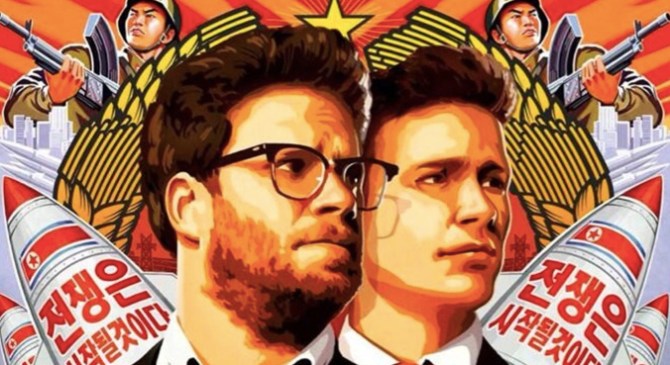
Personally, I would prefer to live in a world where Seth Rogen and James Franco aren’t our foreign policy drivers. Everyone who works at Sony probably feels the same way right now, and quite a few busy people at the State Department, too. North Korea is a loose cannon with a long history of erratic foreign and domestic policies, but the aftermath of the Sony hack has seen America making equally temperamental choices. America is playing down to a lunatic’s level and ignoring lessons it might have learned from 9/11. The notion that America’s free speech is being messed with because The Interview is in distribution limbo is the kind of histrionic overstatement that citizens of a superpower make when they don’t have an accurate self-image.
Prior to the hacking incident, I saw a trailer for The Interview and had a visceral reaction: putting this film out is a terrible idea. I work as a screenwriter now, but my college degree was earned at Georgetown’s School of Foreign Service with a specialty in comparative studies of Asia and Europe. My thesis was on power in the Asian region. I lived and traveled extensively in Asia. From an admittedly dated knowledge base, I feel confident saying that anyone who thinks they won’t get a response from North Korea for depicting the bloody assassination of its leader, images that will be exported globally through the American marketing and distribution machine, is truly living in a fantasy world. If the tables were turned and a film studio in an adversarial country depicted the violent assassination of our leader as comedy and, most importantly, had the power to share that film worldwide, we’d be disgusted and outraged. America has resources and official diplomatic channels to respond to that sort of propaganda attack. We’d start by demanding an apology. In the case of The Interview, America is the perpetrator and we’ve gone after an isolated, unstable dictatorship. Sony foolishly picked a fight with a cornered, rabid dog and dragged the entire country into the alley with them. America has no choice now but to stand behind a questionable film on principle. This is not a strong position.
Satire has a goal. It’s not toothless. Americans frequently, maddeningly blur the line between satire and bad behavior. In the worst cases, racism, misogyny and hate are passed off as comedy. In the middling cases, comedy promotes the status quo, which generally isn’t a good thing. For material to be satirical the writers must have a firm grasp of the issues, be skillful at self-examination, and have the goal of shifting people’s perceptions toward greater clarity. The South Park series comes to mind as an example of great satirical writing, as does The Simpsons. Tropic Thunder was an incredible satire of the film industry, with an edgy script that pushed far beyond discomfort into outright offense and insult. Those writers put Hollywood under the microscope and dissected with aplomb.
In contrast, bad behavior is poking fun at something — a person, an idea, a philosophy, a moral precept — without self-examination. While I don’t know Rogen or Franco personally and I have not watched The Interview, I struggle to be optimistic that Rogen has written a politically self-aware satire of America’s relationship to North Korea. I really enjoyed Rogen’s frat comedy Neighbors, and his upcoming Sausage Party sounds like it will keep his fans happy, but they’re two of many reasons I expect The Interview is no Catch-22 or Dr. Strangelove. The synopsis reads like a couple of stoner writers thought “dictators are stupid and wouldn’t it be funny if…” Well, the answer is no. America assassinating the leader of a foreign country isn’t funny at all and we shouldn’t be in the position of defending it as humorous or entertaining. Now we’re stuck promoting an image overseas that we’ll wield our considerable power in defense of our right to spend Christmas Day laughing at Kim Jong-un’s dismemberment at our hands. The film is a propaganda attack on North Korea’s sovereignty, intentional or otherwise, and one that America really doesn’t want to instigate. There are too many other fires burning.
In touting the release of The Interview as a symbol of our right to say or do anything we want, the American public is trading free speech for common sense and confusing comedy with xenophobia. Further, the aftermath of the initial data dump generated an ugly public conversation about celebrity emails and then about censorship and the perceived cowardice of the victims of the attack. In this way, the public and the media abetted the attackers. To suggest that Sony is “caving” or “capitulating” to people who are threatening violence to their employees and the general public is essentially to say that Sony should ignore their hostage situation. Until Sony is “released” or has outside protection, the company has no way to push back against their attacker. “Free speech” as a concept is not remotely in danger. Individuals and a company are in danger. Sony employees have already been terribly compromised by this cyberattack, and they’re under continued threat. Sony made a mistake with this film, but the company needs the country’s support to get through the situation. It’s important to grasp how effective we could be in pushing back against cyberattacks if we’re all on the same page. Instead, the hackers have forced us to get behind The Interview, a movie that promotes a threatening image of American foreign policy. No one wants to be in that situation. That’s the precedent we don’t want to set.
People who worry about the future of free speech in this country can rest easy. The fallout from The Interview potentially has more long-term positive affects on free speech than negative ones once the danger is over. For one thing, our awareness of how to wield American power in a technologically interconnected world will be greatly increased. We can learn from these mistakes. The film industry needed a recalibration in how it assesses its output and true reach. While this incident may make the Hollywood community fearful initially, the way the country stands behind Sony and deals with the hackers will ultimately embolden executives and talent to make smarter, sharper political films once they’ve shored up their vulnerabilities. Defiance is the backbone of change.
9/11 threw America into a state of fear that divided us. We continue to be divided, and easily distracted. It’s time to regroup so we can address crises like these successfully. America’s power lies dormant in a unified voice we’ve forgotten. Without it, we continue to be vulnerable to even the weakest dictators.
Errol Morris (off camera): If the purpose of the war is to get rid of Saddam Hussein, why can’t they just assassinate him? Why did you have to invade his country?
Donald Rumsfeld: Who is “they”?
Morris: Us!
Rumsfeld: You said “they”! You didn’t say “we.”
Morris: Well, we. I will rephrase it. Why do we have to do that.
Rumsfeld: We don’t assassinate leaders of other countries.
Morris: Well, Dora Farms we’re doing our best.
Rumsfeld: That was an active war.
(Transcription)
Young children think in black-and-white terms. Something is good or it’s bad, the answer to all questions is a variation of “yes” or “no,” and anything more complicated results in frustration. Once kids master basic reality then they move on to complexity. Someone who does a bad thing, like kick you in the shin, isn’t necessarily a bad person, and someone who does a good thing, like offer you candy, can’t automatically be trusted. Grasping that life is nuanced is a rite of passage that signals maturity and readiness for greater responsibility.
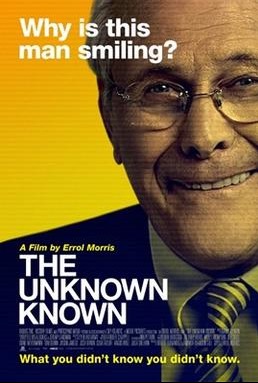
If media and culture are taken as a fuzzy reflection of American tastes, it’s evident that the country needs its leaders to be heroes or bad guys. The public seems largely indifferent to anyone who doesn’t enthrall or disgust it. People demand “the truth” when it’s staring them in the face, they just can’t see it for all of those pesky conflicting details. Such is the case with Errol Morris’s fascinating documentary, The Unknown Known.
The film’s subject is Donald Rumsfeld, the charismatic politician with an uncanny knack for finding a seat in the Oval Office during nearly every political crisis since the 1970s. A Princeton graduate and Navy pilot, he was elected to Congress in 1962 at age 30 and went on to hold several posts in the Nixon administration (during which time he hired Dick Cheney as his assistant.) In 1973, he became the U.S. Ambassador to NATO, a fortuitous departure from Washington that allowed him to emerge unscathed from Nixon’s disgraceful exit and return to the White House as Gerald Ford’s Chief of Staff. He subsequently became the youngest Secretary of Defense in history, then moved into the private sector as CEO, and later Chairman, of pharmaceutical company G.D. Searle. George Shultz asked him to return to public service following the Beirut Barracks attack that killed hundreds of American soldiers in 1983, and Rumsfeld set off on a fact-finding mission as Ronald Reagan’s Special Envoy to the Middle East. He was also notably a lead contender for Reagan’s Vice Presidential running mate, although the position ultimately went to future president George H.W. Bush. Most people know Rumsfeld best for his final tour in Washington as George W. Bush’s Secretary of Defense from 2000–2006, the guy who took America into prolonged, unsuccessful wars in Afghanistan and Iraq in the years following the 9/11 terrorist attacks. In 2014, Rumsfeld is home. Our troops are not.
The Unknown Known doesn’t present any groundbreaking information on history or the six decades Rumsfeld has been in and out of public office. Instead, it recounts what we already know and, in the process, presents an inconvenient truth about American culture: Americans habitually disavow the known knowns of power and democracy when they dislike an outcome. When a country is debating whether a war or a leader was good or bad, honest or evil, it’s safe to say no substantive lessons will be learned.
In his New York Times supplementary pieces, Morris says that The Unknown Known was his quest to pin Donald Rumsfeld down and get some answers to the quagmire of the Iraq war (never mind that Rumsfeld famously stated he “doesn’t do” quagmires.) The entire press corps and media establishment could not accomplish Morris’s goal during Rumsfeld’s ill-fated second stint as Secretary of Defense but this is insufficient evidence for Morris that his objective is a fool’s errand.
For reasons that aren’t disclosed in the film, Morris is a biased, bordering on hostile, interviewer. Perhaps he felt obliged to play the role of interrogator due to the mistreatment of detainees on Rumsfeld’s watch, or maybe he grew frustrated as his questions sent him in familiar circles. No matter the reason, the film is both riveting and disturbing as it illustrates our cultural addiction to black and white thinking, even when we’re prepared and committed to dig for answers.
While American soldiers are still hard at work over in Afghanistan, Iraq, and now the entire Levant, Morris frames Rumsfeld’s account of sending troops to the Middle East as utterly lacking intelligence or rationality. For some, any war lacks intelligence and rationality. Morris’s line of questioning seems to place him in that category. His interview with Rumsfeld plays out as two opposing ideologues who have no interest in understanding each other, only in being understood. An award-winning documentarian with a sterling reputation, Morris indirectly reveals the crux of our national dilemma: We already know everything we need to know here. The real question is: What are we prepared to do about it?
To make the best possible decision, it’s worth laying the cards on the table and playing an open hand.
Photo Credit: Tech. Sgt. Cherie A. Thurlby, U.S. Air Force. (Released)
Known #1: Rumsfeld Left a Prolific Paper Trail
It’s apparent during the film that Rumsfeld is a guy who strictly adhered to the rules and expected others to do the same. He was “dumped” by Nixon in 1973 for not being crooked enough. He was willing to stake his job on corralling Condaleeza Rice when he perceived her to be overstepping her bounds as National Security Advisor. Most notably, he left a paper trail of memos he estimates to be in the “millions” that communicated his thoughts throughout his years of public service. This isn’t a guy who seems to have anything to hide, yet that’s evidence no one wants to acknowledge because it runs counter to the bad guy theme.
Morris raises the topic of Richard Nixon’s proclivity for self-recording. Rumsfeld offers the explanation that perhaps the wayward president felt everything he said was valuable. Morris asks if Rumsfeld knows of any president since who made similar recordings. Rumsfeld says he does not and suggests that people tend not to make the same errors as their predecessors but instead make “original” mistakes. This thinking highlights the key to Rumsfeld’s confidence and serves to make him a compelling figure. While Morris tries to draw a comparison between Rumsfeld’s millions of memos to Nixon’s omnipresent tape recorder, it’s the differences that are most striking. Rumsfeld’s memos were overt and, by his own description, his primary tool of communication with his staff. They were “working documents.” For sheer bulk and publicity, Rumsfeld’s “snowflakes” seem like a precursor to the cult of selfies more than an echo of Nixon’s paranoia. Further, being working documents, the snowflakes were intended to be fluid, even ephemeral. No matter how we choose to interpret the facts, Rumsfeld offers plenty of evidence that he’s working above ground which contrasts sharply with the vacuum of available memos authored by Dick Cheney, Karl Rove, and others in the G. W. Bush Administration.
Morris observes that Shakespeare portrayed historical conflicts as entirely hinging on infighting and personality struggles between individuals in power. This comment follows Rumsfeld’s refutation of any meaningful strife between himself and George H.W. Bush in the years leading up to a presidential candidate fork in the road. It’s interesting that Morris opts to leverage a playwright who dramatized monarchies for the pleasure of a monarch against Rumsfeld’s feathery dismissal of personality politics in American democracy. The blueprints for America’s polarization are on display here: The imagination of those not in power (Morris, Shakespeare) leans toward notions of infinite unchecked aggression, while an erstwhile decision-maker in the most powerful government in the world (Rumsfeld) privileges the process and the system, and grasps the limitations of what one man can actually do with his aspirations in a democracy. Nixon abused his power, was caught and ejected. Rumsfeld recorded his thoughts and intentions publicly and stands by those thoughts today. Morris goes after Rumsfeld as though Rumsfeld is hiding in plain sight, but his questions assume that Rumsfeld has something to hide in the first place. Is it possible the only thing Rumsfeld concealed was his ambition? And if so, based on his track record, did he even conceal it?
How could a man who is so transparent have duped the public into war? In a dictatorship, people are cowed into submission and given no choices, but in a democracy it isn’t rational to claim that an entire population was mystified. A handful of representatives cannot lead a vast, multifaceted, democratically empowered people so far afield of their purported values. Asserting otherwise is an abdication of responsibility, and getting to the truth of what America wrought in the aftermath of 9/11 will require accountability on all sides of the equation. Democracy is predicated on power residing in the people.
Known #2 – Saddam Hussein did not have Weapons of Mass Destruction
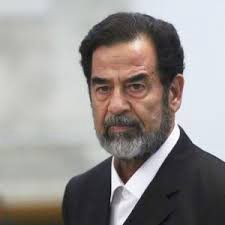
A telling exchange unfolds when Rumsfeld discusses the hunting and eventual capture of Saddam Hussein. His subordinates asked him if he wanted to talk to Hussein. Rumsfeld declined. In the film, Rumsfeld says the person he would have liked to talk to after all was said and done was Tariq Aziz. Aziz was Hussein’s Deputy Prime Minister and right hand man who Rumsfeld first met on his travels through the Middle East in the 1980s. The two men spent hours in conversation and Rumsfeld found Aziz to be a rational guy. He says he would’ve wanted Aziz to explain what alternative approach might have worked to get the Iraqis to “behave rationally.”
With all of the additional evidence we now have about the Iraq War, it’s odd that Morris doesn’t take this opportunity to reframe Rumsfeld’s perspective here. Granted, Morris would have to sympathize with our enemy, a dictator, to point out that the United States was the irrational actor. Saddam Hussein perpetrated unforgivable violence on his own people, but his misreading of his situation vis-à-vis America in 2003 is entirely understandable. America did to Iraq what it should have done to Pakistan if it was serious about invading countries that harbored terrorists connected to 9/11. Hussein couldn’t possibly anticipate the actions of an irrational superpower. America stepped onto the world stage and presented false/made-up/incorrect “evidence” of a nuclear bombmaking program Hussein did not have as justification for starting an illegitimate war.
In playground vernacular that Rumsfeld might appreciate, America got kicked, so it turned around and kicked someone weaker, harder.
Why Morris doesn’t put this to Rumsfeld speaks to how far back we need to go to sort out the context for our decisions, and how deep we need to wade into the dark questions of what we’ve done. The risk is that we’ll be forced to absolve a few bad actors of wrongdoings, that we’ll show characters like Hussein to be less evil or crazy than we need them to be to feel okay with ourselves. Should America forgive itself for acting irrationally after 9/11 and pursuing revenge in lieu of justice? Eventually, but that forgiveness can only come with acknowledgment of its mistakes. That Morris doesn’t take Rumsfeld to that place, a place so many of us want to go, is a missed opportunity to find consensus between polarized Americans. Morris won’t let Rumsfeld off the hook and Rumsfeld won’t ask to be released. It’s gridlock that is breaking the country.
Known #3 – Rumsfeld Was Not the Chief Architect of the Iraq War
Morris: When you’re in a position like Secretary of Defense, do you feel you are actually in control of history, or that history is controlling you?
Rumsfeld: Neither. Obviously you don’t control history, and you are failing if history controls you.
This is an excellent answer. It is representative of almost all of Rumsfeld’s answers to Morris’s questions. Morris gives Rumsfeld two options: Are you a megalomaniac or a pawn? Do you believe you control the world, or that you cannot be controlled? Rumsfeld responds by exposing the black-or-white supposition buried in Morris’s question but doesn’t go further by revealing a third option as he sees it. Both of these guys are smart enough to come up with a third option, even one they might agree on, but neither sticks their neck out to hazard one. They’re both too vexed by a need to be understood. (Answerer: Here’s why I did this. Questioner: Here’s why I hate it.)
The question remains why Rumsfeld didn’t guide the country toward a bit of soul-searching in advance of going to war. If history isn’t going to have us by the tail, if we’re not going to “fail” by Rumsfeld’s definition, we needed to pause and collectively ensure that our actions were informed by history, but also by values, ethics, and newly formed goals in a scary new landscape. With so much knowledge of political decision-making under his belt, Rumsfeld would have been an ideal person to help us ask: Will we feel better about 9/11 after one, two, three…or thirteen years of war? Will we feel avenged by the death of more Americans, and foreign innocents? With the years now passed and the death toll so high, the answer is definitively no. We will not.
As I watched Rumsfeld lay bare his methods of decision-making and politicking, I thought of the complexity of holding high office. Bush and Cheney knew what they were doing when they brought “Rummy” into the White House in 2000. In hindsight, the obvious reason to choose Rumsfeld out of a pool of highly qualified candidates was his willingness to serve the country’s leadership, to voice his opinions in his area of expertise, when requested, and then make decisions and follow directives without looking beyond the well-defined boundaries of his domain. He was not in charge of intelligence gathering, as he points out. Intelligence combined with Rumsfeld’s suggested policy of “ridding the world of terrorism by going after states that harbor terrorists” formed the case for invading Iraq. Yet, Rumsfeld admits to Morris that he heard of the decision to go to war with Iraq from the Vice President in front of the Saudi ambassador. Rumsfeld wasn’t exactly in the driver’s seat.
In 1983, Rumsfeld toured the Middle East as Special Envoy and sent “cables” back to Washington, including the now-famous “Swamp” memo to Secretary of State George Shultz. Morris asked Rumsfeld to read it aloud for the camera. In the film, Rumsfeld’s words are heard over images, presented as one continuous paragraph. In fact, it is a series of excerpts. On my first viewing I mistakenly thought this was a reading of the entire memo, but when I searched for the document I found it was much longer and more involved than its presentation. The following is transcription from the film. I’ve added ellipses to show where the memo breaks:
Rumsfeld (voiceover): I suspect we ought to lighten our hand in the Middle East. … We should move the framework away from the current situation where everyone is telling us everything is our fault and is angry with us to a basis where they are seeking our help. In the future we should never use U.S. troops as a peacekeeping force. … We’re too big a target. Let the Fijians or New Zealanders do that. And keep reminding ourselves that it is easier to get into something than it is to get out of it. … I promise you will never hear out of my mouth the phrase “The U.S. seeks a just and lasting peace in the Middle East.” There is little that is just and the only things I’ve seen that are lasting are conflict, blackmail and killing.
Oddly, Morris omits the final two words of the memo after killing. On the page, Rumsfeld finishes “ — not peace.” Peace is on Rumsfeld’s mind, or it is at least part of the government’s agenda. He does not see it as viable in the Middle East and the memo lays out his sense that America shouldn’t participate there without an invitation, and only in a limited capacity. The entire 8-page memo provides incredible insight into the region at that time and the key players.
Given his strongly worded assessment, it seems unlikely Rumsfeld would have waged a full-blown war there, even 20 years later, if left to his own devices in the aftermath of 9/11. Military action would undoubtedly have been part of any president’s response – Special Forces operations to find Bin Laden would have been on every agenda post-9/11 – but there’s no line drawn, A to B, that indicates a full-scale invasion of two Middle Eastern countries would have been at the top of Rumsfeld’s list of priorities. I was left with the leaden feeling that if Rumsfeld had been Reagan’s chosen running mate three decades ago, rather than G.H.W. Bush, that the country mightn’t have gone to Iraq in the first place with President Rumsfeld at the helm. While Americans may not like the ambiguity, it’s worth remembering that it’s possible to be a warmonger without waging an actual war.
Known #4: American Values Have Shifted
This final card is either the Joker or the ace in our deck. Values are abstract and thus difficult to define, but the discussion is crucially important because it illuminates the context for our decisions. A ramping up of self-centric thinking over the last several decades has lead to a pronounced shift in our concept of civic duty. Personal power captures our imaginations more routinely than national achievement. Steve Jobs is a god, Warren Buffet is a guru, and Beyoncé is America’s “Queen Bey.” America openly worships successful individuals, which is surprising behavior from a country whose defining political victory was independence from a monarchy. Yet in 2014, the public seems eager to bow to a handful of individuals without considering the toxic system that makes those lucky few excessively rich or powerful.
One increasingly common fast track to notoriety comes through social media attacks on “the establishment.” This phenomenon and accompanying philosophy is evident in the example of 23-year-old Twitter activist Suey Park who garnered national headlines earlier this year with a call to cancel The Colbert Report based on a tweet that offended her. Despite her 23,000 followers at that time, she described her social justice activism in the New Yorker as follows:
“There’s no reason for me to act reasonable, because I won’t be taken seriously anyway,” she said. “So I might as well perform crazy to point out exactly what’s expected from me.”
The implications of this statement are that the system is too powerful to be dealt with rationally, that an audience of 23,000 people is not substantial enough to warrant personal accountability, and that mirroring the irrationality of the system is preferable to joining it with an intention to make it better. Park is not alone in her reasoning. Online discourse is full of marginalized citizens expressing anger and helplessness in the face of perceived injustices. It’s not a stretch to expect this notion of personal power will lead to a future society replete with irrational actors.
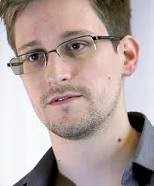
To balance this bleak picture, the example of NSA leaker Edward Snowden comes to mind. Snowden worked within the system and took it upon himself to countermand the National Security Agency’s entire playbook. He maintains that trying to change the intelligence-gathering machine via proper channels would have failed. An examination of the fallout from Snowden’s intel-bomb proves him right. While the media responded with a full-throated cry to label Snowden a “hero” or a “traitor,” the real questions are dead in the water. Who among us is glad to know what our elected officials have been up to and what, if anything, needs to change now? Are we still okay with the Patriot Act, a set of legal procedures that we knowingly permitted our elected officials to enact more than a decade ago? Does a system of covert government controls that once alleviated our fear in the aftermath of 9/11 still serve us? (Based on the current state of this discussion, I’d wager that another terrorist attack will answer these questions for us before we, as citizens, take substantive action to resolve them.) There is no resolution to this story yet. Snowden might be a hero or a traitor, or both. What is clear is his sacrifice of personal freedom for a political principle, and this makes his choice compelling where online ranting is not.
Running counter to these rogue actors and the “i” generation are Donald Rumsfeld and his contemporaries. Serving was the ideal most uttered by Rumsfeld’s generation, specifically serving one’s country, not serving oneself. Upholding the system and “doing their part” was a common refrain in mid-20th century speeches, even as the baby boomers protested the Vietnam War. Ask not what your country can do for you… Today, “service” and “sacrifice” aren’t words you hear many 20-somethings use, vernacularly, and the reasons for that may be rooted in America’s shifted values. Our culture celebrates the notion of making millions of dollars, ostensibly to avoid sacrifice and service of any kind.
Thousands of engineers, designers, marketers, lawyers, and inventors do, in fact, serve in the shadow of “cool” and “awesome” visionaries like Elon Musk, while our government bureaucracy, military outfits and private sector corporations are lazily referred to as necessary evils without a charismatic figurehead to sell the public on their personified goodness.
How people perceive their service is being perceived has become an integral part of individual identity.
Thus, feeling good about a decision is now as-or-more important than the decision itself. What any leader will tell you is that you often can’t feel good about your decisions because they’re rarely black-and-white options you’re choosing from. You’re paid to make complex decisions that almost always sacrifice one desired outcome for another. Holding out for the perfect, feel-good option results in paralysis. No one feels good about dropping bombs unless they’re blind to the risks. Nothing in The Unknown Known indicates Rumsfeld was blind.
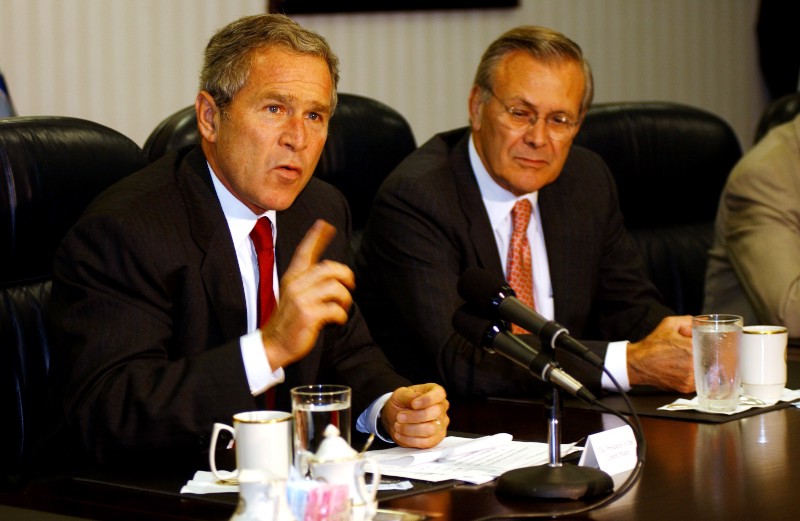
President George W. Bush answers a question about Osama bin Laden during a media opportunity held after meeting with Defense Secretary Donald H. Rumsfeld and the National Security team at the Pentagon on Sept. 16, 2001. DoD photo by Tech. Sgt. Cedric H. Rudisill, U.S. Air Force. (Released)
To that end, Rumsfeld was the ideal figurehead for America’s military in 2001, the perfect pitch person to take the country to war — a guy with decades of experience who loved to spar with the press, whose obvious enjoyment of life, and power, emboldened a bewildered, bereft public to strike back after they’d been hit. Make no mistake, we all had a desire to hit back. It is disingenuous to deny having those feelings in the aftermath of 9/11, and yet in our black-and-white discourse we pigeonhole ourselves into “pacifist” and “warmonger” camps, effectively taking the complexity of crafting an appropriate response to the 9/11 attacks off the table. Rumsfeld was in the Pentagon when an airplane flew into the building, as close as any person could be to the physical attack. He describes the pieces of the airplane strewn across the grass, and footage shows him carrying his injured personnel away from the building. I wondered why Morris didn’t ask Rumsfeld about his personal feelings toward the enemy or whether he desired revenge. Morris clearly agrees with Shakespeare: history is teeming with flawed people in power, driven by emotion, acting on impulse and motivated by greed, so why not invite Rumsfeld to reflect in a personal capacity? Is it because this will make him more relatable? More human?
Still from HBO’s Ghosts of Abu Ghraib
What becomes evident from The Unknown Known is the disconnect between Rumsfeld’s understanding of his role in a new millennium, the exponential increase of personal power over the last several decades that made him singularly responsible in the public’s eyes for guiding the country toward military action in the Middle East. His willingness to talk to the press during the Bush Administration was clearly a function of his enjoyment of interaction, but he did not fully grasp the character of his audience, the general public, nor his soldiers, some of whom perpetrated horrific abuses on our prisoners of war and proudlycatalogued photographic evidence of said abuse to share with friends. For all of his time spent imagining potentially terrible outcomes, Rumsfeld’s understanding of personal power did not stretch to include rogue actors in his own army. Equally blind, these rogue actors had no understanding of how their actions weakened the United States and, in Rumsfeld’s view, gave power to the terrorists.
Rumsfeld: “I testified before the House, testified before the Senate, tried to figure out how everything happened. When a ship runs aground, the captain is generally relieved.”
[cut]
Rumsfeld: You don’t relieve your presence? [sic; does he mean presidents?]
[cut]
Rumsfeld: And I couldn’t find anyone that I thought it would be fair and responsible to pin the tail on, so I sat down and wrote a second letter of resignation. I still believe to this day that I was correct and it would have been better, better for the administration, and the Department of Defense, and better for me, if the Department could have started fresh with someone in the leadership position.”
Morris: “So you wish it had been accepted.”
Rumsfeld: “Yes.”
The Abu Ghraib scandal occurred in 2003. Bush kept Rumsfeld on as Secretary of Defense until 2006. What the American public should then ask is: Why wasn’t his resignation accepted? In light of everything that went wrong with our military action after 9/11, why would Bush keep him on?
CONCLUSION
Even as Rumsfeld gamely debates Morris, compliantly reads his own memos aloud and lays out events with candor, he is portrayed unequivocally as “the bad guy.” Yet, for all of my personal horror at the decisions that were made during Bush’s administration and Rumsfeld’s tenure at DoD, I came away from the film with a clear sense that Rumsfeld was a rational actor who understood the scope and limits of his role and, in fact, did his best to uphold the values of the system. Many Americans did, and do, agree with his actions. While many of us see the system as corrupt, and the Bush Administration as manipulative, it is notable that Bush was reelected in 2004. It wasn’t until the country finally registered a change of heart over the war in the 2006 midterm elections and shifted power to the Democrats that Bush was forced to make a change; Rumsfeld was out.
It turns out Rumsfeld’s untold crime might be that he sticks to what he knows. He doesn’t read legal briefs – “I’m not a lawyer.” – and he’s not a detective or a policeman. He recounts the day he took over the Chief of Staff office in the Ford Administration and discovered a locked safe in one of the cupboards. It had belonged to Nixon’s Chief of Staff, H.R. Haldeman, and remained unopened in the office through Alexander Haig’s short tenure. Rumsfeld asked his then-assistant Dick Cheney to dispense with it through a proper chain of evidence without opening it. Investigating crimes and bringing people to justice were not his areas of expertise. In another era, this blinders-on approach to work was respected. Today, anyone with access to the internet and a search engine is a for-a-day doctor, lawyer, psychologist or war strategist, and Rumsfeld’s dispatching of the safe signals a refusal to get his hands dirty. However, Rumsfeld is of an earlier generation. He followed protocol and got on with his job.
The unspoken aspects of Rumsfeld’s interview are surprisingly easy to miss. There is so much information and history presented, and so much energy in the back and forth between subject and interviewer, that it only came to me later how terribly sad it must be for someone as ambitious as Rumsfeld to end his career the way he did. The personal failure he expresses in the film is dwarfed by the magnitude of torture memos, detainee abuses, and evidence of his ineffectiveness in controlling the military. That Rumsfeld doesn’t mention this sadness, or elicit sympathy for his personal losses, is characteristic of the stoicism of his generation. It’s easy to loathe someone who represents failure, manipulation, abuse of power, and death, but I had a strong feeling after watching this film that he was being dehumanized as penance for our mistakes as well as for his. It troubled me that Morris didn’t pave the way for Rumsfeld to be human on camera. Someone has to go first. Because I inherently relate to Morris’s anger over the war, I hold him to a higher moral standard. He represents me in this film, and I wanted him to offer detente.
Morris’s final question to Rumsfeld is “Why are you doing this? Why are you talking to me?” Rumsfeld responds that it’s a vicious question, and in light of his compliance with Morris’s format, it is exactly that: a vicious question. Whether you agree or disagree with Rumsfeld’s decisions, he’s a public figure with political aspirations who left a paper trail millions of miles long and willingly explains their content. He admits to fretting over complex choices that had to be made but didn’t permit self-doubt to paralyze him. The opposite complaint is lodged against the current administration. There is no winning this either/or war. Careful consideration is a habit we hope for in our leaders because it’s the appropriate way to deal with complexity. Morris ends up looking like he would prefer Rumsfeld were more dogmatic than thoughtful. It’s a trap of the quagmire Morris waded into. The quagmire of quagmires.
What Rumsfeld likely knows, and the American public can’t stomach, is that he did the job he was appointed to do and therefore any apology would ring hollow. Americans elected the wrong president to lead them in the aftermath of a brutal attack. George W. Bush only needed the public’s grief to justify a war, nothing else. Morris supplies evidence, unsolicited, to support the notion that Rumsfeld wouldn’t necessarily have taken us to full-blown war of his own volition: the Swamp memo from all of those years ago. This is potentially as transparent as politics gets. The American public sought revenge after 9/11. Rumsfeld served us.
It’s difficult to say “Rumsfeld isn’t evil” when you look at the photographs from Abu Ghraib. Taking away the “evil” moniker will make some feel like the abuse and deaths he caused, through orders, through policy, and through mistakes, are less honoured or properly remembered. Personally, I think the opposite is true. Mischaracterizing a leader so that we feel better about blaming him is exactly the mistake we made to get us into the Iraq war in the first place. We expanded upon Hussein’s “evilness” to justify our actions. By making that mistake again in analyzing our own leaders, we’re dishonouring the scarred and the dead.
Either Americans were deceived by members of the Bush Administration (which I think is true), or the government was relying on intelligence that turned out to be false (as Rumsfeld, Colin Powell, and others have averred, which I also think is true.) However, Americans’ willful self-deception is the greatest crime of all. That Rumsfeld refuses the role of bad guy or hero in his narrative is what seems to confound Americans most. They want an apologetic villain or a delusional king but they have no apparent capacity to see Rumsfeld for what he is: a decision-maker whose rise to power meant that his failures were amplified and spectacular. This is not absolution, it is a statement of events. The question we should ask ourselves now is: Can Donald Rumsfeld and Errol Morris share a national identity? The answer has far-reaching implications for the future of the country.
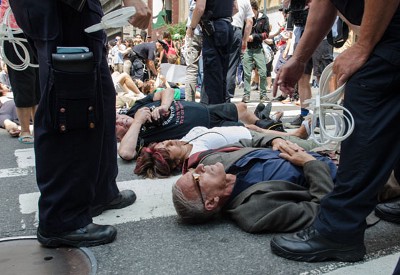
Photo credit: Zachary Roberts for the Village Voice
The country is in the crosswalk arguing passionately over the correct place to stand, in the black or in the white. Sidewalks are gray, and frankly that’s where we should be doing our arguing if we want to avoid another tragedy. Americans would best use their time, then, by moving past the desire to elicit apologies from their would-be villains. Placing blame and bestowing forgiveness won’t ameliorate the gnawing guilt over so many fallen and wounded soldiers and civilians. Instead, people should take a hard look at where they might participate in remedying or, better yet, rebuilding a broken system. To do that effectively, people with conflicting views will have to listen to each other. Morris and Rumsfeld begin that process in The Unknown Known by sitting down to talk.
There’s an early scene in Warren Beatty’s classic film REDS when a couple of great writers have their first lovers’ quarrel. The backdrop is 1916, on the eve of World War I, the Russian Revolution, and the first Red Scare in America, a time when it would be undignified for two top-flight political journalists to go head-to-head over tardiness for dinner, or whose turn it was to take out the trash. As such, Louise Bryant and Jack Reed naturally, bitingly, opt to level each other over the relevancy of their work and the all-consuming question of what to write. Jack shouts his way through this appraisal of Louise’s choices in light of current events:
Why do you even expect to be taken seriously if you’re not writing about serious things? I don’t understand that! I’m not even sure I know what things you’re serious about! One day you’re writing about the railroads and you don’t even finish the piece. The next day you’re doing a piece on an art exhibition that happened three years ago. Look, why do you give me anything to read anyway. If I criticize it at all you tell me you like it the way it is, and when we’re out with other people, if somebody doesn’t ask you a direct question you tell me you feel ignored! But with everything that’s happening in the world today you decide to sit down and write a piece on the influence of the goddamned Armory Show of 1913? Are people supposed to take that seriously?
The answer is yes.
In 2014, the world is once again in a state of turmoil so urgent and complex that it’s a daily chore to wade through the choices and finally plant a flag: Today I will write about this. This is important. Against the measuring stick of relevancy I’m compelled to write about Clare Graham’s art. His exhibition at the Craft and Folk Art Museum, Clare Graham & MorYork: The Answer is Yes, is more vital than ever in this millennium of successive global challenges. Graham holds the key to our future if we’re willing to contemplate it.
The entire 3rd floor of the museum is devoted to Graham’s furniture-adjacent pieces. A ranch-house layout gives the suggestion of seating areas comprising same-material objects that range from cut and hammered soda pop cans and bottle tops to buttons, shuttlecocks, and, memorably, a jar of teeth. The process of fashioning each piece of each mosaic, which one can only imagine was painstaking given the perfect symmetry and construction, is easy to take for granted. The wonder of Graham’s art is the seamlessness. Each chaise and armoire appears to have been born just so. Like the fabled orphans of 19th century literature, the discarded materials he gathers for his work weren’t destined for mundane lives.
The main room showcases his taller cupboards that are made from dominos and mesmerising triptychs of paint-by-number canvases. The paint-by-number art was my introduction to Graham seven years ago when a 3×8 foot geisha-themed panel caught my eye in a gallery on Abbot Kinney Boulevard. I visited that panel for several years until it sold and the gallery owners were kind enough to put me in touch with the artist so I might find another piece to fall in love with.
A Paint-by-Number panel
At the MorYork workshop I found a trove. In fact, there are far too many pieces to love. The workshop itself became the object of my affection. Thousands of square feet are packed with touchable, functional art. Although my affinity for words would indicate a preference for the scrabble tile cupboards that spell out passages from novels, I’m still most powerfully drawn to his paint-by-number pieces. I learned how each small canvas is painted, then cut into 2×2 squares and reassembled in a cubist echo of lovers, horses, or autumn leaves that would make Picasso and Braques fall, rhapsodic, into each other’s arms.
One side of the exhibition is devoted to dismembered teddy bears – probably my least favourite choice of material because it recalls a childhood with too few toys to cuddle. Unlike discarded game pieces and beverage containers, the teddy bears that never find their way to a child make me disconsolate. That is exactly the point of this show. Every material Graham uses is mass-produced without commensurate demand or obligation to utility despite the state of our environment. Need does not equate with inventory in any logical sense. Consumerism drives manufacturing only to generate piles of surplus (“more-more”) merchandise in warehouses and factories across the country to await Graham’s discovery, vision and touch.
Pop-Top furniture
The show has a “this is our house” feeling to it, and on a second walkthrough the dread creeps in. We are all culpable for this waste. We heedlessly accumulate so much we don’t need and never use. For all of the pop tops in Graham’s living room, how many more are floating in the ocean or permanently abandoned in a landfill? His use for these objects demonstrates that the tragedy in wastefulness can be redeemed. He has made something beautiful from America’s refuse and the results are gruesome, funny and most of all practical. We’re invited to sit on our cast-offs, read our literature on the sides of cupboards, and stare at a wall of empathic plastic eyes to contemplate what we might do next.
It’s possible this is what Louise Bryant was thinking as she sat down to write about an art show on the eve of so many wars. It’s possible her unfinished railroad piece was merely a springboard to the train she soon rode across central Europe into Russia to witness Lenin’s victory march into the Kremlin. For anyone who asks whether there is something they can do, or something to be done, Clare Graham offers an elegant answer: Yes.
Ten years ago, the term social media didn’t exist. Facebook was founded in 2004. Twitter was a twinkle in someone’s eye. Billions of users weren’t organized into a handful of hubs and advertisers were barely dipping their toes in the water. One could attribute the rapid escalation in social media use to ease of entry but other factors including desire for entertainment or social value, anxiety at being excluded, and the discovery of online “self” all play a role in an individual’s decision to join the masses in any given forum. I’d be surprised if “Solving humanitarian crises” came out on top in the “Reasons why I joined Twitter” survey, but that’s exactly the point: anything is possible. We should expect to be surprised by internet-based outcomes.
Our proclivity for reverse engineering has driven the conversation about social media and invited near-constant conclusions about human nature based on “the evidence.” Free data of any kind is extremely attractive. We’re hungry for knowledge. Sure, seasoned analysts caution that examples and observations aren’t proof and point out that the internet is one massive, on-going, uncontrolled experiment that makes it nearly impossible to a) ascertain what constitutes reliable data, and b) draw substantive conclusions about causality. The primary use for social media statistics is sales and the stakes are low enough for corporations to ignore the warnings and proceed with trial-and-error marketing ploys. Outcomes have thus become “evidence” of something we want to see.
Through social media, we’ve embarked on a new method of activism that involves marketing a humanitarian cause and citing viral chatter as evidence of public interest and support.
Last week’s Foreign Policy column entitled “Turn on, Retweet, Tune Out” is a good example of this approach. In her piece, Lauren Wolfe reiterates a common refrain about the public’s appetite for humanitarian causes. Specifically, the piece marries social media content to “caring,” an assumption that is so prevalent in contemporary dialogue that the inverse is now a foregone conclusion: if an atrocity, law, event, or person isn’t being discussed on social media then people don’t care. The conversation seamlessly flows to second-tier concern. Why don’t people care? (A frazzled data scientist would follow this question with: Who are “people” and what is “caring”?)
It’s easy to trace this culture-wide assumption to a logical starting point. There have been profound social media “successes” that altered the global political landscape. Hashtags and social media posts during the Arab Spring were widely cited as being instrumental in keeping anti-government protestors connected and informed. On the humanitarian front, Wolfe mentions the ongoing kidnappings in Chibok, Nigeria, and the Kony2012 hashtag in her piece. #Kony2012 was a video campaign to bring Ugandan war criminal Joseph Kony to justice. It attracted the attention of millions of Twitter and Facebook users, many who I expect couldn’t pick out Uganda on a world map even today. #BringBackOurGirls refers to the 300 teenaged girls that Boko Haram took from a school four months ago and continue to hold prisoner today. The hashtag circulates on various sites intermittently while the world waits for news out of the region — the pertinent words for the apathy discussion being “world” and “waits.” Social media’s role in generating global concern by disseminating information is undeniable in these instances, but asking why public support dwindles to apathy over time is merely an activist-end lament. Better to ask: After the retweet, what more can geographically distant non-activists do?
The public isn’t paid for their time on these issues. People willingly participate in humanitarian causes they care about by doing the one thing that they’re directed to do, namely share the story to get the word out. And then what? Share again? This terrible thing happened. It happened. It’s happening. It happened. It’s happening. It happened. It’s happening. The chatter itself doesn’t physically walk Kony into a jail cell, discover the hideout of Boko Haram, or stop bombs from falling in Syria, or Gaza, or Iraq, and since those are the immediate goals then remote participants need guidance on what they can do beyond retweeting. Further, there’s a likelihood that the next step will have nothing to do with clicking a link and more to do with writing a check or contacting a representative, neither of which show up in a Twitter feed. Social media content during the Arab Spring frequently revolved around specific actions – announcing protest locations, giving eye-witness accounts of atrocities to share, uncovering the movements of opposing sides, tracking the whereabouts of arrested protestors – but that chatter is silent now. Should we assume those people are apathetic about continued strife in the region because they aren’t discussing it with the same frequency on social media? Absolutely not.
It’s not a given that every humanitarian crisis will capture global attention but many do, because many people care. The wave of public participation can be ridden much farther than it often is simply by giving people continued guidance on steps they can take beyond posting and tweeting. To this end, it’s crucial for journalists and activists to stay in front of a crisis and lead the groundswell of social media users who eventually turn to face the issue. I expect we’ll see more of this pattern as we learn from our successes and failures in real time, but in the meantime it’s incongruous to assume apathy, or exhaustion, in the absence of online chatter. The short answer to sustaining public participation is to find the best leaders for the cause.
Indisputably, Spike Jonze’s “Her” is a relationship movie. However, I’m in the minority when I contend the primary relationship in this story is between conscious and unconscious. I’ve found no mention in reviews of the mechanics or fundamental purpose of “intuitive” software. Intuitive is a word closely associated with good mothering, that early panacea that everyone finds fault with at some point in their lives. By comparison, the notion of being an intuitive partner or spouse is a bit sickening, calling up images of servitude and days spent wholly engaged in perfecting other-centric attunement.
To that end, it’s interesting that moviegoers and reviewers alike have focused entirely on the perceived romance between man and she-OS, with software as a stand-in for a flesh-and-blood girlfriend, while ignoring the man-himself relationship that plays out onscreen. Perhaps this shouldn’t come as a surprise, given how externally oriented our lives have become. For all of the disdainful cultural references to navel-gazing and narcissism, there is relatively little conversation on equal ground about the importance of self-knowledge and the art of self-reflection. Spike Jonze lays out one solution beautifully with “Her” but we’re clearly not ready to see it.
“Her” is the story of a man who unknowingly begins a relationship with himself.
From the moment Samantha asks if she can look at Theodore’s hard drive, the software is logging his reactions to the most private of questions and learning the cartography of his emotional boundaries. The film removes the privacy issue-du-jour from the table by cleverly never mentioning it, although it’s unlikely Jonze would have gotten away with this choice if the film were released even a year from now. Today, there’s relief to be found from our NSA-swamped psyches by smugly watching a future world that emerges from the morass intact. Theodore doesn’t feel a need to censor himself with Samantha for fear of Big Brother, but he’s still guarded on issues of great emotional significance that he struggles to articulate, or doesn’t articulate at all. Therein lie the most salient aspects of his being. The software learns as much about Theodore from what he does say as what he doesn’t.
Samantha learns faster and better than a human, and therefore even less is hidden from her than from a real person. The software adapts and evolves into an externalized version of Theodore, a photo negative that forms a whole. He immediately, effortlessly reconnects to his life. He’s invigorated by the perky, energetic side of himself that was beaten down during the demise of his marriage. He wants to go on Sunday adventures and, optimistic self in tow, heads out to the beach with a smile on his face. He’s happy spending time with himself, not by himself. He doesn’t feel alone.
Samantha is Theodore’s reflection, a true mirror. She’s not the glossy, curated projection people splay across social media. Instead, she’s the initially glamorous, low-lit restaurant that reveals itself more and more as the lights come up. To Theodore, she’s simple, then complicated. As he exposes more intimate details about himself, she articulates more “wants” (a word she uses repeatedly.) She becomes needy in ways that Theodore is loath to address because he has no idea what to do about them. They are, in fact, his own needs. The software gives a voice to Theodore’s unconscious. His inability to converse with it is his return to an earlier point of departure for the emotional island he created during the decline of his marriage.
Jonze gives the movie away twice. Theodore’s colleague blurts out the observation that Theodore is part man and part woman. It’s an oddly normal comment in the middle of a weird movie, making it the awkward moment defined by a new normal. This is the topsy-turvy device that Jonze is known for and excels at. Then, more subtly, Jonze introduces Theodore’s friend Amy at a point when her marriage is ending and she badly needs a friend. It’s telling that she doesn’t lean heavily on Theodore for support. Instinctively, she knows she needs to be her own friend. Like Theodore, Amy seeks out the nonjudgmental software and subsequently flourishes by standing unselfconsciously in the mirror, loved and accepted by her own reflection.
In limiting the analysis of “Her” to the question of a future where we’re intimate with machines, we miss the opportunity to look at the dynamic that institutionalized love has created. Among other things, contemporary love relationships come with an expectation of emotional support. Perhaps it’s the forcible aspect of seeing our limitations reflected in another person that turns relationships sour. Or maybe we’ve reached a point in our cultural evolution where we’ve accepted that other people should stand in for our specific ideal of “a good mother” until they can’t or won’t, and then we move on to the next person, or don’t. Or maybe we’re near the point of catharsis, as evidenced by the widespread viewership of this film, unconsciously exploring the idea that we should face ourselves before asking someone else to do the same.
When we end important relationships, or go through rough patches within them, intimacy evaporates and we’re left alone with ourselves. It’s often at those times that we encounter parts of ourselves we don’t understand or have ignored in place of the needs and wants of that “significant other.” It’s frightening to realize you don’t know yourself entirely, but more so if you don’t possess the skills or confidence to reconnect. Avoidance is an understandable response, but it sends people down Theodore’s path of isolation and, inevitably, depression. It’s a life, it’s livable, but it’s not happy, loving, or full. “Her” suggests the alternative is to accept that there’s more to learn about yourself, always, and that intimacy with another person is both possible and sustainable once you have a comfortable relationship with yourself. However we get to know ourselves, through self-reflection, through others, or even through software, the effort that goes into that relationship earns us the confidence, finally, to be ourselves with another person.
Elinor Smith Sullivan’s Airplane at the Udvar Hazy Center / E.C. McCarthy
I’ve always believed that men are the key to equality for women. This is a seemingly provocative statement, but history shows that paradigm shifts by those “in power” are necessary before the tide turns on value-based issues. Behind every great woman are more than a few men. Logic prevails. As such, I’ve spent a good deal of time exploring male attitudes toward women and finding creative ways to elicit empathy for women from men.
It mystifies me when men assure me they aren’t feminists. Gloria Steinem often notes that:
“A feminist is…a person, male or female, who believes in the full social, economic, and political equality of women and men. And, I would say, also acts on it.”
She’s quoting the dictionary, not promulgating dogma.
There are increasing numbers of ordinary men out there who see, understand, and feel compelled to speak out against the rampant sexism and misogyny that exist in our society. A standout like Nick Kristof at the New York Times comes to mind. Or Jackson Katz. But in the same way people struggle to list their favorite female authors beyond Jane Austen and J.K. Rowling, women typically struggle to list the male feminists in their lives. That’s pretty horrifying considering that men make up half of our society. Surely we can each come up with twenty or thirty names of guys we know personally who are keeping it real? No? Okay, five. Five is doable. Five guys who are aware of sexism and would vocally back you up in a roomful of coworkers. Now subtract the guys who are comfortable being called feminists. And then subtract the guys who would do the same for any woman, not just you personally. My anecdotal observation is that most women end up with roughly two names. That’s not very many, compared to the number of men we interact with daily. Not enough to make the difference.
Any guy can become a feminist. A reformed rapist can become a feminist. Sexism is a mindset, not an incurable disease, and past behavior doesn’t damn you for the rest of your life. What men may not realize is that women need to hear people articulate the world as it is. It’s soothing and reassuring and hopeful when a guy acknowledges the injustice of gender bias. A simple acknowledgment takes the crazy out of a crazy-making experience and lays the groundwork for change. In time, agreement over the problem becomes a shared goal and a powerful engine for achieving it.
The workplace is a prime opportunity for men to lead by example. The sexism I’ve encountered at work over the years weighs heavily at this point. It has accrued. I would be an idiot to walk into a new situation without lowering my expectations, because I don’t have the time or energy to deal with disappointment over not being treated equally. There was the thirty-something guy who told me “don’t worry your pretty little head” about aspects of a joint project I was brokering between two multibillion dollar tech companies, or the Hollywood film director who told me I’d have serious trouble getting hired as a director myself, no matter how good I was, because, simply, “you’re a woman,” or the agent I was hoping would read my work who instead wanted to know if I or my friends would consider posing naked for photographs. I could write pages of examples that stack up to a mountain of nonsense I climb every time I decide to go get something done. The saddest part is that the guys in those examples weren’t strangers. They were acquaintances and friends.
The worst work-related offenses are when I’m made complicit in the misogyny. I’ve worked in multiple industries and this happens across the board. I’ll be the only woman in a room of guys who throw their elbows around while making comments that objectify or undercut other women. I’m then forced into the position of “boundary-drawer” and “moral-decider.” My energy, which should be focused on meeting people and having interesting conversations about creative projects, is redirected to an uncomfortable inner dialogue over whether to speak up and say I’m offended. When I speak up, I’m frequently shut out of future meetings. When I don’t speak up, I can’t do my best work because I’m concentrating too hard on keeping a smile on my face. Sexism’s mission is accomplished: ultimately, I don’t want to go back to that room. I don’t look forward to being at work, and my motivation to collaborate with the guys is diminished. When I leave a room like that, I take with me the distinct impression that those guys say much worse things when I’m not there, possibly about me, and I’m demoralized. I lose enthusiasm for the game because the guys aren’t playing fair. For any guy who hasn’t noticed, that’s how sexism and misogyny work. And they really do work.
Personally, I think it’s disgraceful that every third or fourth person I meet has an unconscious problem with me before they even shake my hand. Life has enough challenges and I don’t need that one. I wish all people, men and women, would look in the mirror and get curious about their biases, ask themselves how many times they’ve wished a woman would be less emotional, would stop talking, would need less from them, and then ask how many times they’ve wished the same of a man. Even the least biased among us contends with the influences of a biased world. When I’m honest in the mirror, I acknowledge that I still fail to value women equally sometimes, most often myself. Sexism isn’t “a guy problem.” It’s a societal one. Prejudice is wily, but it’s easy to challenge once you’re willing to see it.
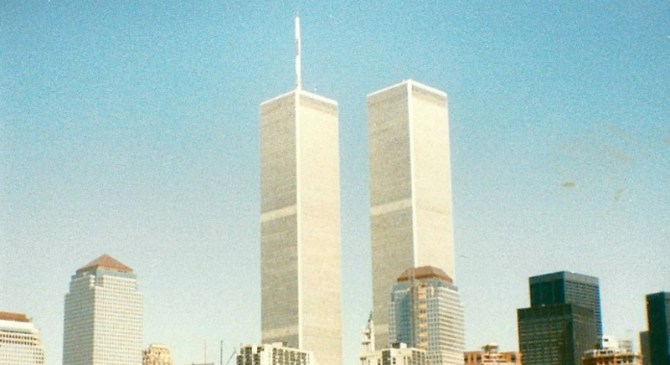
World Trade Center circa 1986 (Photo Credit: E.C. Mccarthy)
A Review of Rebirth, Dir. Jim Whitaker
Rebirth opens on a black screen with audio of a jocular morning deejay talking about the weather in New York City on September 11th, 2001. There is a perceptibly light quality to the deejay’s voice, a casual, unforced ease that has yet to fully return to American society, and hearing it is akin to hearing a younger self talk on tape. It’s amazing we were ever that innocent.
Rebirth is the documentary film directed by Jim Whitaker that chronicles ten years in the lives of five people directly affected by 9/11. He interviews them once a year, every year, beginning in 2002. Concurrently, Whitaker and Director of Photography Tom Lappin set up time-lapse cameras around Ground Zero in 2002. The cameras are still in place today, effectively capturing the aftermath of destruction, the methodical clearing away of debris, and the rebuilding of the site.
Rebirth is a movie about resilience.
For a director sitting on ten years worth of footage, it’s an impressive choice to use as much black screen throughout the film as Whitaker does. We don’t see the planes fly into the World Trade Towers. We don’t linger on shots of awestruck New Yorkers staring at the sky. We don’t watch smoke billowing, and we don’t wait in torment for the moment those towers crumble and fall. Instead, Whitaker wisely gives us audio clips of real time reactions from news anchors and people on the street over a black screen, leaving visual space to recall our own images of that day and adjust to the truth a little bit more. We can’t learn anything further from a new clip, an angle we haven’t seen, or a detail we missed. This happened, it can’t be undone, and time marches forward regardless of how we feel about it. The black screen permits us to recall that day in the same way we recall any trauma: by memory. Whitaker demonstrates profound understanding of grief in his choices.
When we first meet the five subjects in 2002 they are all still in shock. They recollect the events of 9/11 with varying degrees of numbness and hysteria. They articulate denial and disbelief. They search the floor for words. They hold the interviewer’s gaze, needing a sign that their pain and confusion are mirrored, and knowing that they can’t be. Each of their losses is deeply personal. Mike Lyons is a construction foreman down at Ground Zero. He lost his brother, a fireman, on 9/11; Tim Brown is a fireman who lost all of his friends that day, including his best friend, and his mentor. Nick Chirls is a teenager whose mother had recently started a new job on Wall Street and never came home. Tanya Villanueva Tepper’s fiancé was a fireman who never came back. Ling Young was in the South Tower when the second plane hit and she suffered severe burns across her body. She lost her life as she knew it.
We meet these people already changed and struggling to process their immeasurable losses. Their lives are in pieces. The miracle of this film is watching them reconnect to parts of themselves that are capable of happiness and peace, parts they believe beyond a doubt to be dead and we, as strangers, never expect to meet. We’re told by each of the subjects at the outset that they don’t know how to move forward, that what they’ve lost can never be replaced, and we know they’re right. At the same time, we have ten years’ distance and a readiness to believe that time will bring more understanding. The observations each person makes, about their tragedy, about life, about love, about the nature of loss and pain, are poignant, all the more so for their willingness to reveal such personal grief on film. One hopes it’s another form of healing; the sacred sharing of memories. One of the most astounding recollections is given by Nick, who tells of the moment he stepped up to the podium to memorialize his mother and a sparrow flew into the building and landed on his head. The home movie footage is riveting; we wouldn’t believe it if we couldn’t see it. He reaches up and the bird allows him to hold it. He passes it to someone else, and the bird flies away. It’s a moment that defines him in the coming decade as we watch him mature from boy to man, his attachment to his mother somehow calling her forth from beyond.
Parallels between emotional pain and physical pain abound in our culture (note the widespread use of the term “broken heart”), but the two kinds of pain are substantially different. The juxtaposition of Ling Young’s decade of surgeries, skin grafts, peels and joint replacement to the emotional anguish of the four survivors who grieve for their loved ones is a testament to the complexity of pain. In some ways, Young’s story is most difficult to watch because of the extreme nature of her injuries; her healing seems unlikely and the hopelessness is unbearable. It’s difficult not to become numb with her.
Everyone has a relationship to death and can find a way to relate to emotional pain, if they choose, but many of us never experience the physical trauma of third degree burns. Meeting Young in 2002, there is little clue as to what kind of person she is, of her temperament, beyond what she tells us in a lifeless tone. The other subjects express their former selves through declarations of love and loss, but Young’s numbness precludes access to her former self for the viewer. The first five or six years only strengthen the notion that this woman is a pessimist, probably always was a pessimist, and that the rest of her life will be filled with unhappy thoughts and severe physical limitations. Then in one year, roughly 2008, everything changes. Suddenly, Young turns up to the interview as an entirely different person and we meet the woman who had a life before 9/11. She mentions attending a burn victims conference, and in describing the experience, the audience is privy to the woman under the burns, a happy, optimistic, energetic woman capable of great joy and sharp wit; she has broken through the numbness. She will never be rid of the scars. She will never have full use of her hands. Yet, she transforms internally, as do the other survivors, and the relief in watching her smile is overwhelming. In fact, the subjects all turn a corner in their lives within a year or two of each other. One achievement of this film is its demonstration that we heal emotionally from all kinds of pain in roughly the same amount of time, and we shouldn’t push people to “get over” something, or avoid people in pain because we’re afraid of the numbness we feel around them. We can and should hold fast to a sense of optimism for recovery for everyone, always, no matter how long it takes.
I watched September 11th unfold while kneeling in front of my sister’s television in Los Angeles. When the first tower fell, I leapt forward and my hand flew to the screen, my palm pressed to the caving building. I don’t know if I wanted to catch the tower or touch the people in it, but it was an instinctual response that defied logic. Each of the people in Rebirth bravely recount their experiences and feelings, no matter how raw, or illogical, with an openness that is inspiring. They insist they aren’t brave, but their strength of spirit is palpable. By embracing that which they’re most afraid of—of betraying the memory of a loved one, of never being able to love again, of disappointing a parent, of giving up on life—each person comes full circle to themselves and happiness finds its way back in new, unexpected forms. It is also an act of courage to make this documentary, knowing that even the best of intentions might cause suffering. In allowing viewers their own grief over 9/11, without retraumatizing them with images, Whitaker gently paves the way to focus on his subjects’ grief. The experience of this film is unique in its demonstration of healing; the viewer is permitted, encouraged, even dared, to heal as well. The film gives a voice to people’s grief, and in doing so lovingly, it heals.
Rebirth is currently available on Netflix, Amazon, Apple, and other streaming services.























 Elizabeth McCarthy