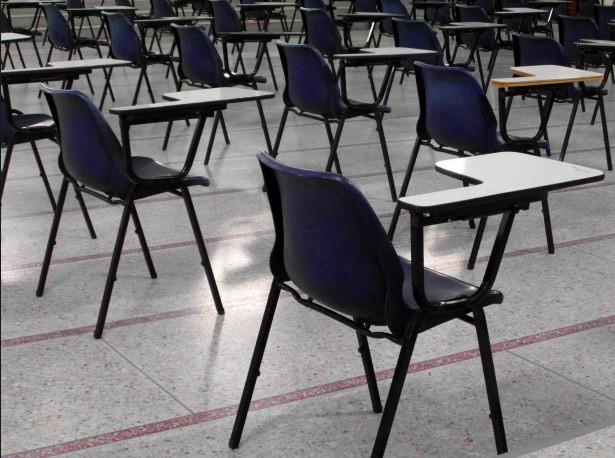
The first time someone tried to cheat off of me it was a revelation. The cheating I’d been taught about in England was a solo endeavor. We were instructed not to write notes to ourselves on our hands or hems, or put answers in flip top desks to refer to. The shame of being caught was too terrible to contemplate, and most of our work was too complicated to be aided by a one word answer anyway. I could never wrap my head around how someone might cheat, so I didn’t follow why there was a lot of discussion about it. And for a long time I assumed no one was cheating because they felt as I did. It was shameful.
Years later, in American high school, a boy I barely knew would pester me through an important biology exam in summer school, demanding answers in a confident whisper as though I had previously agreed to give them to him. He eventually he left me in peace to take the test, but the incident troubled me. He was so casual about what he was doing, and I was disturbed that he had chosen me to rope into his scheme. He acted as though I was harming him by not helping him, like I was abandoning him in a time of trouble. I’ve never forgotten his name. I expect he’s still cheating today.
My senior year in high school, my AP Poli-Sci class made national headlines for a cheating scandal. National. Headlines. It was awful. Known as the “Harvard” of public high schools, and the school John Hughes made famous in some of his films, we were supposedly the lucky kids, and this cheating scandal was an indication that wealth isn’t all it’s cracked up to be. Not everyone who went to my high school was wealthy. Not by a long shot. But there were a handful of very rich kids driving sports cars and wearing clothing I couldn’t afford today, and the suburbs we lived in had some of the highest average incomes in the country. The perception was that if these kids were compelled to cheat, something must be wrong with utopia. (Short answer: There is.)
Because it was a huge public high school with thousands of kids, we had a long-standing mentoring system for freshmen. It was an honor to be chosen as a “senior helper,” assigned to a freshman advisory for their first semester of high school. I applied and was accepted along with 23 other seniors. We worked closely with a freshman advisor, the teacher assigned to each group of students for the full four years of high school.
I had a great group. I organized parties and get-togethers for them. They had my phone number and called me during difficult, and sometimes truly horrible, life moments. One of their mothers died of cancer. Another’s father was violent. I didn’t really know what I was doing, but I talked to them and facilitated putting them in a room with an adult who could help. It was one of the only times in my high school career when I remember the thick cloud of American cynicism lifting. Kids were encouraged to reach out and connect, and they trusted me enough to bridge the student-teacher divide when it was necessary and needed.
One of the freshmen boys’ advisors was a beloved guy, a handsome AP Poli-Sci teacher who coached track. I knew his senior helper, a popular guy, smart, an athlete, and good-looking. It was a photogenic group, and a picture-perfect ideal of what “north shore” families wanted for their kids. I remember a lot of smiling and self-assured banter. I admired them.
I was also in the AP Poli-Sci class and it wasn’t just hard, it was impossible. I figured I was struggling because I had no background in the subject matter, coming from a different country, but most of the other kids were struggling too. The teacher said he was disappointed by how we were doing, especially because there were a few students who were really getting the material. Really putting the time in. Really studying. And for that reason, he wasn’t curving the grades or even addressing the difficulty of the tests.
My parents were constantly on me about my AP Poli-Sci grade. They didn’t buy my story that it was impossible to do well. When a guy in my class picked me up for a date my mother cornered him to talk about whether he thought the class was hard. He just smiled, all charm, and told her he found it pretty easy. I was stunned. Easy?
As it turned out, the AP Poli-Sci teacher’s handsome senior helper had discovered where the tests were kept in his desk drawer. It was never clear whether he stole them himself or told an even less scrupulous friend where they were, but they obtained the tests in advance week after week for over a semester, and shared them among a sizable group of friends who also happened to be the leaders, the cool kids, and the high achievers of my senior class.
Second semester senior year, the scandal broke and what followed was the worst tension I had ever witnessed in my life. PA announcements from the principal sternly informed us that interviews were being conducted and we were expected to be truthful about what we knew. Daily, people were pulled from my classes to be interviewed. They were all people I’d known for three years, the top academic group in a class of 700. Everyone was suspicious of each other. Gossip was out of control. And all the while, college acceptances were rolling in and we were preparing to graduate. A time that should have been exciting was a stressful nightmare.
I will never forget when the scandal resolved. The names of those involved weren’t published. The colleges they’d applied to weren’t notified. The kids were all high-achievers and they were allowed to pass the AP Poli-Sci class. They had their titles taken away; our class president didn’t graduate as class president. Their parents had advocated for them and won. My parents were incensed that colleges weren’t notified. My dad had desperately wanted to me to go to his alma mater, an Ivy League school, and I hadn’t gotten in. The senior helper who’d stolen the tests was going there instead.
American school was new to me then, and I was never invested in the system of getting ahead. It’s still strange to me that learning is turned into a competition here. I also never wanted to go to my dad’s alma mater; my application essay was the driest, most lifeless thing I’ve ever produced. I remember my dad taking it and trying to spruce it up to no avail. I was secretly relieved not to be admitted. But the part of the experience that mattered, what will always haunt me, were the moments I witnessed when lifelong friendships were utterly destroyed. The moment one guy called out in a choking, panicked voice to another guy across a class that was in-progress, begging him not to turn him in, reminding him they were friends. The look of conflicted disgust on the other guy’s face was terrible. Two girls I’d sat with all year in Poli-Sci had been friends since grade school. Then one participated in cheating while the other did not. I’ll always remember the cheater, sobbing, trying to talk to her friend as class started on the day the scandal broke. The friend wouldn’t even look at her. It was gut-wrenching. I felt so helpless. They sat apart for the rest of the year. And I’ll never forget the broken teacher. The guy who was always smiling, who had such positive energy in his classes, was visibly devastated. His philosophy was that kids are essentially good, and you can trust them to make good choices. He’d left his desk drawer unlocked, this was the outcome, and he felt completely responsible. He never recovered.
So, when I read about these parents and their money and their schemes, and I see my university named in today’s scandal, and read the callous jokes and schadenfreude tweets, I can’t help thinking about those moments. There’s a system of justice to deal with the crimes, but there’s no path for dealing with broken trust and betrayal between friends, between parents and kids, between spouses, between schools and families, and on and on. It’s that loss no one will see, but I know it’s there, and it’s truly awful. The emotional damage from today’s scandal is permanent and it has been done to lots of innocent people.
 Elizabeth McCarthy