I love fashion magazines unabashedly. I’ve read them my whole life. Vogue, W, Bazaar, Elle…I love the photography, the art direction, the clothes, the style, and often I enjoy the interviews and writing. I also love to hate the very same magazines because they’re in the business of selling us things we don’t want or need. Fashion magazines push one evil step beyond a museum or gallery by asserting that to look at this art is not enough. To be worthwhile in this world, you have to own.
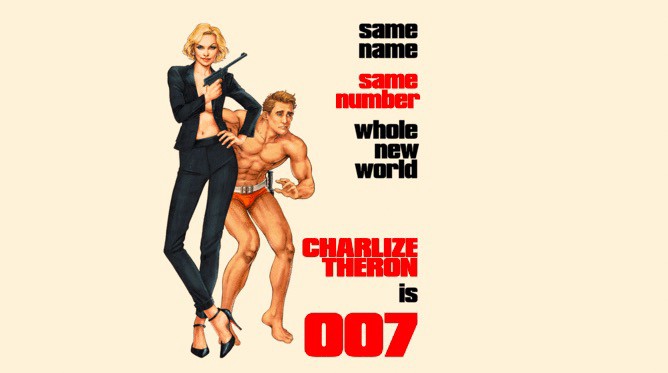
When a piece in W nominated Charlize Theron For Bond, I hit the brakes on my love-/hate-read and parked for a minute to feel my feelings. The trailer for ATOMIC BLONDE is thrilling. Theron is a compelling MI6 agent (based on what’s culled for a 3-minute sizzle reel.) If the movie delivers on its promise, I expect it will clean up at the box office. That’s why, for all of its good intentions, Katherine Cusumano’s “Why Charlize Theron is the James Bond We Need Now” is misguided.
I’ve been writing screenplays for almost 20 years. For most of that time, I’ve stubbornly pitched female-centric films and written female protagonists, despite the fact that they never land with the many (so, so many) male producers I’ve sat across from. It isn’t those scripts that get me in the door. If I’m sitting with a producer, it’s almost certainly because I’ve shopped a script that hits all the right notes and elevates familiar male characters in some unique, non-derivative ways, and checks the boxes for appealing, non-threatening, man-lovable female characters to support them. To stay in the game, I’ve written material to appeal to my first audience, male executives, because they’re predominently the gatekeepers. Over the years, I’ve evolved as a writer to the point where I now pull off this feat and sneak a few mutinous female characters into my stories. I view it as a temporary arrangement to help me sleep at night while I impatiently await the day that I’m sought out for all of the great women I’ve been writing. In my fantasy, I casually pull my unread scripts off the shelf, one by one (as John Hughes famously did with his scripts about teenagers), and I pass them to men and women who have their hands out; producers who are finally ready to make some noise.
Given my aims as a writer, you’d think I’d be in the cheering section for “A Woman For Bond” but at this stage of my career, and at this point in Hollywood’s evolution, the last thing I want to see happen is for popular male characters to be converted into female roles. It all comes down to how an audience meets a character. Back in 2008 when it was announced that the Tom Cruise vehicle SALT would be reworked for Angelina Jolie, I smiled for weeks. When Star Wars writers put Daisy Ridley front and center, I was melancholic (for a parallel youth) and inspired. This week’s announcement of Jodie Whittaker taking on the Doctor Who mantle was spine-tingling. (I grew up in England on a steady diet of Doctor Who. When I experienced my first cast change I dropped the show like a cheating boyfriend. It was my first television show betrayal. That’s the great part about the role of The Doctor — any change is unwelcomed at first. As such, Whittaker’s casting is likely the most well-received announcement in the history of the show, despite what you read online.)
However, those characters were introduced to audiences as women, or in the case of The Doctor can plausibly be any gender without changing a mote of the franchise’s history. Conversely, taking a role like Bond away from men and handing it to women does both a disservice. James Bond, Ethan Hunt, and the like are beloved because the audience is invested in the character’s history. That history shouldn’t change.
Women deserve their own roles, just like men do. Female characters deserve that investment of time and care, and frankly they’re owed more input from female writers. It was crushing to see zero women on the long list of writers for WONDER WOMAN. I have no doubt Patty Jenkins and the female cast of the film brought plenty of ideas to the table, but it was a bitter pill that, in 2017, Marvel didn’t see fit to credit any women for that script. It says to me that they don’t realize how many of us are out here working our a**es off, and how significant that representation would be for us in our daily work.
For all of those reasons, I hope women will sit tight and hold out for their own characters. We’ve waited this long for more recognition in Hollywood. It’s worth waiting a tiny bit longer for the highest quality writing and characters we fully own. I hope audiences will demand the same, and that they’ll support films like ATOMIC BLONDE in the theater so that Lorraine Broughton’s name is as notorious as James Bond’s some day. WONDER WOMAN slayed at the box office, largely because female filmgoers understand the drill now: if we want more high-quality female characters, we have to vote with our wallets and buy what we really need. The only goddess Hollywood bows to is the blessed female buck.
 Elizabeth McCarthy