 On Interstellar, Love, and Time
What if there were a way to influence the past and change the future? With every choice we make — voting for president, purchasing a stock, getting married — we hold an entrenched view that possibilities evolve with time. We discuss the future in predictive terms (likelihood of, on target for, could go either way if…) and plan accordingly. To the extent that future outcomes don’t fall in line with our expectations we infer that we lacked information, were poor readers of probability, or experienced a devilish bit of bad luck.
There’s also a sense of momentum as we approach a crossroads where probability becomes inevitability. Expectations take over. This is evident in the person who doesn’t vote because their preferred candidate is almost certainly going to win, or the person who marries despite back-of-the-church jitters because halting a wedding is impossible. We rationalize away outcomes even though they exist up to “I do.” Would we feel differently about those discarded chances if they were sent to us from the future?

John Cusbert, Research Fellow at the Future of Humanity Institute at Oxford University, challenges our foregone conclusion about chanciness. In his paper “Backwards causation and the chancy past”, Cusbert asserts that chanciness isn’t tethered to time in a linear fashion, and that future outcomes can possibly affect chanciness in the past. This is not to say that all chanciness originates in the future, but theoretically some of it could.
I discovered Cusbert’s paper just as I finished rewatching Christopher Nolan’s excellent space epic Interstellar and the two works independently made sense out of each other. Cusbert provides a framework for what happens in time’s physical dimension in the film, while Interstellar plays out a dramatized version of Cusbert’s backwards causation scenario. The implications for everyday life are extraordinary, and also very fun to consider.
First, a bit of housekeeping. Backwards causation of chance is only possible if we unlink time and chance. Cusbert does an excellent job of explaining the whys and hows, but his conclusion is the jumping off point for this piece. To wit: It is false to assume that chances are defined at times.

Thus, imagine Time and Chance as two objects held up in the air by you (the universe.) When you hold them together they exhibit certain properties (perhaps they’re magnetically attracted) and when you move them apart they exhibit other properties (perhaps one becomes smaller without the heat reflection of the other.) Whatever their properties, Time and Chance are separate entities, bound by the laws of the universe, which interact with each other in noticeable ways that affect our lives.
Now the fun part…hunting for backwardly caused chance in the lives of Interstellar’s Astronaut Cooper and and his daughter Murph.
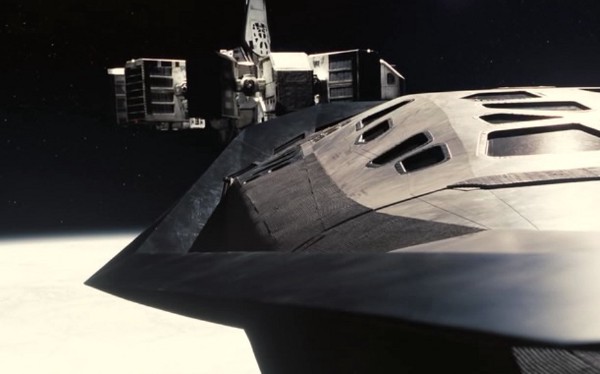
Assumption #1 — Cooper will pilot the Endurance
Cooper will pilot the Endurance because he pilots the Endurance. It is a property of time that the past cannot be changed.
Chance #1 — Cooper may or may not make himself stay on earth
When Cooper travels into a black hole near the end of the film, he encounters a physical dimension of time. The tesseract is a construct of Murph’s bedroom during the week before Cooper left earth on the Endurance. This stretch of time is in the past but within the tesseract it is also a fragmented, nonconsecutive part of the present.
Present Cooper desperately communicates with Past Murph using gravity to knock books to the ground. The past cannot be changed, but Cooper hasn’t realised this yet and is backwardly causing chances to make himself stay. From the tesseract in the present, there is zero probability of those chances working, but they’re chances in the past until Past Cooper leaves earth. They’re also chances in the present until Present Cooper gives himself the coordinates to NASA. Chanciness is chancy. It doesn’t dictate an outcome, it only offers the possibility for it. For a brief window of time, Cooper’s dropped books and coded messages are backwardly caused chances that his past self ignores and Past Murph puzzles over.
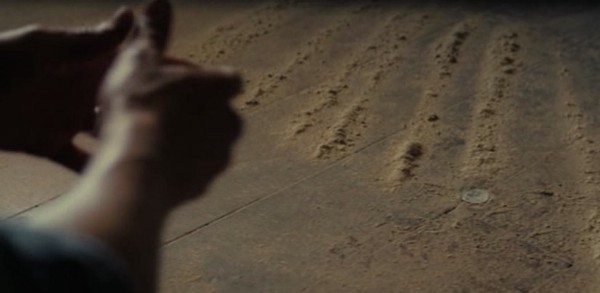
Assumption #2 — Cooper will send himself on the mission
Once Cooper realizes that he sent himself on the NASA mission, and that he needs to go on the mission in order to arrive at the present moment, he locates the night of the dust storm in the tesseract and gives his past self the coordinates to NASA in binary through the falling dust. This is a fascinating moment that seems to be filled with chance―Cooper could decide not to send himself the coordinates, leaving his past self unaware of NASA’s nearby outpost from which his departure from earth is inevitable. However, in the present, Cooper begins to grasp that he has a chance to help Murph and civilization on earth by bringing himself to the tesseract, so he doesn’t even hesitate to send his past self the coordinates. Therefore, there is no chancy element to this event whatsoever. Past Cooper already received the message from Present Cooper, found NASA and left earth.
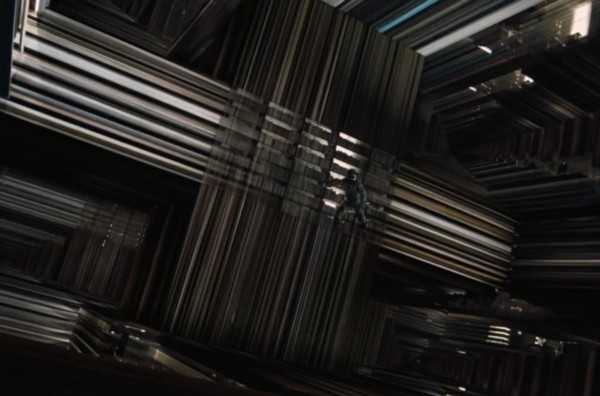
Chance #2 — Cooper may or may not increase the chances of saving the people on earth
Once Cooper realizes he can’t change the past but he might be able to change the future, he interprets his purpose in the tesseract as being “the bridge” to Present Murph. He encodes quantum data in a wristwatch in Past Murph’s bedroom for Present Murph to find decades later. That he chooses the wristwatch and that he encodes the data are two ways he’s backwardly creating chanciness. She might not find the watch and she might not be able to use the data. Neither outcome has occurred yet for Cooper or Murph.

Chance #3 — Murph may or may not find Cooper’s quantum data
A ticking hand on an old watch in an abandoned bedroom in a house where she is not welcome…these are seemingly insurmountable odds against Present Murph finding the data, but the tesseract offers an emotionally significant time for both father and daughter which enables Present Cooper to weight the chanciness heavily in favour of Murph’s eventual discovery of the watch.
Artificially intelligent robot TARS is with Cooper in the tesseract, trying to parse his logic:
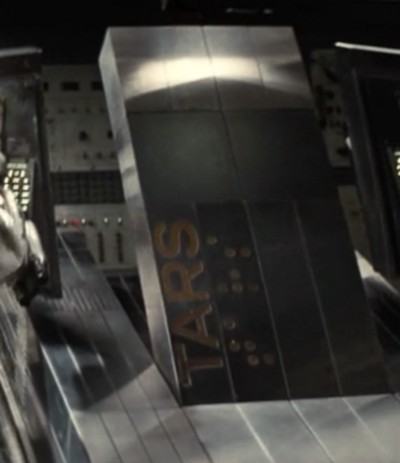
TARS: “Cooper what if she never came back for it?”
COOPER: “She will. She will.”
TARS: “How do you know?”
COOPER: “Because I gave it to her.”
TARS is unable to match Cooper’s innate confidence that emotional attachment is a powerful enough influencer of probability to overcome inevitability. Cooper’s love for his daughter made him give her a watch as a way to keep him close. Murph’s love for her dad will make her happy to find the watch he gave her years later. Murph’s inquisitive nature, nurtured by her dad, will likely cause her to recognize his message encoded in the second hand. It’s not a given that Murph will find the data. It is chancy. The tesseract might belong to descendants of the civilization that Dr. Brand is starting on a new planet, and maybe their only requirement in bringing Cooper into the tesseract is to send himself to NASA to successfully pilot Dr. Brand through space. Cooper’s extra help for Murph is chancy and unproven. Even so, Cooper is powerfully assured that his plan worked because the tesseract closes once he finishes encoding the quantum data. At that same moment across spacetime, we see Present Murph recognize her father’s message in the wristwatch in her bedroom. The future is changed for father and daughter through backwards causation of chance.
*
Could chance be a type of emotive gravity? Emotions certainly influence our decision-making. Could chance be the force that pulls present-time Cooper in line with past time inside the tesseract, acting on him to respond in lockstep with a past he’s already lived? Cooper exhibits a spectrum of emotions during his time in the tesseract. He is distraught when he first arrives and doesn’t understand the system. He’s calmest when he realizes he has an opportunity to transmit useful information across spacetime.
The moment Cooper is no longer controlled by past events, he regains control of his emotions.
Similarly, young Murph is most distressed by Cooper’s highly emotional, ghostly communication through falling books, likely because she is powerless to use the information to convince her father to stay on earth. She is calmest when she recognizes his calmly-sent data decades later, even though her circumstances are considerably more fraught and dangerous. Both father and daughter are calmest when they aren’t trapped by inevitability and have a future-oriented purpose. They’re calmest when they have chances to make informed choices.

One of many interesting definitions Cusbert puts forth in his paper is that “[it’s] essential to chance that a system’s chance properties be among its physical properties: this is what distinguishes chances from other kinds of objective probabilities (such as logical and evidential probabilities).” In the context of Interstellar, gravity is the only force Cooper can use to physically communicate across space-time and cause chanciness. However, the past chances Cooper physically sets up are too weak to make a difference. Without Murph caring that her dad is gone, without Cooper caring whether he saves Murph’s life, without a powerful love and emotional bond between them, the wristwatch would be just another object in a house of objects that is tossed away after decades of no use. Time and gravity need emotion to effectively communicate possibility.
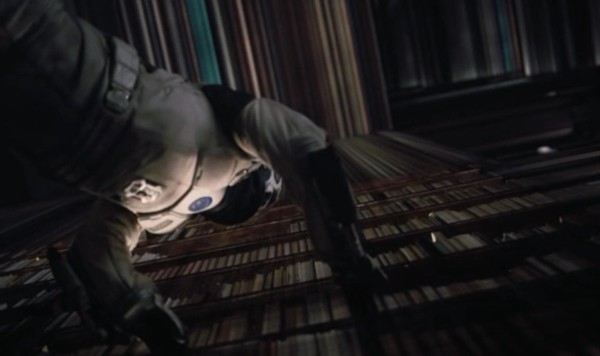
Yet, emotion isn’t powerful enough to change the past. If it were, there’d be nothing constant in our lives. We would have no history. Who doesn’t have an important decision they’d do over? It’s difficult to watch Cooper fight his past, seemingly able to make different choices if only he’d calm down. But of course, he can’t calm down. He’s in a state of agony at being separated from his daughter. Within the tesseract, Cooper’s actions aren’t chancy because his love for Murph is constant. The emotional pull is unwavering and it exists uniformly across space-time. It makes Cooper behave predictably in line with the past. Perhaps emotive gravity is what pulls time powerfully in one direction. Of those two objects you hold in the air, Time and Chance, it would be incredible if Chance were the more powerful of the two.
Cusbert’s theoretical reasoning uses coin tosses, time shifts and algebra to illustrate what Christopher and Jonathan Nolan portray through space travel, tesseracts and a father-daughter bond. The fictional story applies workable science to the real world, then adds the notion that love is the determining factor in backwards causation of chanciness. This is especially pertinent to examinations of modern crises. In so much as love is absent, or not evident, there is no benevolent force steering our lives and a sense of hopelessness and doom pervades our outlook for the future.
It was chance that I found Cusbert’s paper. I wasn’t looking for it. It is one of millions of papers on the internet. It was also chance that I read his paper at a time I was considering time, as opposed to last summer before Interstellar was released. By chance, the publication date of Cusbert’s paper, printed on the front page, is a highly significant date for me, which mildly disposed me toward reading it rather than passing it over. (I am someone who attributes compelling qualities to coincidence; when I meet someone with my same name I am affected.) None of these chancy elements are gravity-related, but rather are familiar examples of chance that moves linearly with time. Cusbert doesn’t suggest that all future outcomes determine all past chanciness, just as Interstellar doesn’t suggest that future beings control the present through spacetime. However, both works offer compelling reasons to reconsider our long-held view that future outcomes are caused by past and present possibilities alone. By entertaining the notion that chance could come to us from the future, we have yet another reason to listen to our hearts and learn to better read our emotions.
 Elizabeth McCarthy